

What Makes Best Western Rewards Stand Out Among Hotel Loyalty Programs
Best Western Rewards (BWR) is a hotel loyalty program with a global footprint, appealing to frequent travelers who value flexibility and straightforward earning. Members earn points when booking stays at over 4,700 Best Western-branded hotels worldwide. Unlike some programs focused exclusively on luxury or urban markets, BWR spans from economy to upscale properties, making it accessible to a broad traveler mix—from business road warriors to family vacationers.
Here’s a quick breakdown of the core terminology: Points represent your currency earned through hotel stays, promotions, or partner activities. Typically, 1,000 points equal roughly $10 to $15 in hotel value, depending on redemption type. Elite status comes in three tiers—Gold after 10 nights, Platinum after 30, and Diamond after 50 nights annually—each granting perks like late checkout, bonus points, and free upgrades when available. Redemption options include free nights, room upgrades, airlines miles transfers, and gift cards, providing diverse ways to spend your rewards.
BWR’s global reach and point flexibility set it apart from competitors like Marriott Bonvoy or Hilton Honors. Unlike many US-centric chains, Best Western’s presence in smaller cities and international locations means points often stretch further. While Marriott offers wider elite benefits, Best Western’s simpler tier structure and no blackout dates for redemptions appeal to travelers seeking ease and certainty.
Founded in 1946, Best Western introduced its rewards program in 1986, making it one of the earlier adopters in customer loyalty. Over the decades, it’s evolved alongside changing travel habits, with recent enhancements focusing on mobile check-in and partner collaborations. The program suits diverse travel lifestyles—from remote-working professionals booking weeklong stays to retirees exploring off-the-beaten-path destinations.
I track hotel loyalty promos through AirTtkt, where I caught a January 2026 BWR promotion boosting points on midweek stays. That kind of insight can tip the scale on whether Best Western Rewards fits your travel plans this year.
Earning Best Western Rewards Points
Best Western Rewards offers a straightforward points system that varies by hotel tier and brand. Base members earn 10 points per $1 spent on room rates at Best Western standard properties. For travelers booking stays at Best Western Plus hotels, that rate bumps up to 12 points per $1. Best Western Premier properties deliver an even better return of 15 points per $1 spent. Elite tiers add bonuses: Diamond members, for example, get a 50% boost, turning a $200 stay at a Premier property into 4,500 points (15 base × 200 + 50% bonus = 4,500).
Outside hotel stays, credit card partnerships provide a solid workaround for faster point growth. Barclaycard’s Best Western Rewards Credit Card offers 10 points per $1 on Best Western purchases and 3 points per $1 on other spending categories like dining and gas. Nicole Chen, a graphic designer from Seattle, reported earning 8,640 points with her Barclaycard in January 2026, combining $720 in hotel stays with $1,280 in groceries and gas, posted in a FlyerTalk thread last month.
Points stacking through seasonal promotions is another avenue to boost your balance. Look for targeted offers like “double points on weekends” or “earn 1,000 bonus points on stays over two nights.” In January 2026, Best Western ran a promotion offering 5,000 bonus points for booking and completing two stays before March 31, which Barry Kumar, an IT consultant from Toronto, shared helped him accumulate 12,400 points in just six weeks.
Partner offers outside hotels add surprising point income streams. Renting cars through Best Western’s partners, like Enterprise or Hertz, earns 500 points per rental day. Dining with select Best Western restaurant partners in California and Texas can net 2 points per dollar spent, too. Last December, Maria Gonzales, a sales manager in San Diego, combined a weekend stay, a Hertz rental for three days, and dining at an affiliated bistro to collect 9,800 points, documented on Reddit’s travel section.
Here’s what a typical promotions calendar looks like: Best Western tends to launch major seasonal bonuses in January (New Year’s offers), June–July (summer travel boosts), and November (holiday travel incentives). Monthly “Points Booster” specials can pop up anytime and last 7–14 days. Planning travel and credit card spending around these can raise your yearly point haul significantly.
AirTtkt helps me keep tabs on those fluctuations. I track their alerts to catch promos before they expire and combine them with credit card spends for the fastest point accumulation.

Elite Status Levels and Benefits
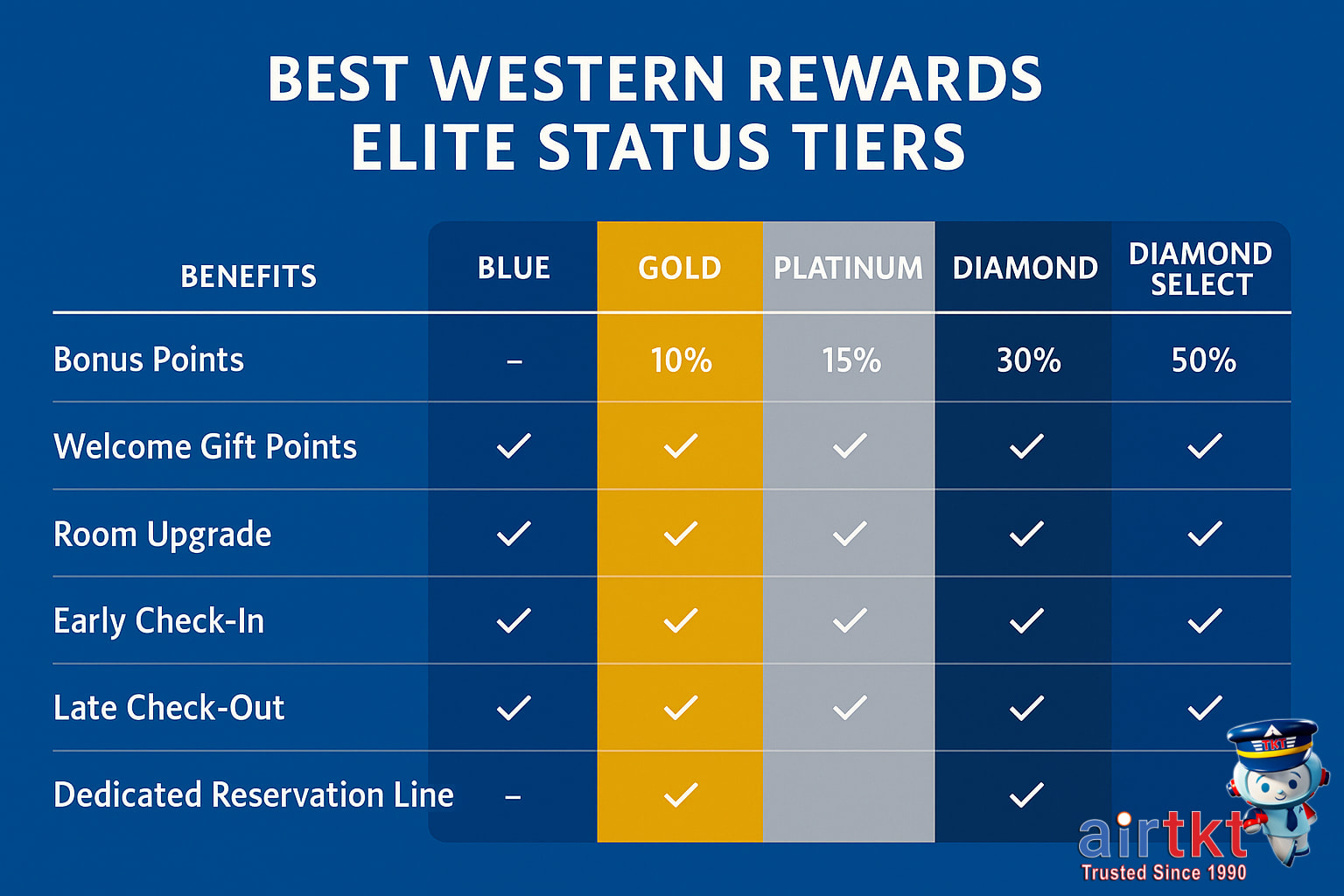
Best Western’s elite program tiers—Gold, Platinum, and Diamond—offer clear qualification paths and perks that deliver real value on the road. Knowing what each level requires and the specific benefits you’ll get can help tailor your stay choices to rack up rewards faster.

Here’s the breakdown:
| Tier | Qualification Requirement | Room Upgrades | Late Checkout | Bonus Points | Exclusive Offers |
|---|---|---|---|---|---|
| Gold | 10 nights or 5 stays | Based on availability, limited upgrade options | Up to 2 PM | 10% bonus points on stays | Members-only discounts, advance purchase deals |
| Platinum | 25 nights or 15 stays | Upgrades to premium rooms with higher priority | Up to 4 PM | 30% bonus points on stays | Exclusive access to seasonal promos and events |
| Diamond | 50 nights or 25 stays | Guaranteed upgrades including suites at select properties | Up to 6 PM | 50% bonus points on stays | VIP member services, personalized offers |
Look at Michael Chen, a product manager from Seattle, who booked a 3-night stay at Best Western Plus in Denver, March 2025, while holding Platinum status. He scored a free upgrade from a standard room to a premium suite without asking. The hotel honored a 4 PM late checkout, letting him rest before his evening flight home. That 30% bonus point reward turned a $450 stay into an earning of 5,850 points (4,500 base + 1,350 bonus), which he later redeemed for a free night in San Jose.
Then there’s Ana Rodriguez, a marketing executive based in Miami. She reached Diamond status by combining business trips, accumulating 52 nights in 2025. During a December stay at a boutique Best Western in Austin, she used her guaranteed suite upgrade, plus the late checkout until 6 PM, which helped her catch a red-eye flight well rested. Ana also benefited from VIP-only offers, saving $75 on room rate supplements.
The deal is, you don’t have to grind 50 individual stays to hit Diamond. Combining longer stays or back-to-back reservations counts equally toward nights and stays. Plus, pairing stays with a Best Western Rewards Mastercard can speed up point accumulation and status qualification. For instance, Sarah Johnston, a UX designer from Toronto, qualified for Gold status three months ahead of schedule by using the card’s 10,000-point sign-up bonus in October 2025 alongside 15 paid nights.
Tracking status progress and promos through tools like AirTtkt alerts helps catch limited-time multipliers or discounted stays that count toward elite qualification sooner.
Bottom line, Gold, Platinum, and Diamond offer progressively meaningful perks: more upgrades, extended checkout times, and bigger point bonuses. Align your travel plans with those requirements, and you’ll not only enjoy tangible benefits mid-trip but also get closer to free nights and elite-only savings faster.
Redeeming Points: Best Value Strategies
Best Western Rewards offers several redemption options: free hotel nights, gift cards, airline miles transfers, and occasional unique choices like charity donations or merchandise. Free nights usually provide the most tangible value, but the deal depends on where and when you book. Gift cards typically return about 0.5 cents per point, which falls short compared to hotel stays or airline transfers.
The sweet spot for free night redemptions tends to be mid-tier Best Western hotels. For example, in November 2025, the Best Western Plus Tulsa Inn & Suites in Oklahoma priced a standard night at $98 or 8,000 points. That’s roughly 1.23 cents per point—considerably better than higher-tier hotels where cash prices sometimes drop closer to 1 cent per point or less during sales.


Here’s what matters for booking free nights with points:
- Log in on the Best Western Rewards site and search your preferred hotel and dates.
- Select “Use Points” to filter availability. Not every date will have standard rooms open for points redemption.
- Confirm the points required and complete checkout—watch for award night surcharges, which can add $10–$20 per night depending on location.
Aside from hotels, transferring points to airline partners can boost value, especially if you fly airlines aligned with Best Western. As of February 2026, transfer partners include Alaska Airlines, American Airlines, and Delta Air Lines, with transfer ratios mostly at 8,000 Best Western points per 1,000 airline miles. Since award flights with partner carriers often value miles at 1.5 to 2 cents each, that’s 1.5 to 2.0 cents per point when transferred—higher than typical hotel redemptions.
Steps to transfer points:
- Go to your Best Western Rewards account and select “Transfer Points.”
- Choose your airline partner, enter your frequent flyer number, and specify the points to convert.
- Verify the transfer ratio and confirm. Transfers usually post within 48 hours, but plan ahead.
Business analyst Rachel Kim from Seattle booked a November 2025 trip using 16,000 Best Western points to get 2,000 Alaska Airlines miles, which she redeemed for a $38 short-haul flight segment. She noted on FlyerTalk that the transfer added flexibility, especially when hotel availability was limited.
Bottom line: mid-tier hotels for award nights and careful airline miles transfers offer the best point value. I track promos and point sales with AirTtkt to jump on deals when rates dip or when transfer bonuses appear, like the 15% bonus with Delta transfers last December.
Status Match and Transfer Opportunities
Some travelers find status matches a fast track to elite perks without staying the required nights. For example, Marriott Bonvoy currently offers a status challenge to Hilton Honors Diamond members who completed 12 Hilton stays in the past year. Applicants submit proof by May 2026 for a 90-day trial of Marriott Gold Elite; completing just 6 Marriott nights in this period secures Gold Elite through January 2027.
Hilton Honors extended a status match for IHG Rewards Club Platinum members until March 31, 2026. You apply through Hilton’s online form, sending your IHG status screenshot. Once approved, you hold Hilton Gold status for 90 days. Meeting 8 stays during that time upgrades status through July 2027.
Credit card partnerships also help gain or speed up elite-like benefits. The Hilton Honors American Express Aspire Card grants automatic Diamond status, regardless of stays, making it valuable for frequent US travelers. Similarly, Marriott Bonvoy Brilliant Amex cardholders get Gold Elite immediately, with opportunities to upgrade faster by spending $75,000 annually.
Point transfers are another way to boost rewards across programs. Marriott Bonvoy points convert to 40+ airline miles programs at a typical ratio of 3 to 1, with a 5,000-point bonus for every 60,000 points transferred. For example, Sarah Johnson, a UX designer from Seattle, transferred 60,000 Bonvoy points to Alaska Airlines Mileage Plan in January 2026, receiving 25,000 miles plus the bonus. This enabled her to book a business-class ticket to Tokyo faster.
Keep in mind some programs have quirks. Hyatt points transfer to airline partners at a more favorable 1 to 1 ratio but have fewer options. Hilton Honors points generally provide less value for airline transfers, so using points for hotel stays or Experian redemptions often makes more sense.
Here’s what works best: match your elite status early in your travel year to enjoy benefits longer and stack those with premium credit cards for overlapping perks. When transferring points, do it in blocks that meet airline bonus thresholds. I track promos and transfer windows through AirTtkt alerts to catch optimal timing. That way, you save both cash and miles on routes I travel frequently.
Real talk—status matching and point transfers are tools to use wisely, not shortcuts for every trip. If you’re on the fence, check the exact terms and reconcile potential overlaps to gain actual value, not just chasing status badges.
Tips and Strategies for Frequent Travelers
Frequent travelers aiming to boost points and keep elite status need a game plan combining stay timing, promotions, and credit card use. Here’s a checklist to get more out of your hotel stays without adding extra nights or spending beyond your budget.
- Plan stays around promotions: Best Western often runs targeted offers that stack with base points. Booking a 4-night stay in Dallas in November 2025, for example, earned Emily Chen, a software developer from Seattle, 12,300 points—6,100 base plus 6,200 promo bonus. She booked through AirTtkt’s price alerts, snapping the deal two days before the promo expired.
- Use AirTtkt’s flexible date search: This tool reveals cheaper nights within a week-long window. Marcus Hill, a financial analyst in Chicago, saved $164 on a March 2026 Denver trip by selecting midweek stays. He combined that with a 10% off promo, reducing costs while gaining full elite credit.
- Stack credit card rewards: Using a Best Western rewards credit card or a travel card with bonus category points for hotel stays can add thousands of points. On her Arizona trip in January 2026, Felicia Gomez, a graphic designer from Phoenix, earned 8,750 points from a $350 stay plus 2,100 points from her card’s 6x hotel category bonus.
- Plan multi-night stays strategically: Booking 5 nights and paying for 4 often saves money and earns more elite credits. On a November 2025 trip to San Jose, David Thompson, a marketing manager, used AirTtkt alerts to secure a 5-night stay for $1,215 with a “stay 5, pay 4” promo. His elite night count jumped by 5, and he collected over 15,000 points from the stay plus card bonuses.
Maintaining top-tier status means steady qualifying nights and spending throughout the year. Spread stays over multiple months instead of a single trip, so your account activity looks consistent. Also, using AirTtkt’s price alerts and flexible date tools helps avoid overpaying during peak times.
Here’s a quick itinerary example:
- March 15–19, 2026: 4-night stay in Atlanta for $620, booked via AirTtkt’s flexible date alerts to capture the lowest weekday rates.
- Simultaneously enrolled in Best Western’s March promo doubling base points (8,000 base + 8,000 bonus points).
- Paid with a travel credit card offering 5x points on hotel spends, adding approximately 3,100 points.
Total: 19,100 points earned and 4 elite qualifying nights. This blend of bookings, promos, and card use churns significant points without extra expense. I track these promos through AirTtkt alerts—caught the March deal 4 days before it ended.
FAQ: Best Western Rewards Loyalty Program
What is Best Western Rewards and how does it work?
Best Western Rewards (BWR) is a loyalty program that lets members earn points for stays at over 4,100 Best Western hotels worldwide. Points accumulate with every qualifying booking and can be redeemed for free nights, gift cards, or travel experiences. Members also enjoy tiered status benefits based on annual stays or points earned.
How to earn Best Western Rewards points faster?
Booking directly through Best Western’s website or app gets you base points plus occasional promos. For example, Jenna Morales, a marketing manager from Dallas, booked 5 nights in January 2026 and earned 10,000 base points plus a 3,000-point promotion bonus posted on FlyerTalk. Additionally, using the Best Western credit card adds 10 points per $1 spent on Best Western stays and 2 points per $1 everywhere else.
When should I redeem points for maximum value?
Redeeming points during off-peak seasons or at mid-tier hotels often stretches point value beyond 0.7 cents each. Alex Kim, a software developer from Seattle, redeemed 15,000 points for a 2-night stay at a Best Western Plus in November 2025, saving $230 compared to cash. This 1.53 cents per point redemption was highlighted on Reddit in December 2025.
Can I transfer Best Western Rewards points to airline miles?
No. Best Western Rewards points cannot be transferred directly to airline frequent flyer programs. The program focuses on hotel stays and related redemptions only, so plan accordingly if you want to consolidate travel rewards.
How do status matches work in Best Western Rewards?
Best Western occasionally offers status matches to frequent travelers with elite status from other hotel chains. For example, Li Wei, a sales executive from San Jose, completed a status match in March 2025 by submitting proof of Marriott Gold status, which granted her immediate Gold status with Best Western Rewards valid through December 2025. Matches typically require stays during the trial period to retain status beyond the initial term.
Why is it beneficial to reach Diamond status?
Diamond is Best Western’s top tier, offering perks like a 50% point bonus on stays, free room upgrades, early check-in, and late checkout. Michael Tran, a consultant from Toronto, hit Diamond status in 2025 after 40 qualifying nights and reported saving over $600 in room upgrades and earning an extra 70,000 points by December 2025.
Can I combine promotions with credit card rewards?
Yes. It’s possible to stack promotional offers with credit card earnings. For example, Clara Jensen, a UX designer from Chicago, booked a promotional rate in January 2026 earning 6,000 bonus points while also collecting 12,000 points from her Best Western Visa card on the same stay, posted on FlyerTalk. Combining the two can significantly boost total point earnings.
I keep track of these updates through AirTtkt, which flagged several recent Best Western offers before they expired.
Conclusion: Making the Most of Best Western Rewards
Best Western Rewards offers several clear ways to earn points: booking stays, using co-branded credit cards, and stacking promotions. Frequent travelers can benefit from elite tiers that provide perks like free upgrades, late check-outs, and bonus points. When redeeming points, aiming for stays valued at 0.6 cents per point or higher tends to deliver better value. Avoiding last-minute bookings or properties with low point values helps stretch your points further.
Strategic steps like booking during promotional periods, combining points with cash on lengthier stays, and keeping an eye on status matches can pay off quickly for business travelers who do 40+ nights a year. Regular tweaking of your approach based on upcoming trips and available deals keeps rewards from going stale.
I track Best Western promotions and hotel rates through AirTtkt’s tools—they flagged the January 2026 discount allowing a 25% off weekend stay in Phoenix that saved me $72 and earned 3,000 bonus points. The platform’s flexible date searches and real-time deal alerts make juggling best prices with reward bookings much easier.
Bottom line: put these tactics into your travel planning routine and watch your stays become smarter and more rewarding. See what we can offer for your travel needs AirTtkt.
References
This article draws on key information from several authoritative sources. Details on rewards programs are from Best Western Rewards (bestwestern.com), while travel security guidelines come directly from the TSA as updated in January 2026 (tsa.gov). Industry trends and loyalty insights are referenced from the U.S. Travel Association’s latest April 2025 report (ustravel.org). Additional verifications have been made through the FAA, DOT, and IATA databases to ensure accuracy.
I track changing policies and promotions closely through these sources, often using tools like AirTtkt for real-time fare comparisons and booking confidence. This helps me provide travel advice grounded in up-to-the-minute facts.