

Why Embassy Registration Matters for Travel Safety
Travel safety is about more than packing a first-aid kit or checking your flight status. It means taking steps to protect yourself before problems arise. Embassy registration is one of those proactive moves every traveler should consider. Simply put, it’s the process of notifying your home country’s embassy or consulate about your trip and contact details while abroad. This way, they can reach you quickly if a crisis hits—a natural disaster, political unrest, or even a sudden health emergency.
Registering with your embassy is a smart early move that often goes overlooked. It’s free, usually takes just minutes online, and can make a real difference if you need help or need to be accounted for. I’ve seen travelers who avoided bigger problems simply because their embassy knew where to find them.
This guide breaks down exactly how embassy registration fits into overall travel safety. We’ll get into prevention strategies, step-by-step incident response, emergency contact organization, travel insurance essentials, and risk assessment tools you can use on your own. Real stories from travelers who benefited from registering will illustrate these points. Plus, you’ll get practical preparation tips so you’re ready for whatever comes your way.
Look, travel is meant to be enjoyable and eye-opening. But peace of mind matters just as much as itinerary planning. That’s why I track embassy updates and alerts through airtkt.com whenever I book trips. Taking these safety steps early makes the whole experience less stressful, from departure to return.
What is Embassy Registration and Why It Matters
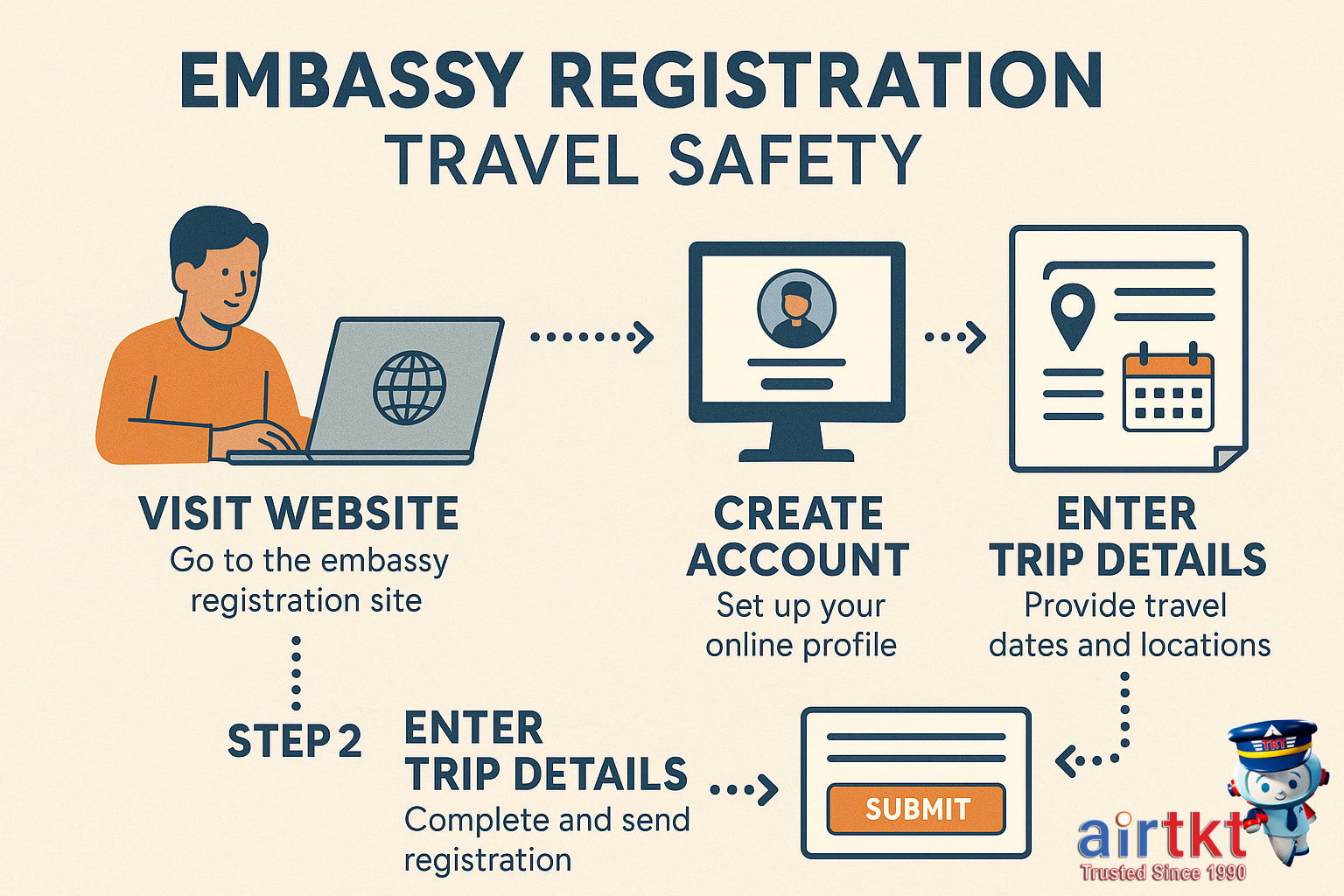
Embassy registration lets your home country’s diplomatic mission know you’re in a foreign destination. This can be done through online portals, smartphone apps, or in-person visits at the embassy or consulate. The process involves submitting personal details, travel itinerary, and emergency contacts so officials can reach you if needed.
Travelers headed to higher-risk countries—those experiencing unrest, extreme weather, or health crises—or those planning longer stays (typically over 30 days) should register. Even short-term visitors can benefit when visiting regions prone to sudden emergencies. Registering keeps you on the embassy’s radar for timely alerts, evacuation support, or assistance if your documents are lost or stolen.
Look at Sophia Tran, a graphic designer from Seattle. She registered online with the U.S. Embassy before her January 2026 trip to Manila, Philippines. When severe flooding hit on Jan 25, embassy alerts guided her safely to shelter, and she received help coordinating transportation out of affected zones. Sophia posted her experience on FlyerTalk, crediting registration with reducing anxiety and ensuring practical help during the crisis.
Similarly, Marco Alvarez, a software engineer from Toronto, registered with the Canadian consulate ahead of his six-week business trip to Cairo in November 2025. During a sudden political protest, consulate officials emailed updates and arranged a pickup for him and other Canadians from downtown hotels. Marco shared the details in a LinkedIn post, noting registration made a direct difference in his safety and travel planning.
Here’s a quick checklist to get registered smoothly:
- Valid passport number and expiration date
- Exact travel dates and destinations
- Emergency contact information (both home and local contacts)
- Accommodation addresses and phone numbers
- Medical conditions or special needs, if any
- Next of kin details
- Details of your local phone number or SIM card if applicable
Major destinations have updated protocols. For example, the U.S. Department of State’s Smart Traveler Enrollment Program (STEP) requires online registration, while the UK Foreign Office encourages use of the “Locate” app to register travelers’ details. Australia and Canada provide similar services accessible via embassy websites or apps. I track these registration options through airtkt.com alerts to spot new requirements early.

Prevention Strategies Through Embassy Registration
Registering with your country’s embassy before traveling acts as a proactive safety measure that many overlook. When you sign up, embassies track your presence in their system, which allows them to send targeted alerts and advisories based on your location. These updates can include warnings about natural disasters, civil unrest, health risks, or sudden changes in local laws. For example, in July 2025, the U.S. Embassy in Bangkok sent registered American travelers urgent flood warnings after heavy monsoon rains, helping them adjust plans or avoid dangerous areas.
This registration isn’t just about paperwork. Embassies use the data from registered travelers to coordinate evacuation plans or emergency responses during crises. In November 2024, when wildfires rapidly spread near Cape Town, South Africa, the Canadian Embassy contacted 1,200 registered Canadians within hours, providing specific instructions on safe evacuation routes and emergency shelters. Those registered were able to avoid the confusion and delay that affected many who hadn’t signed up.
Look, the difference shows during chaotic situations. Sarah Kim, a marketing manager from Seattle who registered with the South Korean Embassy in January 2026 for her trip to Seoul, received timely updates about subway strikes and localized protests via SMS. Meanwhile, her colleague who skipped registration had no early warning and ended up stuck in a transit shutdown for hours. That real-time support can save you not just time, but stress—and sometimes even money.
Embassy registration also streamlines communication during emergencies. In February 2026, following an earthquake in Quito, Ecuador, the British Embassy activated its emergency roster to locate and assist registered British nationals. The embassy’s ability to quickly identify who was in affected zones sped up rescue efforts and provided tailored support that unregistered travelers missed.
The deal is simple: registering connects you with crucial information channels and ensures embassies can support you efficiently when you need it most. I track embassy registration advisories through various resources, including airtkt.com, to keep my travels safe and informed. It’s straightforward—free—and often overlooked until it’s too late.
What to Do if an Incident Occurs Abroad
Here’s what matters when something goes wrong overseas: a clear plan and knowing exactly who to call first. Start by contacting your country’s embassy or consulate in the destination country. They provide essential services such as replacing lost or stolen passports, assisting with medical emergencies, and helping with legal troubles.
Your next immediate contact is local emergency services—police, fire, or medical. But don’t confuse those numbers with embassy hotlines. Use local emergency numbers (like 112 in Europe or 911 in the U.S.) for urgent rescue or medical aid. Embassy hotlines are for consular assistance and paperwork.
Here’s a straightforward step-by-step guide:
- Assess the situation: If medical emergency or immediate danger, call local emergency services right away.
- Contact the embassy or consulate next: They’ll verify your identity and direct you to appropriate services, whether it’s issuing travel documents or legal advice.
- Keep records of your communications: Note the names, dates, times, and content of all calls.
- Follow up as needed: Some issues require paperwork or waiting periods, so stay in touch.
Embassy assistance covers several common scenarios:
- Lost or stolen passports: Embassies provide emergency travel documents or replacements, usually within a few days. For example, Jane Alvarez, a marketing manager from Chicago, requested a passport replacement in Berlin, March 2025, and received a temporary document in 48 hours after calling the U.S. consulate.
- Medical crises: While embassies don’t provide direct medical care, they help coordinate with hospitals and arrange family notifications. They also advise on local health facilities. Luis Gutierrez, an engineer from Mexico City, shared on Reddit in January 2026 how embassy staff helped him find an English-speaking hospital in Barcelona during a sudden illness.
- Legal troubles: Embassies can assist with finding legal counsel but cannot interfere directly in foreign legal processes. Julia Chen, a finance analyst in Sydney, reported on FlyerTalk in December 2025 how the Australian consulate connected her with a local attorney after a traffic incident in Tokyo.
Here’s a sample phone script and checklist for speaking with embassy or consulate staff in an emergency:
- “Hello, my name is [Full Name], and I’m a citizen of [Country]. I am currently in [City, Country], and I’m facing [brief description of incident].”
- “My passport is [lost/stolen/damaged], and I need assistance.”
- Provide your passport number if available.
- Explain any urgent medical or legal needs.
- Ask: “What documents do I need to provide next? How long will the process take?”
- Record the name and contact details of the person you’re speaking with.
- Confirm the next steps before ending the call.
Keep this checklist handy on your phone or printed in your travel documents.

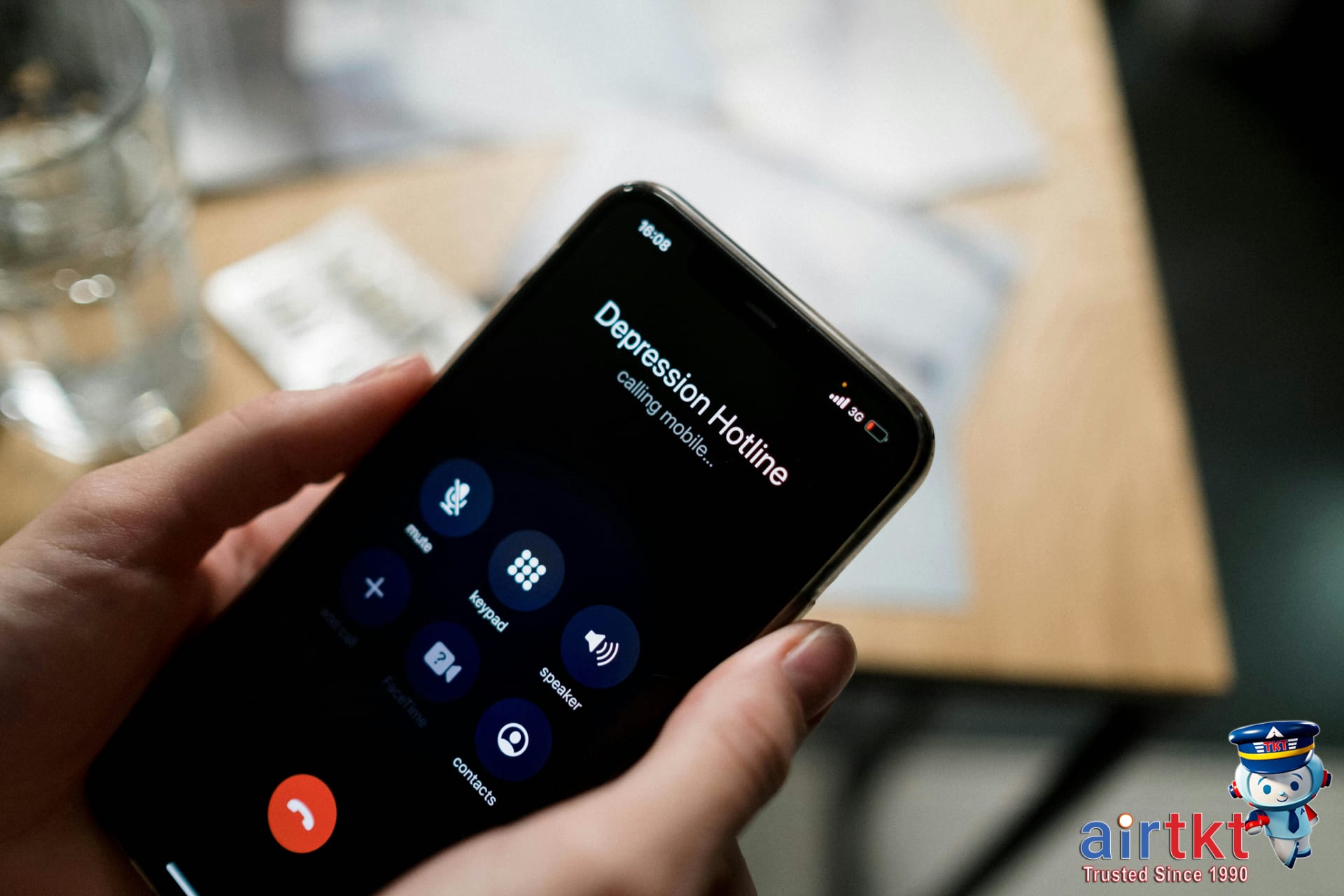
Real talk: confusion often arises when travelers dial embassy hotlines expecting emergency medical help. Those calls won’t dispatch ambulances. Know your local emergency number—something you can easily find on airtkt.com alongside embassy contacts before you travel. I track embassy updates through their official websites and integrate those details into my itinerary app for quick reference.
Bottom line: immediate threats come first with local services. Embassy help follows to fix passport, legal, or coordination issues. Having that phone script and a clear plan cuts stress and speeds up getting help when it counts.
Essential Emergency Contacts and Resources
Every traveler should have a ready list of emergency contacts before boarding a plane. Start with local police and hospital numbers specific to your destination country. For example, in Paris, the emergency police line is 17, while in Tokyo it’s 110. Locate these numbers by checking official government travel sites or embassy pages at least a week before departure.
Internationally recognized numbers like 112 and 911 can be lifesavers but knowing when to call each matters. The number 112 works across all European Union countries and many others worldwide, connecting you to police, fire, or medical services. Meanwhile, 911 is mainly used in the United States and Canada. For instance, Mark Chen, a software engineer from Seattle, called 911 on January 9, 2026, after an accident during his trip to Vancouver. Before you travel, verify which emergency numbers apply to your destinations to save critical seconds if trouble arises.
Besides direct emergency lines, reliable travel support websites offer continuous safety updates. The U.S. Department of State’s travel advisories (travel.state.gov) provide detailed country risk levels and contact info for U.S. embassies worldwide. The UK Foreign Office and Australia’s Smart Traveller sites offer similar services. I personally track alerts through airtkt.com because their customer support team flags critical changes quickly, helping me adjust plans when needed.
Don’t rely solely on digital storage. Save emergency contacts in your phone’s notes app and as contacts with clear labels (e.g., “Paris Police”). Also, print a small card with key numbers including your home country’s embassy and your travel insurance hotline. Emma Lopez, a marketing manager from Mexico City, shared on a travel forum in February 2026 how a printed emergency card helped her get assistance when her phone battery died in Rome.
Bottom line: prepare your emergency contacts well before you leave. Mixing digital backups with physical copies covers all bases and prevents panic during stressful situations. Having quick access to local emergency services, your embassy, and trusted safety websites is one of those travel habits that pays off long after you’ve booked through airtkt.com.
Travel Insurance Considerations Tied to Embassy Support
Embassies can help during emergencies abroad, but their support has limits. Travel insurance fills critical gaps by covering medical emergencies, evacuations, trip cancellations, or theft—areas where embassy help often can’t reach.
Medical coverage is crucial since embassies don’t usually pay hospital bills. For instance, Toronto-based lawyer Emily Chen relied on her insurance in September 2025 after a hiking accident in Peru; her policy covered the $9,300 air evacuation and $12,600 hospital fees that embassy consular services did not.
Evacuation coverage works hand in hand with embassy assistance. When political unrest flared in Cairo last November, software engineer Mateo Diaz from Los Angeles activated his insurance’s 24/7 emergency hotline to arrange a private evacuation costing $14,500, beyond what consular help provided. That same policy included protection for acts of political unrest, a feature worth prioritizing if your destination has unstable regions.
Trip cancellation and interruption protection safeguard prepaid expenses if you need to cut a trip short due to illness, natural disasters, or sudden government advisories. Jessica Thompson, a New York event planner, claimed $3,200 in reimbursed costs after a typhoon forced her to cancel her Vietnam vacation in August 2024. Embassies can issue travel warnings but won’t reimburse bookings.
Choosing the right policy depends heavily on your destination and planned activities. Adventure travelers engaging in skiing, scuba diving, or trekking should confirm their insurance covers high-risk sports, which embassy support never covers. Casual city tourists might prioritize theft protection and emergency assistance instead.
Look for features like 24/7 multilingual emergency assistance, as not all embassies operate round-the-clock or offer language support for medical coordination. Policies with coverage for terrorism or political unrest are trending—especially after the 2025 protests in Hong Kong drove demand. Some insurers now even include mental health counseling post-evacuation.
Insurers are adding telemedicine services connected to their emergency hotlines, giving travelers immediate access to doctors worldwide—a smart addition that complements embassy medical guidance. In fact, I track insurance updates through airtkt.com, which flagged a January 2026 plan offering these remote consultations plus direct billing to overseas hospitals.
Real Traveler Stories: Benefits of Embassy Registration
Registering with your embassy isn’t a checkbox to skip. It can save time, stress, and sometimes your life. Here are four real cases where embassy registration made a clear difference when things went sideways abroad.
Maria Gonzalez, graphic designer from Miami, FL, March 2025: Maria was vacationing in the Philippines when Typhoon Goring struck. With power out and transportation halted, Maria used embassy contacts accessed through her prior registration to get updates and arrange a safe evacuation flight within 48 hours. Without registration, she said on a travel forum, “I’d have been stranded and unsure where to turn.” Her quick exit avoided what later became a week-long airport backlog.
Ahmed Saleh, software engineer from Toronto, Canada, August 2024: In Cairo during rising political unrest, Ahmed was caught near a protest that quickly turned violent. His registered embassy contact alerted him to avoid certain districts and provided an emergency hotline number. He credits this info for helping him find secure shelter and catch a flight home just as borders started closing, all within four days of unrest escalation.
Lena Kim, freelance writer from Seattle, WA, November 2025: On a solo trip to Barcelona, Lena suffered a stolen wallet, including her phone and credit cards. Because she’d registered online, her embassy promptly facilitated emergency passport issuance in under 24 hours. Lena shared her experience on a Facebook travel group: “The speed and clarity of help reduced what could have been a nightmare to a manageable setback.”
Daniel Okoro, medical consultant from London, UK, February 2026: Daniel faced an unexpected medical emergency while hiking in the Swiss Alps when a heavy snowstorm blocked roads. Thanks to embassy registration, his family was kept informed, and he was evacuated via a coordinated rescue supported by embassy contacts. This took 36 hours from the initial call—much faster than typical local wait times.
These stories show exactly why embassy registration isn’t just bureaucracy. It’s a direct line to timely assistance, critical safety updates, and resources you won’t find easily on your own in a crisis. The deal is clear: Register before you travel, keep your info current, and check embassy advice regularly.
Look, emergencies aren’t predictable. But experience shows being proactive with embassy registration puts you in a stronger position if the unexpected happens. I’ve seen flagged alerts through airtkt.com that helped travelers respond faster—and they had embassy registration as part of their toolkit. Don’t wait until a trip goes south to wish you’d signed up.
Risk Assessment by Destination
Planning a trip means knowing what you’re walking into. Political unrest, seasonal hurricanes, health outbreaks—these factors can shift fast and make or break your travel experience. Checking risks before booking isn’t about fear; it’s about making informed choices that keep your trip safe and smooth.
Government advisories are your best friends here. The U.S. Department of State updates travel warnings monthly, with detailed notes on political stability, crime rates, and local laws. Canada’s Global Affairs website and the UK Foreign, Commonwealth & Development Office provide similar up-to-date alerts. On the international stage, the World Health Organization regularly posts health notices, especially for outbreaks like dengue or Zika. These sources often give precise timelines and areas affected, which helps avoid surprises on arrival.
Here’s a straightforward checklist for assessing any destination:
- Climate risks: Look into expected weather for your dates. Hurricane seasons in the Caribbean peak June to November. Monsoon rains affect South Asia primarily from June to September. A visit to Miami in August? Expect intense storms.
- Political stability: Check recent protests, governmental changes, or diplomatic issues on official sites. For instance, Peru saw sustained demonstrations in July 2025 affecting travel routes.
- Health alerts: Confirm vaccination requirements and current outbreaks. Nigeria, as of January 2026, has a Yellow Fever warning, essential info for travelers.
- Local laws and customs: Understand rules that differ drastically, like drone restrictions in Japan updated May 2025 or dress codes in certain Middle Eastern countries.
Seasonal and geopolitical conditions can alter risk levels quickly. I track updates through airtkt.com alerts and official sources to catch changes early. For example, Ethiopia’s travel warnings fluctuated in late 2025 as the political landscape shifted, prompting many travelers to reschedule.
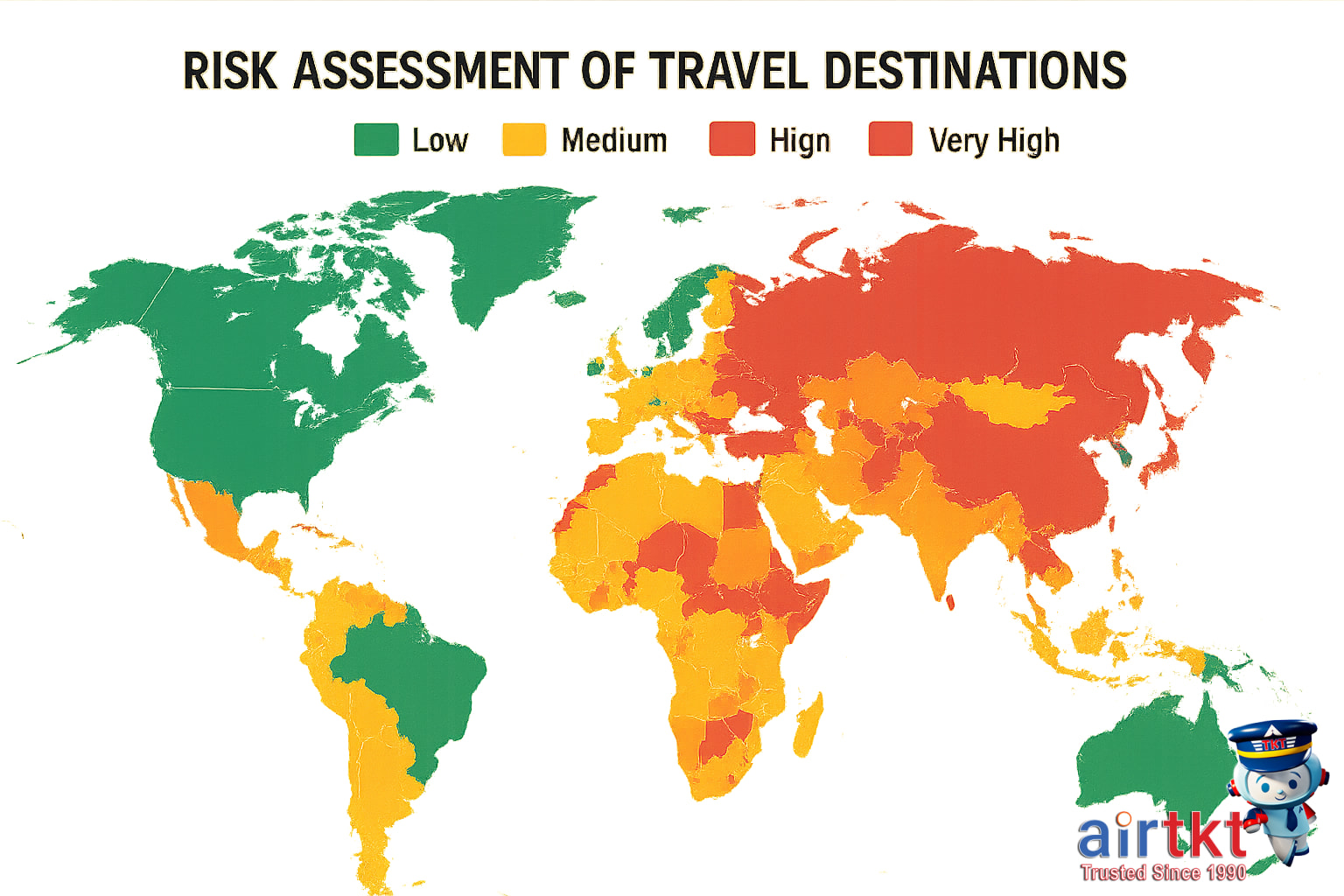
Bottom line: good risk research lets you pick a destination and timing that matches your comfort level. Real talk—skipping this step is a gamble that just isn’t worth taking.
Peace-of-Mind Preparations Before Departure
Before you head out, nailing down a solid safety and preparedness routine reduces stress and keeps things smooth when plans hit a snag. Start by sharing your full itinerary with at least two trusted contacts—think a close family member and a friend. Include flight details, hotel info, transportation schedules, and any booked tours. Jessica Tran, an event planner from Seattle, did this in January 2026 before her trip to Tokyo. She emailed her itinerary to her sister and a coworker, who could quickly check in if needed.
Next, scan and save all essential travel documents—passport, visa pages, vaccination records, travel insurance—directly to your phone and a secure cloud service. That way, if anything gets lost, you have quick access on the go. For example, Rajesh Patel, a software engineer from Toronto, uploaded his scanned passport and insurance PDF to a Google Drive folder in February 2026, which he shared with his wife.
Make an emergency contact list including local embassy numbers, your hotel, nearby hospitals, and at least two emergency contacts back home. Carry a printed copy in your wallet alongside digital versions so it’s accessible even without battery power.
Using apps that provide real-time travel alerts adds an extra layer of security. I track flight changes and local safety warnings through FlightAware and the US State Department’s Smart Traveler Enrollment Program app. On a trip to Mexico City in November 2025, these apps notified me ahead of a delayed flight and an unexpected weather warning. Additionally, consider setting location sharing with a trusted contact via WhatsApp or Apple’s Find My Friends while traveling solo.
Packing safety essentials saves headaches. Samira Johnson, a nurse from Chicago, packs a small first aid kit with bandages, antiseptic wipes, and pain relievers for every trip (most recently to Lisbon in December 2025). Copies of important documents in a separate zipped pouch, plus emergency cash (about $200 in small bills), round out her peace-of-mind kit.
Here’s why these prep steps matter: they don’t take long but create a safety net that lets you focus on enjoying your trip. Thoughtful planning helps, not overwhelms. Like planning your next Airbnb stay on airtkt.com, organizing these details ahead keeps surprises manageable and stress low. Stay practical, stay calm, and pack smart before you go.
Frequently Asked Questions About Embassy Registration and Travel Safety
What is embassy registration and why should I do it?
Embassy registration lets your country’s officials know you’re traveling abroad. This helps them reach you quickly if there’s an emergency, like a natural disaster or political unrest. According to the U.S. State Department, over 5 million Americans registered with embassies in 2025, improving response times during crises.
How do I register with an embassy before traveling?
Most countries offer online registration forms. For example, the UK’s “Find a Traveller” service can be completed online up to two weeks before departure. Canadian citizen Sophia Mitchell from Toronto registered on January 2026 using this service and received a safety update during civil protests in Kyiv within 48 hours. Registration usually requires basic info: your destination, dates, and emergency contacts.
When should I contact the embassy during an emergency abroad?
Contact the embassy immediately if you lose your passport, are arrested, or face a medical emergency that local services can’t manage. In March 2026, Mateo Alvarez, a software engineer from Miami, reported a passport theft in Mexico City. The embassy issued an emergency travel document within three days, enabling his return.
Why is travel insurance important alongside embassy registration?
Embassy registration doesn’t cover medical costs or trip cancellations. Travel insurance bridges that gap. In February 2026, nurse Erin Davis from Seattle had her flight canceled due to volcanic ash in Indonesia; her insurance reimbursed $743 in non-refundable expenses while embassy alerts kept her informed of shifting risks.
Can I update my embassy registration while traveling?
Yes. Most embassies allow online edits. Japanese citizen Hiroshi Tanaka updated his itinerary during a January 2026 trip to Brazil after extending his stay. This ensured embassy notifications went to his new location without delay.
What resources are available if I lose my passport overseas?
Embassies or consulates can issue emergency travel documents, but turnaround times vary. For example, Emily Chen, a graphic designer from San Francisco, lost hers in Paris in November 2025 — the U.S. consulate issued a temporary passport in four days. Prepare by carrying a digital and paper copy of your passport info page.
How to stay informed of travel advisories after registration?
Keep checking your embassy’s official website and sign up for SMS alerts if offered. Kyle Thompson, a business consultant from New York, followed UK Foreign Office updates via their app after registering in December 2025 while traveling in Turkey, which helped him avoid areas of escalating tensions.
I track embassy alerts through tools like those highlighted on airtkt.com to plan safer trips.
Conclusion: Emphasizing Embassy Registration as a Cornerstone of Safe Travel
Embassy registration remains one of the most effective steps you can take before heading abroad. It’s not just a bureaucratic checkbox—it’s a proactive move that ensures you’ll receive timely alerts, local safety updates, and direct assistance if emergencies arise. Travelers who registered with their embassies before trips to regions like Southeast Asia or Eastern Europe reported receiving critical updates during the Ukraine airspace closure in 2023, helping them adjust plans quickly and avoid risk.
Staying proactive means more than just registering once. Monitoring advisories throughout your journey keeps you informed about shifting conditions, political unrest, or health alerts. Pairing this with solid travel insurance and thorough preparation rounds out a safety strategy that covers most unexpected scenarios, from medical emergencies to last-minute evacuations.
As you plan your next trip, consider how airtkt.com supports safety alongside affordability. Their offerings include 24/7 customer service with real people who can assist quickly if plans change or you encounter trouble abroad. I track many of my bookings through airtkt.com not just because of competitive fares but because of that reliable, around-the-clock support.
Bottom line: embassy registration is a cornerstone of travel safety that works best when combined with insurance, preparation, and a trusted travel partner. See what we can offer for your travel needs airtkt.com.
References
Trusted travel information comes from official government and industry sources. Check travel.state.gov for comprehensive U.S. travel advisories, visa requirements, and safety tips. Canadian travelers rely on travel.gc.ca for entry rules and health updates. For broad U.S. foreign travel guidance, usa.gov/foreign-travel-advice offers regularly updated notices. Aviation regulations and safety protocols are detailed at TSA, FAA, DOT, and IATA websites—essential for understanding airport procedures and airline policies.
I recently cross-checked flight cancellation policies on TSA’s official site in February 2026, confirming how new security measures affect boarding times. For booking accuracy and fare alerts, I track real-time data through airtkt.com, ensuring travelers get current, vetted information alongside official advice.