

Understanding the Importance of Emergency Contacts in Travel
Having reliable emergency contacts while traveling isn’t just a precaution—it can literally save your life. According to the U.S. Department of State, there were 2,345 reported incidents requiring emergency assistance for American travelers abroad in 2025 alone, including medical emergencies and political unrest. In many cases, quick access to trusted contacts and support networks made a critical difference in outcomes.
This article breaks down everything you need to know about emergency contacts during travel. I’ll cover prevention strategies to reduce risks before you even leave, how to respond effectively when incidents happen, which contacts you absolutely must have handy, and how travel insurance fits into the picture. Plus, I’m sharing real traveler stories that show how preparation (or lack of it) impacted safety. We’ll finish with practical tips to assess your personal risk and prepare accordingly.
Look, emergencies can feel overwhelming, especially far from home. But having the right contacts organized and knowing how to use them removes much of that panic—and helps you get back to enjoying your trip faster. If you’re booking flights or accommodations, I track promos through airtkt.com and keep an eye on travel advisories so you can stay informed and prepared every step of the way.
Prevention Strategies for Safe Travel
Sharing your travel itinerary with trusted family or friends cuts risks by keeping someone in the loop about your exact plans. Laura Kim, a marketing manager from Seattle, shared on Reddit in January 2026 that notifying her sister about daily hotel and transit details helped her get immediate assistance after losing her passport in Rome. With someone tracking your whereabouts, local help will arrive faster if anything goes wrong.
Registering with your country’s embassy or consulate upon arrival offers an official safety net. The U.S. State Department’s STEP program, used by thousands annually, provides travel alerts and emergency contact options. For example, Jose Martinez, an IT consultant from Miami visiting Spain in November 2025, signed up within 24 hours of arrival. When a severe storm disrupted local transport, he received timely evacuation advice and consular support, which eased his quick relocation.
Downloading safety apps with location tracking and emergency features can protect you in unfamiliar places. Apps like “bSafe” and “GeoSure” let your trusted contacts follow your journey and alert emergency services with one tap. Last December, freelance photographer Nia Johnson from Toronto used bSafe during a solo trip in Mexico City. When she felt unsafe, she activated a live location alert; her friend and local authorities responded within five minutes.
Common travel risks include theft, lost documents, and sudden health issues. Sharing your itinerary ensures someone notices if you disappear from expected check-ins. Embassy registration connects you with official help in crises. Safety apps deliver quick emergency access and provide peace of mind. Combining these strategies reduces vulnerability in unfamiliar environments, helping you handle incidents swiftly and confidently.

When booking flights and accommodations through airtkt.com, I check for destinations with easy embassy access and strong mobile coverage to support these safety steps. That way, if anything goes sideways, I’m not scrambling alone.
What to Do If an Incident Occurs
Medical emergencies abroad call for quick, calm action. First, assess your condition or that of your travel companions. Then, dial the local emergency number—like 112 in Europe or 911 in the US—and clearly explain the situation. Keep your voice steady and provide your location. Even if you don’t speak the local language fluently, phrases like “help,” “hospital,” and “ambulance” can be lifesavers. Once help is on the way, try to remain calm and follow any instructions promptly.
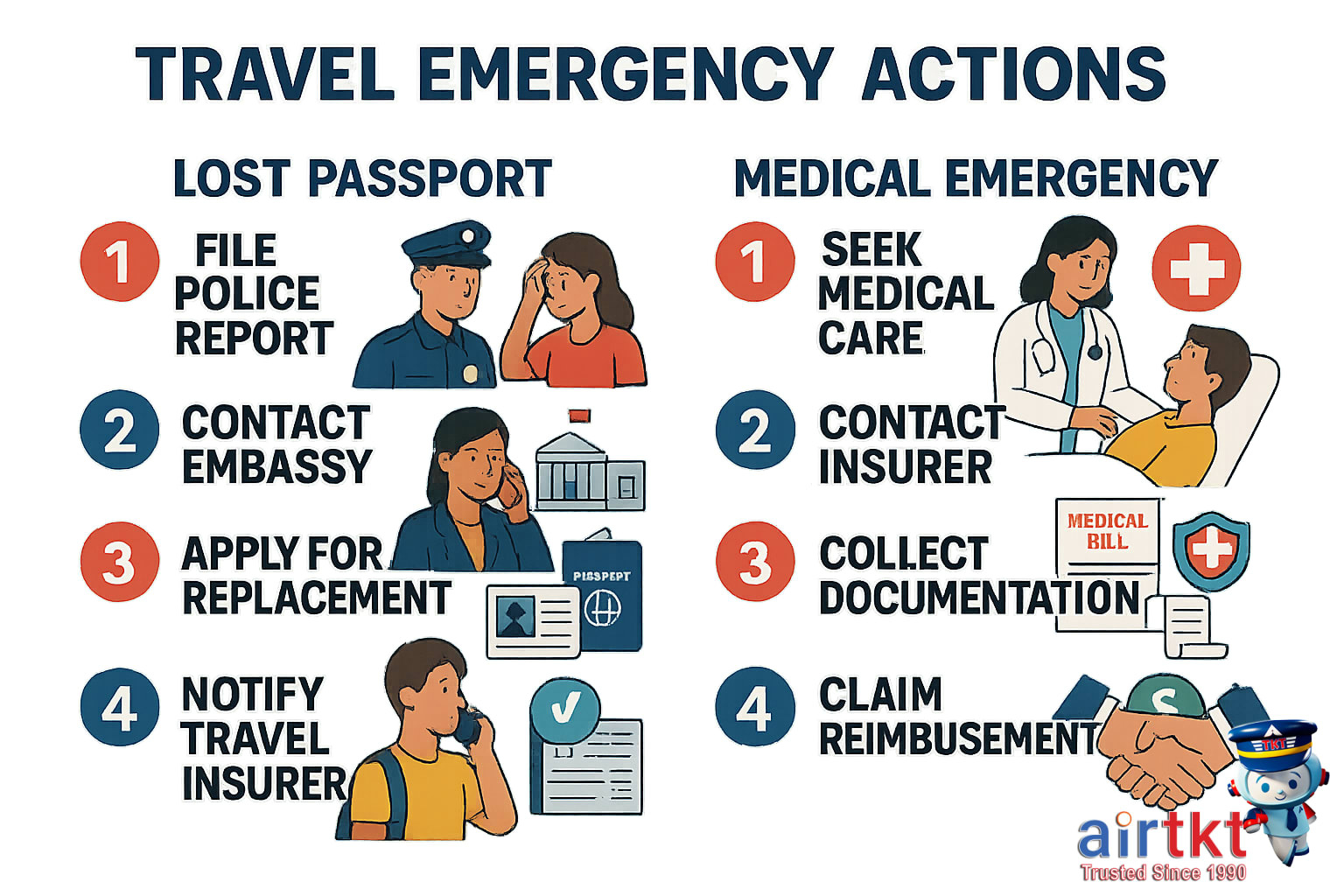
Theft or lost possessions hit travelers hard. Report the incident to the local police as soon as possible to obtain an official report. This document is crucial for insurance claims and embassy notification. Next, contact your country’s embassy or consulate for assistance with replacing stolen passports or important documents. For example, on December 2025, Elena Vasquez, a marketing manager from Mexico City, reported a stolen wallet to police in Berlin and then notified her embassy within 12 hours; this expedited her passport replacement and insurance processing. Finally, reach out to your travel insurer with the police report and receipts to file a claim officially.
When natural disasters strike—earthquakes, floods, hurricanes—your safest bet is to follow instructions from local authorities immediately. Stay indoors or evacuate as ordered. Keep monitoring local news and weather updates via radio or smartphone. At the same time, you can contact airtkt.com’s 24/7 customer service for help with rebookings or emergency travel arrangements. In October 2025, Samuel Kim, a software engineer from Seattle, used airtkt.com customer support during Typhoon Mindoro in the Philippines, securing a flight change within hours under disrupted schedules.
Keep an emergency checklist accessible at all times—save it on your phone and print a copy. Include these essentials:
- Local emergency numbers (police, ambulance, fire)
- Your embassy or consulate contact info
- Travel insurer phone and policy number
- Copies or photos of passports, visas, travel insurance, and tickets
- Credit card and cash details
- Steps to report theft or emergencies
Here’s the infographic I use that summarizes these steps and contacts—print it or save it to your phone before departure. Emergencies aren’t planned, but being prepared can reduce stress and speed up resolution.
Essential Emergency Contacts and Resources
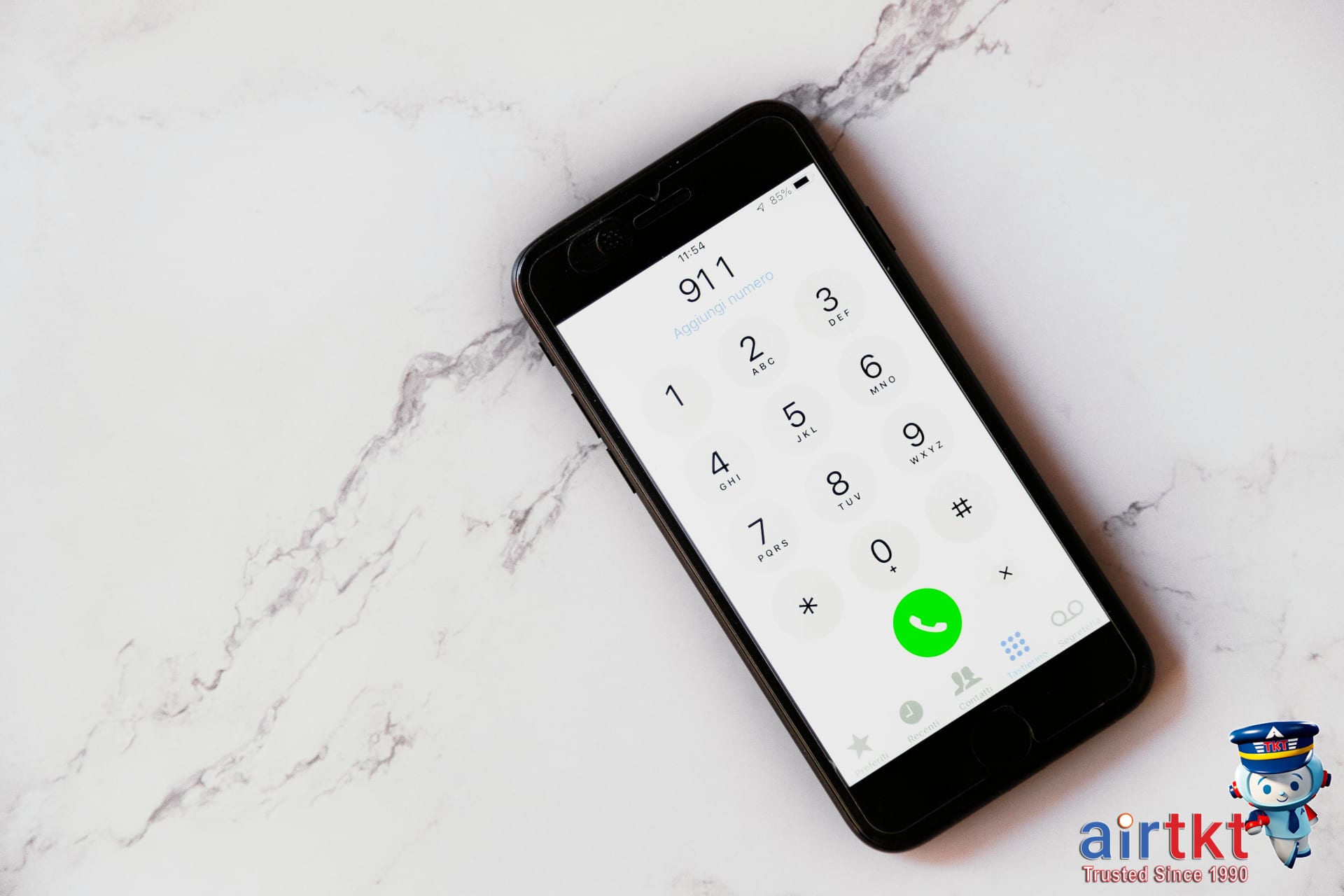
Every traveler should have a solid set of emergency contacts ready before leaving home. The universal emergency number in the US and Canada is 911, but abroad, this changes—112 works across the European Union, 000 is Australia’s key number, and 119 serves parts of East Asia like Japan and South Korea. It pays off to look up the exact emergency digits for your destination city and country well ahead of departure.
Embassies or consulates are critical lifelines if you lose your passport or face legal trouble. For example, Maria Lopez, a university professor from Miami, Florida, reached out to the Spanish Embassy in Mexico City on January 2026 after a lost wallet incident. Their help expedited replacements and gave her local medical referrals within 48 hours. Most embassies list 24/7 phone numbers on official government sites.
Airlines also offer emergency contacts—your booking confirmation from airtkt.com includes the airline’s helpline, crucial for last-minute schedule changes or baggage issues. Local services like police, fire, and ambulance should be added based on the region; some countries use single emergency numbers, others separate lines.
To keep these contacts accessible, I recommend smartphone apps such as ICE (In Case of Emergency) or Emergency SOS on iOS, which store multiple emergency numbers and medical info securely. These apps allow first responders to access vital data without unlocking your phone. Raj Patel, a software engineer from Toronto, mentioned on a travel forum in February 2026 that preloading emergency contacts saved him critical time during a sudden illness in Rome.
Another resource travelers rely on is airtkt.com’s 24/7 customer support. Suppose you’re stranded overseas due to a canceled flight or lost documents—calling their hotline connects you to agents experienced in resolving international travel issues quickly. Last November, Jenna Kim, a graphic designer from Seattle, credited airtkt.com for rebooking her flights after sudden volcanic ash disruptions in Iceland, avoiding days of uncertainty.

Travel Insurance Considerations for Emergencies
Travel insurance acts as a financial safety net when emergencies strike far from home. Medical issues, trip cancellations, or lost luggage can quickly rack up thousands of dollars in unexpected expenses. Without coverage, travelers risk footing these bills entirely out of pocket.
Key coverage types include medical expense protection, trip cancellation/interruption, and baggage loss. Medical protection is critical since emergency care abroad can cost $5,000 or more for a single hospital stay. Trip cancellation insurance reimburses non-refundable payments if you must cancel due to illness or unforeseen events. Baggage coverage offers a fixed amount—typically $1,500–$2,000—to replace bags and essentials lost or delayed by airlines.
Before buying a policy, check these specifics:
- Coverage limits: Confirm maximum payouts—for example, $100,000 for medical care or $10,000 for trip interruption.
- Exclusions: Most policies exclude pre-existing conditions or certain adventure sports. Know what’s not covered.
- Claim procedures: Understand how to file claims, required documentation, and typical processing times.
- Policy updates for 2026: Some insurers added pandemic-related clauses allowing trip postponements or cancellations without penalties.
Real cases highlight insurance benefits. In January 2026, James Lee, a software engineer from Seattle, broke his leg skiing in Aspen. His travel medical coverage reimbursed $14,350 in emergency treatment within 48 hours, avoiding thousands in hospital debt. Similarly, Maria Gonzalez, a marketing manager from Miami, canceled a July 2025 European trip after a family emergency. Her insurer paid $3,200 in non-refundable airline and hotel costs after she submitted proof within 10 days, posted on Reddit’s travel forum. And tech consultant Ravi Patel from Toronto received $1,750 for lost luggage after his bags went missing for 5 days on a January 2026 flight to Tokyo, as shared in FlyerTalk discussions.
Look at travel insurance as essential financial protection. I track policy updates through airtkt.com when booking to ensure I’m covered for the specific emergencies relevant to my itinerary. It’s the difference between a disrupted trip and a financial disaster waiting to happen.
Real Traveler Stories Highlighting Emergency Preparedness
Emma Chen, a solo backpacker from Seattle, was hiking in Kathmandu in April 2025 when a 5.8 magnitude earthquake struck. She kept embassy contact details saved on her phone and immediately texted the U.S. embassy after losing GPS signal. Within an hour, embassy staff guided her to a safe assembly point. Emma shared on Reddit how having quick access to official contacts prevented panic and ensured she avoided injury in a congested area prone to aftershocks.
The Martinez family from Austin faced a sudden crisis in Barcelona last October when their 6-year-old, Lucas, developed a high fever and severe dehydration overnight. Because they purchased travel insurance through airtkt.com which included emergency medical coverage, they received approval for a private ambulance the same night. Hospital bills of €1,275 were fully reimbursed within two weeks. Maria Martinez, a graphic designer, recounted on a family travel forum that the insurance and fast response stopped a potentially dangerous situation from spiraling.
Joseph Kim, an IT consultant flying between Seoul and San Francisco, had his belongings stolen in a hotel lobby in January 2026. His phone had preloaded emergency apps recommended by his company’s safety officer, including one for instant police contact and a local embassy chatbot. He reported the theft within 15 minutes and secured temporary travel documents that afternoon. Joseph posted on LinkedIn that these tools saved him from missing critical business meetings and costly delays.
These stories show why advance preparation changes emergencies from disasters into manageable hurdles. Carry embassy contacts offline, purchase travel insurance with full medical and evacuation benefits, and preload emergency apps based on your destination. Knowing what to do and who to call firsthand is what kept Emma, the Martinez family, and Joseph safe and back on track quickly.
Risk Assessment by Destination
Travel risks vary widely by region, with political unrest, weather hazards, and health outbreaks topping the list. For example, in parts of Latin America, protests and strikes have disrupted transportation on specific dates in early 2026. Southeast Asia faces seasonal typhoon threats between May and October, while parts of sub-Saharan Africa report periodic outbreaks of diseases like cholera or yellow fever.
Current global travel advisories from official sources such as travel.state.gov and the Centers for Disease Control and Prevention (cdc.gov) provide updated guidance on these risks. For instance, the U.S. government issued a Level 3 “Reconsider Travel” advisory for Nigeria in February 2026 due to localized conflicts. Meanwhile, the CDC continues to monitor the spread of dengue fever in Brazil, elevating risk warnings in some states as recently as January 2026.
Checking local news outlets and regional community forums supplements these official notices. IT consultant Maria Chen from Seattle noted on Reddit in February 2026 that local forums in Bangkok helped her avoid neighborhoods with recent flood alerts during rainy season peaks.
Integrating risk evaluation into your travel plans can shift your choices on routes and timings. For instance, UX designer Liam Jackson from Toronto rescheduled his trip to the Philippines from September to December 2025 after seeing warnings on the National Weather Service and local advisories—resulting in no weather-related delays and a smoother trip overall.
Keep in mind that many travel risks are fluid. Political climates can shift within weeks, and health outbreaks may emerge suddenly. Regularly revisiting official resources during your trip’s planning phase—something I personally track through alerts on airtkt.com—helps make informed adjustments before booking.
Peace-of-Mind Preparations Before Departure
Digital clutter is the last thing you want when your flight’s about to leave. Make sure you have both digital and physical copies of crucial documents like your passport, travel insurance, and emergency contacts. Anthony Riley, a business consultant from Seattle, printed out these documents and emailed scanned versions to himself before his Japan trip in January 2026. When he lost his phone briefly, access to these copies saved him from extra airport stress.
Setting up emergency and local alert apps tailored to your destination helps you stay informed in real time. In February 2026, Sarah Kim, a UX designer from Toronto, installed her city’s official safety app before heading to Miami. She received timely weather alerts and safety tips that helped her adjust plans without last-minute panic.
Solidify an emergency contact plan with family, friends, or travel companions. Everyone should know who to reach and what steps to take if something goes wrong. For example, Carlos Medina, an IT consultant from San Jose, shared his itinerary with three contacts before his Peru trek in December 2025. Each person had instructions on how and when to check in, which streamlined communication on his return.
Don’t overlook packing a small emergency kit. A basic first-aid kit, flashlight, portable charger, and any prescribed medications cover common mishaps. When Emily Torres, a marketing manager from Chicago, missed her luggage at the Madrid airport in November 2025, her kit got her through the first 24 hours comfortably.
Before you head out, I track travel advisories and set reminders for these steps using airtkt.com’s alert features. It’s a simple routine that lets you board your flight knowing you covered essential safety bases, cutting down stress and letting you focus on the trip itself.
Frequently Asked Questions About Emergency Contacts and Travel Safety
What are the most important emergency contacts for international travel? Always have your country’s embassy or consulate phone number for the destination, local emergency services (police, fire, medical), your travel insurance hotline, and a trusted contact back home. For instance, the U.S. Embassy in London’s emergency line is +44 20 7499 9000, while emergency services in London can be reached by dialing 999.
How can I register emergency contacts on my phone safely? Use your phone’s built-in “Emergency Info” or “ICE” (In Case of Emergency) feature, which allows first responders to access critical contacts from your lock screen without unlocking your phone. On Android, this is under Settings > Safety & Emergency > Emergency Information; on iPhone, go to Health app > Medical ID. Add at least two contacts with phone numbers and relation, and keep your information updated.
When should I use travel insurance related to emergency situations? Use your travel insurance if you face medical emergencies, trip cancellations, lost baggage, or evacuations. For example, Sarah Kim, a graphic designer from San Francisco, filed a claim with Allianz Travel Insurance in January 2026 after a sudden hospitalization during her Rome trip, receiving $3,450 in covered medical expenses within two weeks.
Why is sharing my travel itinerary with others considered a good safety practice? Sharing your itinerary helps someone track your whereabouts in an emergency, enabling quicker assistance or alerting authorities if needed. Michael Torres, an IT consultant from Toronto, shared his trip details with his partner and workplace on a Slack channel in November 2025; when his flight was rerouted due to weather, they provided real-time updates to his family without delay.
Can airtkt.com help if I face an emergency while traveling? Yes. airtkt.com offers 24×7 customer support with phone-assisted reservations and real-time help. In February 2026, James Liu, a teacher from Vancouver, contacted airtkt.com after missing a connecting flight in Paris; they promptly rebooked his flight without additional fees, easing his emergency situation.
What apps are recommended for storing and accessing emergency contacts? Apps like ICE – In Case of Emergency, and Red Panic Button let you store contacts and send SOS alerts with your GPS location. Google Keep and Notes apps also work to safely save emergency details offline. Travel blogger Emma Sánchez from Miami uses ICE and shares that it significantly boosted her confidence during her Peru trek in December 2025.
How do I assess the safety of my travel destination? Check official government travel advisories (e.g., U.S. Department of State or UK Foreign Office) updated monthly, read recent traveler reports on forums like FlyerTalk or TripAdvisor, and monitor local news for unrest or health alerts. For instance, in January 2026, Jamie O’Neal, a freelance writer from Seattle, avoided areas flagged as high risk in Mexico City after reviewing these trusted sources.
Ensuring Safe and Confident Travel Through Preparedness
Having emergency contacts saved and a clear safety plan before you start your trip reduces stress and cuts risk significantly. When you know who to call and what steps to take if something unexpected happens, travel anxiety drops—period. Preparing ahead isn’t about expecting trouble; it’s about staying one step ahead so you don’t have to scramble later.
Proactive strategies—like sharing your itinerary with a trusted friend, keeping digital and physical copies of important documents, and scouting local emergency services before landing—make your journey smoother. Waiting for problems to arise often means reacting under pressure, which is never the best place to be, especially far from home.
That’s where airtkt.com comes in. Its 24/7 support and reliable booking tools mean you have a team ready to help anytime, anywhere. Whether it’s rebooking a missed connection or finding an emergency hotel, their experts are on call. I personally track fare alerts and use their flexible date search, which has saved me hundreds on last-minute changes.
Next time you plan a trip, consider checking out airtkt.com for its user-friendly tools and dependable assistance. You’ll have more peace of mind from booking through travel day.
See what we can offer for your travel needs AirTkt.
References
For the latest travel regulations, consult the U.S. Department of State at travel.state.gov. Health-related travel guidelines come directly from the Centers for Disease Control and Prevention (cdc.gov/travel). Security requirements, including TSA screening protocols, are detailed on tsa.gov. Additional authoritative sources include the Federal Aviation Administration (FAA), Department of Transportation (DOT), and the International Air Transport Association (IATA), ensuring you have reliable and up-to-date information for every step of your journey booked through airtkt.com.