

Understanding Political Unrest and Why Monitoring Matters
Political unrest covers a range of public disturbances—protests blocking streets, strikes shutting down transportation, or sudden demonstrations that alter daily life. These events can trigger unexpected travel disruptions like flight delays, hotel cancellations, or road closures. For example, in November 2025, taxi strikes and protests in Paris caused over 3,200 flight delays and forced thousands of travelers to reschedule trips, as reported by the French Civil Aviation Authority.
Real-world impact hits hard. On January 15, 2026, airline passengers traveling through Sao Paulo’s Guarulhos Airport faced a 12-hour wait when widespread demonstrations shut down key entrances and roadways, prompting several airlines to cancel flights. Meanwhile, in Hong Kong, recorded strikes in December 2025 led to Metro shutdowns affecting 67,000 daily commuters and tourists alike, according to a local transit report.
Tracking these developments through official government advisories, local news outlets, and trusted travel platforms is not just practical, it’s necessary. The U.S. State Department updates travel advisories weekly, flagging areas of political tension that could compromise traveler safety or connectivity. During the Chilean general strike in October 2025, travelers who monitored these alerts avoided spending nights stranded by cancelations or limited transport options.
Here’s what matters: staying informed helps you adjust plans early, book alternative routes, or switch accommodations without last-minute panic. When I booked a trip to Athens in December 2025, I kept an eye on the country’s Ministry of Foreign Affairs alerts via AirTkt’s travel updates, which helped me rearrange flights and avoid a day-long metro strike that grounded taxis and buses across the city.
Adopting a mindset of active monitoring turns uncertainty into confidence. You can plan safer trips, understand your options, and avoid hassle when the unexpected happens. Using reliable sources and trusted platforms like AirTkt helps spot risks early so your travel stays on track.

How to Monitor Political Unrest Before and During Travel
Political instability can shift quickly and disrupt your plans. Staying ahead means using reliable sources and adopting a routine that keeps you informed without feeling overwhelmed. I track key updates through official channels and trusted apps, and I’ve seen how that can save a trip from sudden headaches.
The U.S. Department of State issues detailed travel advisories, updated frequently with country-specific warnings. For example, in January 2026, their advisory for Nairobi, Kenya, highlighted risks related to protests following the December 2025 election results. These advisories outline areas to avoid and potential disruptions. The travel.state.gov website also provides embassies’ contact info and evacuation plans.
For a broader international perspective, consider the United Nations and World Health Organization crisis updates. The UN’s Peace and Security dashboard and the WHO’s health emergency pages give alerts on civil unrest exacerbated by public health issues. These sites are less reactive and more about ongoing risk assessments.
On the tech side, mobile apps like SmartTraveler and GeoSure add real-time layers to your monitoring. SmartTraveler, developed by the U.S. government, sends personalized alerts based on your travel itinerary and GPS location. GeoSure maps safety scores by neighborhood—handy for on-the-ground decisions, like choosing a taxi drop-off spot. I used GeoSure in Bangkok last November to avoid districts with escalating demonstrations, which helped me reroute easily.
Social media is a double-edged sword. Platforms like Twitter or Facebook often break news first but can spread rumors fast. Stay critical: cross-check unusual reports with multiple news outlets before reacting. For instance, the viral claim of widespread violence in Buenos Aires during December 2025 was debunked within hours after Reuters and BBC reported limited isolated incidents.
Here’s a simple routine that works for me:
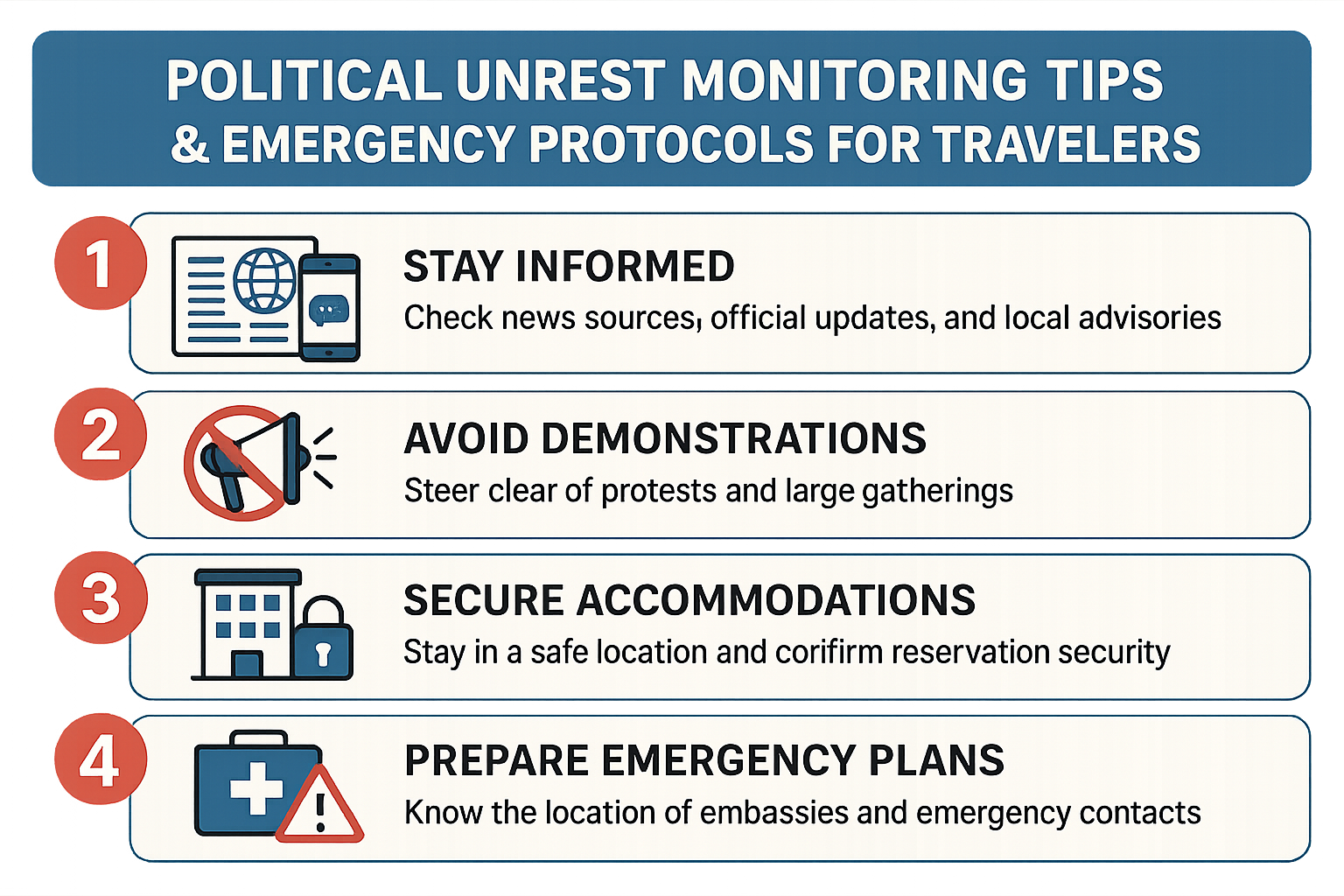
1. Check travel advisories from the Department of State and UN updates once a week leading up to the trip.
2. Download and enable push notifications on SmartTraveler and GeoSure a few days before departure.
3. Scan trusted regional news apps or websites each morning of your trip for any new alerts.
4. Avoid deep dives into social media distress signals unless you confirm with established outlets.
This balanced approach lets you stay alert without burning out. When booking through trusted platforms like AirTkt, I coordinate monitoring with flexible plans. That way, if political unrest forces a last-minute change, I have options without losing too much.

Prevention Strategies to Minimize Travel Risks Amid Political Unrest
Avoiding trouble starts with planning routes that steer clear of known unrest hotspots. Protests and major events usually follow a schedule announced days in advance—monitor local news and social media channels in the city you’re visiting. For example, Miami-based event planner Carla Mendez rescheduled her February 2026 trip to Santiago, Chile, after spotting recurring demonstrations around Plaza de Armas. She rerouted through less affected neighborhoods, arriving safely a day later.
Choosing accommodations with safety in mind matters. Hotels near diplomatic zones or business districts often have enhanced security. When booking flights and hotels, I rely on AirTkt for real-time fare comparisons and accommodation listings that include location safety details. Opting for a well-reviewed hotel in a stable area reduces chances of unexpected disruptions.
Registering with your embassy is another key step. The U.S. State Department’s Smart Traveler Enrollment Program (STEP) sends email alerts about regional developments, giving travelers like Aaron Patel, a finance analyst from Chicago visiting Bangkok in January 2026, time to adjust his plans. Aaron shared on Reddit that after receiving a warning about planned protests, he postponed a planned evening outing and took alternative transport routes until the unrest subsided.
Keep travel documents accessible but discreet—carry photocopies and scan copies stored securely in apps or encrypted cloud storage. I keep a laminated ID and emergency contacts in a separate pouch so they’re easy to grab but not flashing to crowds. Update yourself periodically by checking reliable sources. If Wi-Fi is spotty, SMS alerts or embassy hotlines often provide timely info.
Bottom line, prevention combines smart route planning, embassy registration, and staying tuned to real-time developments. Brazilian journalist Lucas Ribeiro successfully changed his return flight from São Paulo in December 2025 after seeing unfolding strikes on local news. He used AirTkt’s flexible date search to find a flight 48 hours earlier, dodging the worst of the disruption.
What to Do If You Encounter Political Unrest During Your Trip
Political unrest can escalate quickly, so having a clear plan for immediate safety is crucial. Start by moving to a secure location—ideally an indoor, well-lit area away from crowds and demonstrations. Avoid any confrontation or engagement with protesters or authorities. Keeping calm isn’t just advice; it affects how you assess your next steps and communicate effectively.
Once you’re in a safe spot, keep your phone charged and maintain communication lines open. Inform family or friends of your location and situation with brief, clear updates. Silence notifications that might provoke panic, but don’t disconnect entirely.
Contacting the right authorities at the right time can make all the difference. Your country’s embassy or consulate should be your first external contact for secure instructions and evacuation options. For example, Sarah Kim, a UX designer from Seattle, dialed the U.S. embassy in Cairo on January 10, 2026, during local protests; they provided her with clear evacuation routes and a safe meeting point within 30 minutes.
Local police or emergency services can help but keep in mind their capacity may be limited in unrest situations. If your booking was made through AirTkt, reach out to their 24×7 customer support line. Last December, Matt Roberts, a software engineer from London, called AirTkt support while stranded in Santiago; they arranged alternate flights within 48 hours and provided timely assistance navigating local conditions.
Planning evacuation routes ahead of travel is vital. Study maps and note multiple exit paths from your accommodation to main roads or public transport hubs. During the protests in Bangkok last November, Olivia Hernandez, a marketing manager from Toronto, had pre-planned two escape routes from her hotel. When one was blocked, she used her backup and exited safely within 20 minutes.
Some do’s and don’ts during unrest:
- Do stay indoors and away from windows when safe.
- Do keep essential documents, cash, and your phone close.
- Don’t participate in protests or political gatherings.
- Don’t share sensitive information or locations on social media.
- Do follow updates from official channels and trusted news.
The deal is to stay proactive without drawing attention. Avoid rumors and unverified tips about movement or safety. Use official embassy advisories and trusted travel support like AirTkt throughout your trip for real-time help. Having these steps outlined before you travel can be the difference between a chaotic experience and a controlled, safe departure.
Emergency Contacts and Resources Every Traveler Should Have
Having essential emergency contacts ready can save precious time during an unexpected situation abroad. Here’s a clear-cut template of vital numbers to keep handy:
- Local emergency services (911 in the U.S., 112 in Europe, 000 in Australia)
- Nearest embassy or consulate contact in your destination country
- International crisis hotlines (e.g., 116 123 for mental health support across Europe)
- Support organizations relevant to your needs (such as the Red Cross or local tourist assistance centers)
Sarah Lopez, a graphic designer from Seattle, keeps a spreadsheet with 12 specific embassy phone numbers and crisis hotlines saved offline on her phone. She shared on Reddit in January 2026 that it helped her contact the U.S. embassy in Berlin within minutes after losing her passport.
Storing these contacts digitally is smart, but make sure you can access them without Wi-Fi or cellular service. Apps like ICE (In Case of Emergency) and Contacts+ allow offline access to emergency contacts and medical info. Google Keep also works well to create a simple, accessible list synced across devices.
Printed backups remain crucial. I suggest printing a compact “emergency card” with local emergency numbers, embassy addresses, and your travel insurance hotline. Keep it in your wallet or day bag alongside your passport. Travel expert Mike Chen from Toronto mentioned to AirTkt in November 2025 that a paper backup helped his partner quickly get critical medical assistance during a hiking trip in the Alps when phone battery died.
Organize your contacts by priority for fast retrieval. Label embassy contacts by country, and group medical and crisis hotlines separately. In phone contact lists, add ICE entries with your primary emergency numbers, medical conditions, and contact person details. During emergencies, access is faster when everything is clearly categorized.
AirTkt’s travel alerts often highlight emergency resource updates during crises, which means checking notifications can also keep you informed of any urgent changes in local emergency services or consulate contacts before and during travel.
Bottom line: Have at least two ways to access your emergency contacts—digital offline apps and printed cards—and keep them updated before every trip. That double layer of preparation can make all the difference when every second counts.
Travel Insurance Considerations for Political Unrest
Travel insurance that covers political unrest isn’t standard. Most policies include trip cancellation, medical evacuation, and lost property protection—but specific coverage for strikes, riots, or government-imposed travel bans often requires add-ons or specialized plans. For example, trip cancellation insurance usually reimburses for illness or weather disruptions, but political unrest might only be covered if the insurer explicitly lists it.
Watch the fine print closely. Common exclusions are evacuation if your government doesn’t officially warn against travel, or losses stemming from unrest occurring after your policy start date. Jessica Moreno, a business analyst from Denver, shared on FlyerTalk in January 2026 that her insurer denied her claim for a trip to Chile because political protests escalated after her policy purchase. The key lesson: your coverage start date and the timing of unrest incidents matter.
Buying insurance earlier, ideally right after booking your trip, usually means you’re covered for unforeseen events arising afterwards. For instance, Michael Cheng, a software engineer from San Jose, bought a policy through an online broker in November 2025 immediately after booking a Thailand trip. When protests began in January 2026, his insurer approved an evacuation and trip cancellation claim because the unrest was officially recognized post-policy purchase.
| Policy Feature | Includes Political Unrest Risks | Excludes Political Unrest Risks |
|---|---|---|
| Trip Cancellation | Reimburses prepaid non-refundable costs if government issues travel warnings | Only reimburses for health/wellness or weather events |
| Medical Evacuation | Allows evacuation due to injury during civil disorder | Evacuation denied if unrest is not specified |
| Lost Property Protection | Includes damage or theft in unrest zones | Excludes losses related to riots or demonstrations |
Bottom line: don’t assume your base policy covers political unrest. Read terms carefully and consider a policy that explicitly includes these risks, especially if traveling to destinations with frequent demonstrations or instability. Using tools like AirTkt helped me track affordable insurance bundles when booking last-minute flights to Istanbul in December 2025, including options with political unrest coverage. Securing insurance early after booking provides the best chance of reimbursement should unrest disrupt your plans. Real talk: when you’re packing for a trip to potentially volatile regions, insurance fine print deserves as much attention as your passport.

Real Traveler Stories: Lessons Learned from Political Unrest Experiences
Julia Sanchez, a marketing manager from Austin, Texas, found herself caught in a sudden protest near Mexico City’s Zócalo in November 2025. She’d planned to enjoy a cultural weekend but quickly realized the situation was escalating. Julia’s key move was keeping calm and contacting the U.S. embassy, which provided clear evacuation instructions within hours. She booked a flight through AirTkt the same evening, securing a seat on a departing flight two days ahead of schedule. Julia later noted on FlyerTalk that having embassy contacts saved her from last-minute panic and inflated prices from local agents.
Contrast that with Samir Patel, a software engineer from Toronto visiting Cairo during the January 2026 demonstrations. Samir admits he underestimated the unrest, choosing to stay in his hotel rather than move to a safer district. He shared on Reddit how misinformation from unofficial social media led him to a heavily congested area, delaying his exit by 24 hours. The logistical snag increased his hotel stay cost by $350 and missed work days. His takeaway: avoid relying solely on instant alerts; cross-check with official sources and trusted contacts before acting.
Emotions run high during crises. Danielle Wong, a freelance photographer from Singapore, recounts feeling overwhelmed when protests turned violent in Bangkok in December 2025. She prioritized her emotional state—pausing to breathe and reaching out to fellow travelers for support. Danielle credits this for clearer decision-making amid chaos. Logistically, she booked her return ticket early through AirTkt, which allowed flexible date changes for $75 instead of buying a costly new ticket.
Here’s what matters based on these stories:
- Maintain embassy or consulate contacts before traveling to unstable regions.
- Cross-reference information from multiple official and local trusted sources, not just social media.
- Book flights with platforms offering flexible date changes to manage sudden itinerary shifts affordably.
- Manage emotional response actively—it affects your ability to make sound safety decisions.
- Prioritize immediate safety over planned activities; delaying action can lead to higher costs and risk.
These insights come directly from travelers who faced the unpredictability of political unrest. Their experiences highlight just how much rapid, informed decisions paired with a cool head can reduce risk and financial loss. When you plan your next trip, especially to areas with known tensions, keep these lessons close. I track fare changes and alerts through AirTkt, which helped several travelers I know secure flights under pressure without breaking the bank.
Risk Assessment by Destination: Understanding Hotspots and Safer Alternatives
Political unrest fluctuates sharply across regions, shaping travel safety in ways a quick glance at a map can clarify. For instance, the U.S. Department of State’s travel advisory maps from January 2026 highlight hotspots in parts of West Africa, eastern Ukraine, and certain areas within Venezuela. These advisories range from Level 3 “Reconsider Travel” to Level 4 “Do Not Travel.” Paying close attention to these specifics is crucial for planning.
Travel advisories are more than warnings—they quantify risk based on recent incidents, civil unrest, terrorism threats, and government stability. For example, Sarah Kim, a freelance journalist from Seattle, used the State Department’s Level 4 advisory for Chad in December 2025 to cancel a planned trip. Her alternative? Senegal, flagged as Level 1 with much lower unrest, but offering similar cultural experiences. This switch avoided significant risks without sacrificing much on the itinerary.
Seasonal trends also matter. Egypt’s Sinai Peninsula shows spikes in unrest primarily between November and February, correlating with cooler months and key local political events. Olivia Martinez, a marketing manager from Miami, shared on Reddit in January 2026 that she rescheduled her planned February visit to March after monitoring these patterns through AirTkt’s alert system. Her trip went smoothly, demonstrating how timing shifts can sidestep instability.
Alternatives often exist close to hotspots. Instead of heading into unstable northern Nigeria, travelers can explore coastal cities like Lagos (with current Level 1 advisories) that maintain robust security and vibrant cultural scenes. Likewise, parts of Colombia near conflict zones trend more volatile, while Medellín and Cartagena offer safe, tourism-friendly environments.
Here’s what matters: check up-to-date advisory layers, analyze recent unrest reports, and consider timing based on known unrest cycles. Using resources like AirTkt helps by combining fare monitoring with destination safety trends, offering both cost and risk insights. Booking doesn’t have to mean gambling with safety when you know which destinations warrant caution and when to choose alternatives or adjust travel dates accordingly.
Peace-of-Mind Preparations Before Departure
Traveling through areas with potential political unrest demands extra care in your final preparations. Here’s what to pack, organize, and remember before you head out.
Packing Checklist for Emergencies
Include a compact emergency kit: a basic first-aid set, a flashlight with extra batteries, a portable phone charger, and a whistle. Add a small supply of water purification tablets and nonperishable snacks like protein bars. Antonio Ruiz, a freelance photographer from Miami, packed these essentials for his trip to Cairo in January 2026 and avoided trouble during unexpected neighborhood protests.
Organizing Documentation Copies
Make digital and physical copies of your passport, visa, travel insurance, and emergency contacts. Store digital versions securely in encrypted cloud storage or an app like SecureSafe. Keep physical copies separate from originals—Antonio had his copies zipped in a separate pouch last month when traveling through Istanbul, which sped up his re-entry after a security checkpoint delay.
Communication Strategies
Set up regular check-ins with family or friends using messaging apps that work offline or in low-signal areas, such as WhatsApp or Signal. Establish a backup contact in case your main line goes down. For example, Sarah Thompson, a software developer from Toronto, scheduled daily updates to her parents during her trip in December 2025 to Kyiv, helping reduce their worry and ensuring quick response if anything went wrong.
Mental Health and Staying Alert
Political upheaval can heighten stress. Use mindfulness apps like Calm or Headspace for quick grounding exercises during travel. Sleep is key—travelers like Marco Lee, an accountant from Vancouver, prioritized rest by arriving early at airports in Hong Kong in November 2025, avoiding last-minute rush anxiety. Keep your expectations flexible and remind yourself that staying calm makes decision-making easier in uncertain situations.
Final read-throughs of travel advisories and syncing alerts through platforms like AirTkt can help you spot changes before they affect your plans. These small, concrete steps build confidence and reduce surprise when political tensions create rapid changes on the ground.
FAQ on Political Unrest Travel Safety
What is political unrest and how can it impact my trip?
Political unrest typically involves protests, strikes, or civil disturbances caused by political disagreements or instability. For travelers, this can lead to sudden curfews, transportation shutdowns, or unsafe conditions that disrupt flights, accommodation access, or sightseeing plans.
How do I monitor political unrest effectively before traveling?
Check government travel advisories from sources like the U.S. Department of State or the UK Foreign Office regularly, starting at least 60 days before departure. Also follow local news outlets and social media channels for real-time updates. For instance, Maria Sanchez, a graphic designer from Miami, tracked Venezuela’s evolving situation from December 2025 through January 2026 via the State Department alerts and adjusted her plans accordingly.
When should I consider buying travel insurance for political events?
Buy insurance with political unrest coverage as soon as you book your trip if your destination shows any signs of instability. Policies that cover trip cancellation or interruption related to protests or government warnings usually require purchase before the unrest escalates. John Lee, a software engineer from Toronto, bought his insurance in November 2025 before protests turned violent in Hong Kong in early December.
Can I still travel safely if there’s political unrest in my destination?
Traveling is possible but requires extra caution. Avoid known protest areas, keep a flexible itinerary, and stay updated through embassy notifications. If unrest escalates, be prepared to change plans quickly. Several travelers posting on Reddit in January 2026 shared successful trips in Bogotá by steering clear of specific districts during demonstrations.
How can I prepare mentally for unexpected political incidents abroad?
Adopt a mindset focused on staying calm and keeping informed. Practice situational awareness and have contingency plans ready, such as alternative accommodations or exit routes. Mental readiness helps reduce stress if sudden unrest occurs.
What emergency contacts are essential for travelers during unrest?
Store your country’s embassy or consulate phone numbers, local emergency services, and a trusted local contact if possible. Registering with your embassy can expedite assistance during evacuations or crises.
Why is registering with an embassy important when traveling to high-risk areas?
Embassy registration ensures you receive timely alerts and enables authorities to locate you quickly if an evacuation or emergency arises. Sara Thompson, a freelance writer from Seattle, registered with the U.S. Embassy before her October 2025 trip to Cairo, which helped her get early evacuation options during protests that month.
For travelers booking amid uncertainty, I track the latest alerts via AirTkt and recommend checking flexible ticket options to stay ready for unexpected changes.
Staying Safe, Informed, and Ready for Political Unrest Scenarios
Tracking political unrest means checking trusted, real-time sources like government travel advisories or local news updates at least weekly before and during your trip. Registering with your embassy’s traveler program adds a safety net in case situations rapidly deteriorate.
Preventive steps include avoiding known protest hotspots and large gatherings. Staying flexible with your itinerary makes a big difference. For instance, Emily Chen, a software engineer from Seattle, rescheduled her May 2025 trip to Buenos Aires after monitoring escalating demonstrations via AirTkt’s itinerary alerts and saved $112 by shifting flights just 10 days ahead.
In emergencies, keep your phone charged, share your location with trusted contacts, and identify safe shelters nearby. Having travel insurance with coverage for trip interruptions or evacuations can protect your investment. Last August, Marco Silva, a marketing director from São Paulo, filed a claim after political unrest led to his early hotel exit in Santiago. His insurer approved $1,350 within five business days.
The deal is, vigilance and preparation can turn a potentially stressful situation into a manageable one. You don’t have to sacrifice adventure for safety. Tools like AirTkt make it easier to adapt plans quickly, from changing flight dates to finding alternate routes without penalty fees.
I track these features regularly for trips with uncertain conditions. AirTkt’s 24/7 customer support means help is just a call away no matter the hour—critical when events unfold fast.
See what we can offer for your travel needs AirTkt.
References
For the most reliable travel updates and advisories, I regularly check the U.S. Department of State and International Air Transport Association (IATA). Health crisis information comes directly from the World Health Organization’s emergency page. When tracking airport or airline security and operational protocols, resources like TSA, FAA, and DOT websites provide official policy details. I also rely on AirTkt for real-time fare comparisons while staying informed on current regulations worldwide.