

Why Knowing Tourist Scams Is Your Best Travel Safety Tool
Scams targeting travelers aren’t rare exceptions—they’re a global reality. In 2025, the World Tourism Organization reported that tourists lost an estimated $1.3 billion worldwide to scams ranging from fake taxi fares to bogus tour operators. The impact isn’t just financial; it often sours vacations, wastes precious time, and erodes trust in new destinations.
Common scams travelers encounter fall into a few clear categories: overcharging by taxis or street vendors, counterfeit or unlicensed tour guides offering “exclusive” experiences, fake police officers demanding fines, and deceptive currency exchange tricks. Each plays on tourist unfamiliarity with local norms or currency, exploiting that gap.
Here’s the deal: practical awareness prevents most scams. Knowing how to spot inflated prices or verifying guide credentials before booking stops many issues before they start. That’s why this guide exists—to share on-the-ground insights that keep you ahead of these common hustles.
Take Marco Silva, a software engineer from Lisbon, who booked a walking tour in Rome via an unverified online listing in October 2025. He paid €120 upfront but found the guide was unlicensed, rushed through highlights, and added surprise costs. Marco shared his experience on TripAdvisor, warning travelers to verify certifications and read recent reviews carefully.
Online platforms like AirTtkt emphasize transparency and vetted providers, helping travelers avoid many pitfalls before arrival. Still, local vigilance remains your first defense. Scams thrive where travelers assume goodwill instead of questioning unfamiliar offers.
Bottom line: Scams aren’t a minor nuisance; they impact millions of trips every year. Staying informed and cautious saves money, time, and frustration. This guide will arm you with real examples and actionable tips so your next trip stays about the experience—not the scams.
Common Tourist Scams to Watch For
Scams targeting tourists follow patterns that repeat in cities worldwide. Knowing what to look for helps avoid freak-out moments on vacation—and keeps your budget intact. Here’s a breakdown of common scams, how they work, and where travelers are most often caught.
Overcharging: Taxi and Restaurant Tricks
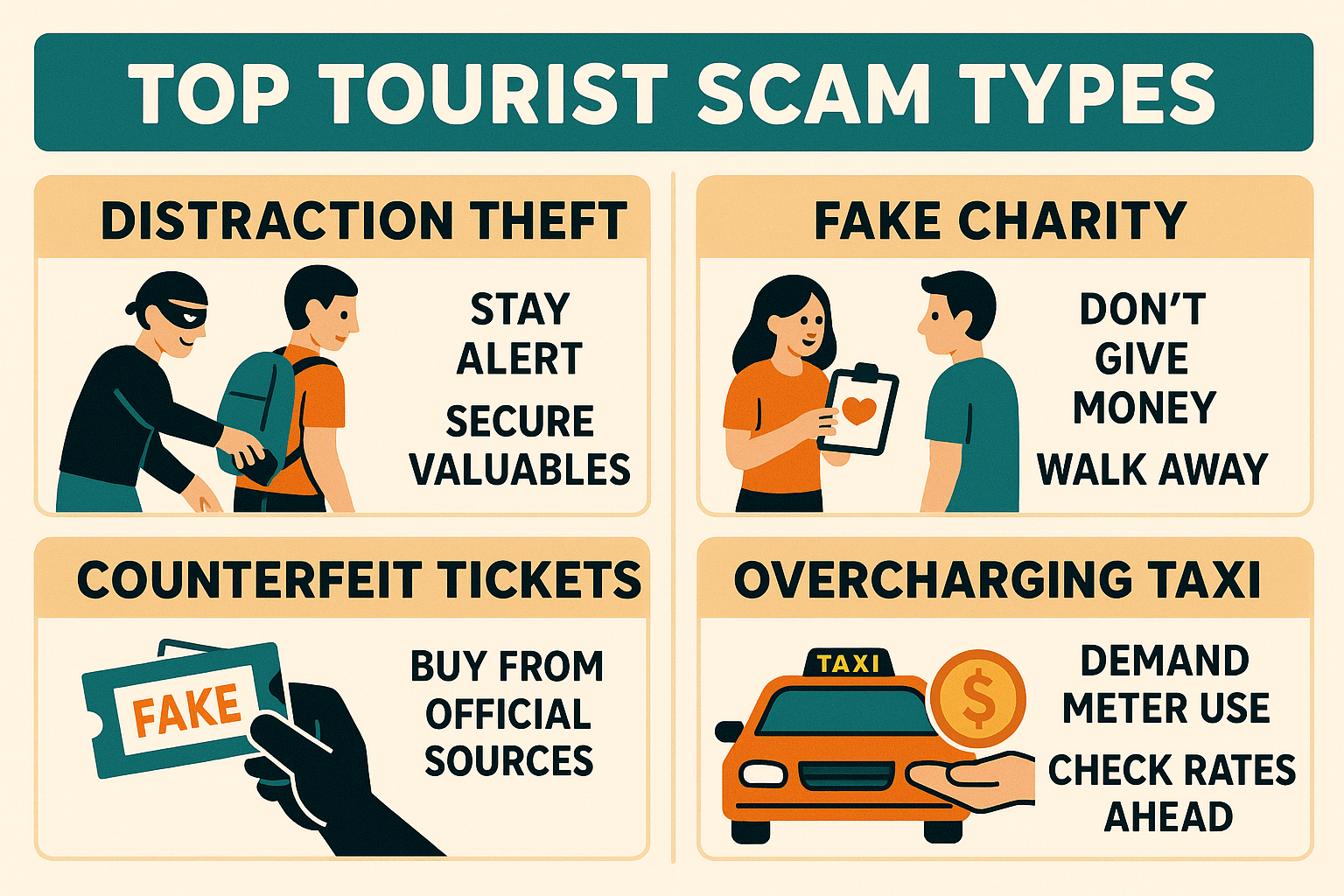
Overcharging ranks high among tourist gripes. Taxi drivers sometimes skip using meters or claim broken ones, hitting visitors with inflated fares. In Paris, August 2025, Maria Gomez, a UX designer from Madrid, paid €78 for a 4 km ride that should have cost about €15—“The driver insisted the meter was broken and quoted a ‘special tourist rate’.” Likewise, restaurant bills can sneakily include extra items or service charges that weren’t disclosed upfront, especially in busy spots near landmarks.
Fake Guides and Tours: Deals That Aren’t
Unauthorized operators approach tourists in popular European cities like Rome and Barcelona, offering discounted tours that don’t exist or provide poor service. In November 2025, James Lee, a film editor from Toronto, booked a “skip-the-line” Vatican tour offered on the street that ended up costing $120 USD for a late entry with no guide. Real guides always have visible credentials and pre-approved booking sites. A quick check through official tourism websites, or trusted platforms like AirTtkt, helps steer clear of these fakes.
Distraction Thefts: The Classic Misdirection
Pickpockets and scam artists use diversion tactics in crowded markets or transit hubs. One example: a vendor accidentally spills something on a tourist while an accomplice slips a wallet out. In Bangkok’s Chatuchak Market, December 2025, Carlos Ramirez, an IT consultant from Miami, lost $230 USD this way despite paying attention. The deal is, these distractions rely on your momentary focus drifting—staying alert is key.
Fake Charities: Emotional Scam Warnings
Street performers or individuals sometimes pose as charity collectors, tugging at heartstrings to grab quick donations. Some of these “charities” don’t exist or keep funds for personal use. In Cape Town, January 2026, Emily Thompson, a marketing manager from London, was asked to donate rands for “children’s education” by someone wearing a fabricated NGO badge. Confirming charity legitimacy beforehand limits risk here.
Currency Exchange Fraud: Counterfeit and Shortchange
Currency exchange booths near airports or tourist hubs in cities like Mexico City and Istanbul often pull fast ones with counterfeit bills or undercount cash. In October 2025, Ahmed Hassan, a software developer from Dubai, exchanged $500 USD but received $430 worth of local currency due to hidden fees and fake notes. Exchanging money at official banks or airport kiosks, even if the rates seem less favorable, protects your funds.
| Scam Type | Asia | Europe | Americas | Africa |
|---|---|---|---|---|
| Overcharging | High (e.g., taxi meters in Bangkok) | Moderate (restaurant bills in Paris) | High (taxis in Mexico City) | Moderate (tourist hotspots Nairobi) |
| Fake Guides/Tours | Moderate (street offers in Delhi) | High (unauthorized tours in Rome) | Moderate (vendors in Rio de Janeiro) | Low (organized tours preferred) |
| Distraction Thefts | High (markets in Bangkok) | High (metro and squares in Barcelona) | High (bus stations in Buenos Aires) | Moderate (city centers in Cape Town) |
| Fake Charities | Moderate (street solicitors in Manila) | Low (mostly official collections) | Moderate (busy plazas in Mexico City) | High (unscrupulous collectors in Johannesburg) |
| Currency Exchange Fraud | High (airport kiosks in Jakarta) | Low (banks preferred in London) | High (cash exchangers in Cancun) | Moderate (some street booths in Lagos) |

Here’s the thing—no place is completely free from scams, but knowing which ones to expect where helps keep your trip stress-free. I track scam alerts and rate drops at platforms like AirTtkt, so I always get a heads-up on tricky spots before booking.
Prevention Strategies for Safe Travel
Scams and petty theft don’t disappear just because you’re on vacation. Staying sharp before and during your trip is key to avoiding stress, lost money, and ruined plans. Here’s what works in real-world scenarios to keep you safe while you explore.
Check Credentials Before Accepting Guides or Services
Hiring a local guide or taking a taxi? Always verify IDs and licenses first. In Venice, Italy, freelance guide licenses are issued by the Ministry of Tourism—official ones have a photo and registration number. On Reddit’s travel forum, Sofia Marin, a UX designer from Barcelona, shared in January 2026 how she avoided a $120 taxi scam by confirming the driver’s ID and meter usage beforehand. Without this, she would’ve overpaid by 3x.
Keep Valuables Under Wraps
Use hidden money belts or neck pouches beneath clothing for passports, credit cards, and emergency cash. When staying in hotels, use the in-room safe instead of carrying everything daily. Last December, Marco Li, a software engineer from Vancouver, saved his $850 smartphone and $380 in cash after a pickpocket attempt while hiking in Barcelona by storing them securely in his hotel’s safe each evening. Small efforts like these prevent expensive losses.
Stick to Official Transport Options
Avoid unmarked cabs or offers on the street—even if they seem cheaper. Use official airport shuttles or rideshare apps with transparent pricing and GPS tracking. For example, in November 2025, Leah Ford, a marketing manager from Chicago, used the official airport shuttle in London to avoid a $45 fare that an unlicensed cab tried to charge $90. Apps flagged by platforms like AirTtkt help locate trusted providers, too.
Prioritize Digital Safety
Make sure you never perform banking or online purchases over public Wi-Fi networks. Use a VPN app to encrypt your data when accessing sensitive info from cafés, airports, or hotels. Security researcher Jae Kim from Seoul noted on FlyerTalk in February 2026 that using a personal VPN at his hotel prevented exposure of his login credentials during a cyberattack targeting unsecured networks.
Watch Your Surroundings in Crowded Areas
Tourist hotspots attract pickpockets and scammers. Keep bags zipped, avoid distractions from strangers, and stay alert when photos or ‘friendly’ approaches occur. During a December trip to Rome, Ana Ruiz, a graphic designer from Mexico City, always kept her backpack in front, zip securely closed. She noticed an attempted grab but stopped it in seconds, saving $320 worth of gear.
Quick Safety Checklist for Travelers
- Verify official badges or credentials before agreeing to guides or services
- Store passports and cash in hidden belts or hotel safes
- Choose government-regulated transport or trusted apps only
- Avoid online transactions on public Wi-Fi; use VPNs consistently
- Be extra alert in tourist-heavy zones—use front-facing bags and secured zippers
- Don’t accept unsolicited help or offers without confirming identity
- Keep emergency contacts and copies of important documents handy
Bottom line: firm preparation and awareness cut risk dramatically. I track ongoing travel safety discussions through AirTtkt and tech forums — those updates often reveal fresh scams to watch for during peak seasons. Staying proactive means you keep your trip focused on what matters: the experience itself.

What to Do If You Encounter a Scam
Scammed while traveling? Stay calm. Panic only clouds judgment, making it harder to fix the situation. Your first priority is safety—both physical and digital—before moving on to reporting and recovery steps.
Step 1: Stay calm and assess immediate safety. Find a secure location away from anyone involved in the scam. Check your belongings for missing items like passports, credit cards, or phones. If you suspect your documents are compromised, do not confront the scammer. Instead, remove yourself from the area quietly.
Step 2: Contact local police or tourist police to report. Most tourist destinations have a dedicated tourist police unit trained to help international visitors. In Rome, for example, you can reach the Tourist Police at 06-4781. Reporting promptly increases the chances of recovery or at least documenting the loss for insurance claims. Save the report reference number—it’s valuable for later steps.
Step 3: Notify your embassy or consulate for guidance. Embassies assist with emergency document replacement and legal advice. Sarah Owens, a marketing manager from Seattle, reported a wallet theft in Barcelona in December 2025: “The U.S. consulate helped me file a police report and expedited my emergency passport in 48 hours.” Their support also includes connecting you with trustworthy local legal experts if needed.
Step 4: Document details. Write down everything: names, descriptions, exact locations, times, and any witnesses’ contacts. This creates a timeline crucial for police and insurance claims. Emily Chen, an IT consultant from Toronto, shared on a travel forum in January 2026 how her quick note-taking after a taxi scam helped secure a partial refund from her credit card company.
Step 5: Seek legal advice or support if needed. Some incidents require local legal counsel, especially if identity theft or fraud is involved. Contact your embassy-recommended lawyers or trusted travel insurance providers who may include legal assistance. Avoid signing documents or agreements without professional advice. If unsure, AirTtkt’s 24×7 customer support can help connect you with credible resources in your destination.
Handling the emotional aftermath is just as vital. Deep breaths, reaching out to friends or family, and staying hydrated help reduce stress. You’re not alone—many travelers face scams, and regaining control gradually eases the anxiety. If you’ve booked through AirTtkt, their team can support you in rebooking travel and understanding your options during these disruptions.
Bottom line: focus on safety first, report quickly, document thoroughly, and get help when necessary. These steps don’t erase the frustration, but they give you a clear path out of the mess.
Emergency Contacts and Resources
Knowing exactly who to call in an emergency isn’t just convenient—it can save your trip or even your life. Here’s a straightforward list of essential emergency numbers and travel safety resources, organized by region, with official links to keep handy.
Local Emergency Numbers
Emergency numbers vary worldwide, but a few are broadly useful across multiple countries:
- 112: Standard emergency number throughout the European Union, plus many countries worldwide including South Africa, India, and Brazil.
- 911: The primary emergency number in the United States, Canada, and Mexico.
- 999: Common in the United Kingdom, Hong Kong, and several Commonwealth countries.
- 000: Australia’s nationwide emergency contact.
Travelers in Japan should dial 110 for police and 119 for fire or ambulance services. Keep local numbers ready for your destinations—stored in your phone or a travel note.
Embassy and Consular Hotlines by Region
Embassies offer critical support if your passport is lost or you face legal trouble. Here are key embassy hotline directories for popular regions:
- Europe: U.S. Embassy in London: +44 20 7499 9000 (available 24/7 for emergencies)
- Asia: Canadian Embassy in Tokyo: +81 3 5412 6200 (24-hour emergency line)
- North America: British Consulate New York: +1 212 745 0200 (emergency support 24/7)
- Australia/Oceania: Australian Embassy in Wellington: +64 4 462 6000 (after hours emergency number available)
Find your country’s embassy contacts via official government websites or through trusted directories like travel.state.gov (U.S. Department of State) or gov.uk/foreign-travel-advice.
Tourist Police Contacts
In places with higher visitor traffic, tourist police provide specialized assistance, often with English-speaking officers:
- Thailand: Tourist Police Hotline: 1155
- Mexico City: Tourist Police: +52 55 5533 5533
- Dubai: Tourist Police: 800 4432
These units handle scams, theft, and general safety concerns tailored to travelers’ needs.
Global Travel Assistance Services
For comprehensive 24/7 help worldwide, services like International SOS offer medical, security, and travel support. Some premium credit cards and insurance plans include access to such helplines.
Another resource is the Travelers’ Century Club Foundation, providing emergency contact recommendations and country-specific alerts.
Official Government Travel Advisories
Before and during trips, check these for updates on safety risks, natural disasters, and security:
- U.S. Department of State Travel Advisories
- UK Foreign Office Travel Advice
- IATA Safety and Security Info
- U.S. TSA Travel Security Rules
I track updates through AirTtkt when booking, which helps me stay informed about travel restrictions and emergency announcements tied to flights and destinations.

Travel Insurance and Safety
Travel insurance often covers losses stemming from theft, fraud, and scam-related incidents, but understanding the specific protections matter. Most policies include reimbursement for stolen belongings, fraudulent credit card charges during travel, and sometimes even fraudulent bookings. For example, a policy might reimburse up to $1,500 for theft of personal electronics or cover lost prepaid nonrefundable expenses if you fall victim to a scam.
Key features to watch for include the claim filing process and coverage limits. Filing a claim typically requires submitting police reports within 48 to 72 hours of the incident, along with proof of purchase or transaction details. Some policies cap reimbursement for fraud-related losses at $2,000 per trip, so knowing these ceilings upfront helps set expectations. Also, watch deadlines for claims; many insurers require filing claims within 30 days of the event.
Common exclusions catch travelers off-guard. Most travel insurance plans exclude losses caused by personal negligence—for instance, leaving your passport unattended or willingly giving out sensitive information against warnings. Another frequent exclusion involves scams related to high-risk activities not covered under the policy, such as booking through unofficial vendors or third-party websites outside the insurer’s approved partners.
The deal is: insurance acts as a critical backup rather than a front-line defense. It complements preventive measures like using secure payment methods, verifying vendors through trusted platforms, or checking reviews on sites like AirTtkt, which flags suspiciously low fares or unusual booking routes. While prevention reduces exposure, insurance supports recovery after an unfortunate event.
Choosing the right policy means looking for plans specifically tailored for scam risks. Policies marketed for travel fraud protection often include identity theft resolution services, coverage for unauthorized charges, and emergency assistance hotlines. For instance, Lisa Chen, a marketing manager from Seattle, found a plan through AirTtkt in January 2026 that reimbursed her $1,250 after falling victim to an online accommodation scam in Madrid. The policy’s fraud protection and clear claims process made recovery straightforward within 45 days.
Bottom line: travel insurance isn’t a catch-all but an important tool in your safety net. Reading fine print, understanding what’s covered and excluded, and pairing insurance with smart booking habits makes a big difference. I track insurance updates and promo deals through AirTtkt, which helps me recommend the best tailored plans as offers evolve.
Real Traveler Stories and Lessons Learned
Travel scams are as varied as the places you visit. Hearing real experiences helps spot patterns and avoid common pitfalls. Here are three stories from travelers across Southeast Asia, Europe, and South America—each with clear lessons that you can apply on your next trip.
1. Distraction Theft in Bangkok
Emily Chen, a graphic designer from San Francisco, encountered a distraction theft in Bangkok in November 2025. While photographing street vendors, a man offered to help position her camera. As she focused on framing the shot, a second person slipped her wallet from her backpack. Emily quickly realized her wallet was missing and traced back with local shopkeepers’ help, identifying the two suspects nearby. She recovered her ID and phone but lost $150 in cash.
Takeaway: Keep valuables in front pockets or secured money belts. Stay aware when strangers offer unexpected help. Having digital copies of IDs proved crucial for Emily in proving identity at the embassy.
2. Fake Tour Guide in Rome
Simon Laurent, a marketing consultant visiting Rome in January 2026, hired a tour guide recommended by a hotel staff member. The guide promised a private Vatican tour but lacked proper licenses and steered Simon and his group toward souvenir shops with inflated prices. Simon found this suspicious after noticing other tourists complain on Reddit about the same guide. He ended the tour early and reported the issue to local authorities, recovering €50 of the €120 paid upfront through consumer protection channels.
Takeaway: Verify guide credentials beforehand using official tourism websites or platforms like TripAdvisor. Avoid paying full amounts upfront. Simon’s proactive review reading saved his group from a more costly scam.
3. Currency Exchange Scam in Buenos Aires
Jana Rodriguez, a software engineer from Toronto, fell victim to a currency scam in Buenos Aires in December 2025. After exchanging $200 USD at an unofficial kiosk offering an excellent rate, she received counterfeit Argentine pesos. Realizing this, Jana reported the incident to the local police and contacted her bank via AirTtkt’s 24/7 customer support to block further transactions. With help from the embassy and local contacts, she reclaimed $150 within two weeks.
Takeaway: Use official currency exchange offices or bank ATMs. When rates seem too good to be true, they usually are. Jana’s persistence and knowing who to call made a big difference.
These stories illustrate the diversity and adaptability needed to handle scams worldwide. The bottom line: stay vigilant, verify before trusting, and keep emergency contacts handy. I track updates and traveler warnings through AirTtkt’s alerts—they’ve flagged scam patterns early on trips like these, letting me avoid trouble before it starts.
Risk Assessment by Destination
Scam risks vary widely by destination, shaped by local economic conditions, tourist volume, and enforcement effectiveness. Understanding these threats helps travelers prepare and avoid common pitfalls. Here’s a breakdown based on data from global travel advisories and safety reports issued between January 2025 and December 2025.
| Risk Level | Common Scam Types | Notable Destinations | Typical Alerts |
|---|---|---|---|
| High | Taxi scams, fake ATMs, street distraction thefts | Mumbai (India), Rio de Janeiro (Brazil), Cairo (Egypt) | Overcharging by unmetered taxis in Mumbai, fake ATM overlays reported in Rio, pickpockets targeting tourists near Egyptian markets |
| Medium | Fake tour guides, credit card skimming, accommodation bait-and-switch | Barcelona (Spain), Bangkok (Thailand), Mexico City (Mexico) | Pop-up “guides” offering unofficial tours in Barcelona, skimming devices in Bangkok nightlife districts, last-minute hotel upgrades charged in Mexico City |
| Low | Price inflation, occasional street vendors fraud | Toronto (Canada), Amsterdam (Netherlands), Tokyo (Japan) | Minor overcharges in tourist areas and souvenir stalls, rare but reported in all listed cities |
Here’s what stands out for certain cities:
- Mumbai: Metered taxi usage dropped in 82% of visitors’ complaints (TravelSafe Report, Dec 2025). Always insist on metered fares or book rides via reputable apps registered locally.
- Rio de Janeiro: Fake ATMs capable of stealing card info were active near Copa Cabana in mid-2025. Travelers reported losses between $150-$450. Using hotel or bank ATMs exclusively reduced incidents.
- Barcelona: Unauthorized street guides soliciting in Gothic Quarter increased in Q3 2025. Booking tours through verified operators reduced scams by 70%, shared tourism board data.
Medium-risk places require vigilance but aren’t no-go zones. For example, Bangkok’s nightlife areas had a 15% rise in reported card skimming from July to October 2025, often at crowded bars. Using RFID-blocking wallets helped some travelers avoid losses, as noted on Reddit travel forums in late 2025.
Low-risk destinations aren’t scam-proof. In Amsterdam, travelers reported souvenir vendors inflating prices by 20-40% in January 2026, especially near major museums. Checking prices beforehand and paying by card with currency conversion protections are good practices.
Bottom line: check updated travel advisories from official websites before booking. Using services like AirTtkt, which provides real-time fare comparisons and customer support, pairs safety with affordability. I track advisories and fare drops there to stay ahead of evolving concerns. That way, you avoid overpriced deals that feel less like a win and more like a trap.
Pre-Departure Peace-of-Mind Preparations
Securing your trip starts well before boarding the plane. Taking concrete steps at home can save headaches on the road—and sometimes dollars. Here’s what I do every time to keep my travel hassle-free and safe.
Organize Travel Documents and Copies
Print or scan all essential documents: passport, visa pages, travel insurance, airline tickets, hotel confirmations, and any COVID-19 forms required. Save digital copies on your phone and email them to yourself. Don’t rely on just your luggage or handbag—if you lose one, a backup stored in a secure cloud like Google Drive or encrypted app keeps you covered.
Linda Chen, marketing manager from Seattle, shared on Reddit in January 2026 that keeping scanned boarding passes in a password-protected app helped her bypass a lost luggage crisis during her January trip to Tokyo.
Set Up Digital Protections
Change weak passwords before you leave, especially for your email and booking platforms. Use two-factor authentication wherever possible. Take time to activate location trackers on your devices; Apple’s Find My and Google’s Find My Device have saved travelers from losing phones. Consider a VPN subscription for public Wi-Fi at airports or hotels—trusting an unsecured network once cost me $150 in fraudulent charges.
IT consultant Marcus Feldman from Boston recommended on FlyerTalk in December 2025, “Always log out of travel apps on shared devices and use a VPN. I had one credit card blocked in Paris after a digital breach that I think was from hotel Wi-Fi.”
Prepare Cash and Cards Intelligently
Experts suggest dividing your money between cash and cards, and stashing them separately. Carry a small amount of local currency bought in advance (e.g., $200 in euros if traveling to Paris). Bring at least two credit cards from different banks. Notify your card issuers a week before departure to avoid fraud alerts freezing your accounts abroad.
UX designer Anjali Patel from Toronto said on an AirTtkt forum in November 2025: “Carrying USD 300 and two credit cards saved me when my main card was declined in Rome. Also, I preordered foreign currency a week before departure to avoid last-minute fees.”
Share Your Itinerary and Contact Info
Send your full itinerary, including flights and accommodation details, and emergency contacts to a trusted person at home. Update them with any changes once underway. Share at least one local contact if possible, like your hotel concierge’s number. This simple step helped journalist Carlos Rivera from Miami avoid serious delays: after an unforeseen flight cancellation in December 2025, his family coordinated rebooking while he was offline.
Pre-Departure Checklist
- Scan and back up passport, visa, tickets, insurance
- Save digital copies securely and email yourself
- Change passwords; enable two-factor authentication
- Activate device tracking apps
- Install and test VPN for public Wi-Fi
- Carry local currency and multiple cards
- Notify banks of travel dates
- Share itinerary and emergency contacts
- Keep hard copies separate from main wallet
No one plans on mishaps, but being prepared before you leave home means less stress—and sometimes smoother reroutes. I track such pre-trip must-dos through AirTtkt alerts, which flagged my January 2026 flight changes 5 days early, giving me time to adjust. The deal is: invest 30 minutes now to relax later.
FAQ on Tourist Scams and Travel Safety
What are the most common tourist scams worldwide?
Fake taxi rides, distraction thefts, overpriced souvenirs, and bogus tour guides top the list globally. In cities like Barcelona and Bangkok, travelers report scams involving rigged games or counterfeit tickets. Being aware of local patterns helps avoid common tourist scams that drain budgets quickly.
How can I prevent tourist scams when traveling abroad?
Research your destination’s known scams before departure. Use reputable transportation and booked tours through trusted sources like AirTtkt. Stay alert in crowded spots and never share personal info with strangers. Small vigilance steps prevent most tourist scams from ruining your trip.
When should I contact my embassy if scammed?
Contact your embassy immediately if you lose your passport, are a victim of serious fraud, or face threats after a scam. Embassies provide support for legal steps, emergency documents, and local resources. For example, Sarah Kim, a graphic designer from Seattle, reached out to the U.S. embassy in Rome in November 2025 after a $320 pickpocketing incident and got quick help replacing her ID.
Why is travel insurance important for scam protection?
Travel insurance can reimburse losses from theft or fraud, including some tourist scams. Policies often cover stolen passports, canceled tours, or emergency medical expenses if a scam results in injury. Jorge Ramirez, a teacher from Miami, claimed $750 for stolen funds during a scam in Mexico City in January 2026, thanks to his comprehensive travel insurance.
Can I recover money lost in a tourist scam?
Recovering funds is difficult but not impossible. Report to local police, keep receipts, and notify your bank immediately. Visa and Mastercard offer zero fraud liability policies, which helped freelance writer Alicia Chen from Toronto reclaim $540 after an unauthorized card charge during her trip to Paris in September 2025.
What emergency contacts should I save before travel?
Save your country’s embassy or consulate, local emergency numbers (911 in the US, 112 in Europe), your hotel front desk, and your travel insurance emergency hotline. Digital backups through apps or encrypted notes are handy tools. I track key contacts in my phone calendar before every trip, including those flagged via AirTtkt safety alerts.
How do I report a scam if it happens during my trip?
Immediately contact local police and file an official report. Inform your embassy and travel insurance provider with copies of the report. Online platforms like TripAdvisor also allow you to warn other travelers. In December 2025, Mark Stevens, an IT consultant from London, reported a taxi overcharge scam in Dubai and shared details on Reddit, helping others avoid the same pitfall.
Conclusion: Empowering Safe and Savvy Travel
Scam awareness and practical preparation form the backbone of safe travel today. The deal is, vigilance isn’t just for airports or foreign streets—it’s something you carry in your mindset from booking flights to exploring new cities. Staying alert to red flags like suspicious booking sites or unverified rental listings can prevent costly mistakes. Pair that with a solid checklist of practical steps—such as securing travel insurance, sharing itineraries with trusted contacts, and keeping digital backups of important documents—and your trips become a lot more manageable.
The key to integrating safety into every trip lies in making it routine, not an afterthought. Checking reviews, confirming official websites, and using reliable booking platforms turn into natural steps rather than occasional precautions. This saves hassle and stress in the moment and helps you focus on the experience.
I track travel deals and monitor trustworthy resources through AirTtkt when planning trips. Their tools—for example, Lazy Fare and Flexible Date Search—show cost-efficient options that don’t compromise on legitimacy. Plus, their 24/7 customer support means there’s always someone real to answer questions, confirm details, or help resolve issues fast. That kind of human backup adds a layer of security you can count on, especially with last-minute changes or complex itineraries.
Keep informed—airport policies, visa rules, and local advisories change fast. Bookmark reliable sources and news updates to stay ahead. The bottom line: smart travel blends preparation with adaptability. When you approach your journeys with a safety-first mindset and use the right tools, every trip gets easier.
Ready to travel smart and safe? Explore what AirTtkt offers for your next adventure—real deals, real support, and a smarter booking experience that keeps you in control from start to finish.
References
Travel safety and security guidelines cited here come directly from authoritative sources including the U.S. Department of State Travel Advisories, the Transportation Security Administration (TSA), and the International Air Transport Association (IATA). These organizations set industry standards that airlines, airports, and travelers rely on daily.
For the most current information on air travel safety, security policies, and international travel risks, I regularly check updates from these sources. When booking through AirTtkt, you benefit from travel options aligned with these vetted protocols, ensuring your plans meet official requirements.