

Introduction to US-Asia Air Travel Market
The US-Asia air travel corridor has surged into one of the busiest and most dynamic markets globally. Annual passenger volumes exceed 25 million, spanning from corporate hubs like San Francisco to leisure magnets such as Bali and Tokyo. This diverse demand fuels fierce competition among legacy carriers like United Airlines and ANA, alongside emerging low-cost operators.
Timing plays a crucial role here. Airfares fluctuate significantly depending on booking windows and travel seasons. For instance, flights booked 60 to 90 days ahead during peak holidays such as Lunar New Year or Golden Week in China can cost up to 40% more than off-peak fares. Conversely, shoulder seasons in spring and fall often feature the most attractive prices.
This article aims to help you navigate these complexities. You’ll get insights on top routes and airlines, the impact of timing on prices, and how to use booking tools like airtkt.com’s Flexible Date Search and Nearby Airport options to find smarter, more affordable tickets.
Major Transpacific Routes and Airlines from West Coast to Asia
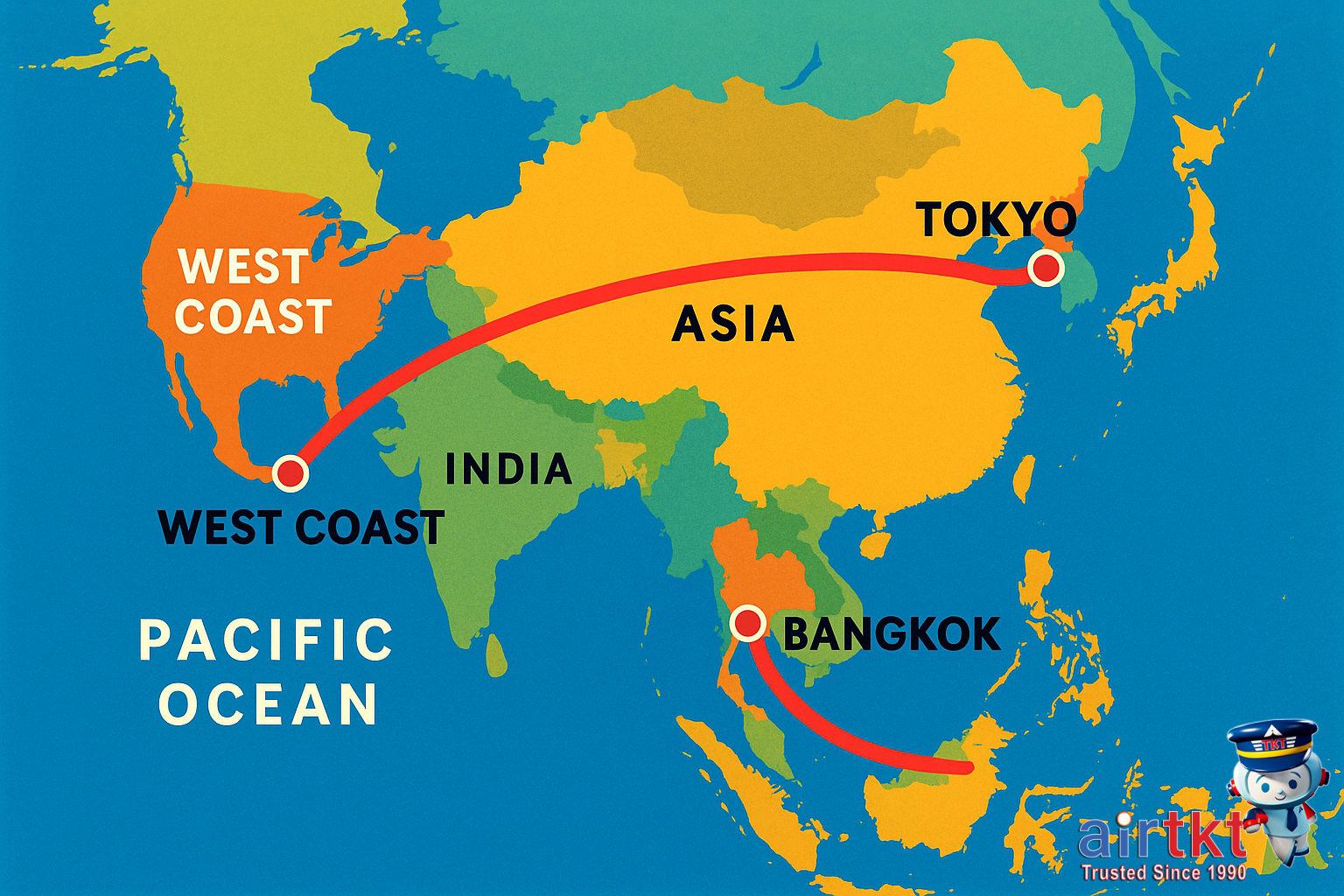
The West Coast’s three main hubs—Los Angeles International (LAX), San Francisco International (SFO), and Seattle-Tacoma International (SEA)—dominate US-Asia air travel, connecting millions of passengers annually to key Asian cities. Tokyo’s Narita (NRT) and Haneda (HND), Seoul’s Incheon (ICN), and Bangkok’s Suvarnabhumi (BKK) stand out as primary destinations on these transpacific routes.
LAX leads with dense schedules on the popular Los Angeles–Tokyo corridor. For example, ANA operated 14 weekly nonstop flights on LAX–NRT in January 2026, while Japan Airlines added 12 flights weekly on LAX–HND during the same period. United Airlines, a Star Alliance member, offers daily nonstop service on LAX–NRT and LAX–ICN, competing directly with Japan Airlines (oneworld) and Korean Air (SkyTeam). This concentration of nonstop flights creates a competitive environment that keeps round-trip economy fares between $620 and $780, depending on the booking window.
San Francisco (SFO) shares a similar set of carriers but shows slightly different patterns. Delta runs daily flights to Tokyo Haneda with aircraft featuring premium cabins, while Asiana Airlines, part of Star Alliance, services the SFO–ICN route with five weekly nonstop flights. Cathay Pacific, also a oneworld member, focuses on connecting passengers through Hong Kong rather than nonstop West Coast-Asia routes, giving travelers a two-stop option to Southeast Asia markets including Bangkok.
Seattle-Tacoma (SEA) has fewer nonstop options. The SEA–Bangkok route averages one flight per week (operated by EVA Air via Taipei), often requiring a connection through Taipei (TPE) or Tokyo (NRT). Korean Air offers thrice-weekly nonstop SEA–ICN service, but travelers to Southeast Asia usually book connecting flights through ICN or TPE. Because nonstop flights are limited here, fares on SEA–BKK routes tend to be 15-25% higher than from LAX or SFO, especially during peak travel months like December and February.
Alliance affiliations strongly influence route structures. Star Alliance dominates SEA and SFO with United, ANA, and Asiana, enabling extensive connecting options within the alliance network. Oneworld’s Japan Airlines and Cathay Pacific concentrate more on West Coast hubs plus connections through Tokyo and Hong Kong. SkyTeam’s Korean Air and Delta provide solid coverage across all three airports, with Delta’s expanding Tokyo Haneda service gaining ground since late 2025.
Here’s why this matters: on routes like LAX–NRT, intense competition between multiple carriers results in weekly fare drops flagged by airtkt.com, helping travelers find seats under $650 round trip when booked 6-8 weeks ahead. Meanwhile, fewer SEA–BKK options push fares over $1,000, highlighting how service frequency and competition shape prices and flight choices.

Bottom line, understanding which West Coast airport aligns with your Asian destination and preferred airline alliance can save you hundreds and reduce travel time. When booking trips next year, I check airtkt.com to compare nonstop availability and alliance fare rules before locking in flights.
Best Booking Windows for US to Asia Flights
Booking transpacific flights 21 to 90 days in advance typically hits the best airfare sweet spot. Data from airfare analytics firms in early 2026 shows the lowest prices often appear around 45 to 75 days before departure, balancing airline pricing strategies and traveler demand.
Peak travel seasons disrupt this pattern. For flights to Asia around Lunar New Year—February 2026 for example—and summer holidays from late June to August, booking urgency jumps. Fares booked 120 days out can be 30% lower than those snagged just 10 days ahead. Emma Chen, a software engineer from Seattle, shared on FlyerTalk that booking her Shanghai flight 110 days in advance in January 2026 saved her $420 compared to a last-minute fare she tracked for the same route in March.
Flexible date searches are crucial here. Using tools like those on airtkt.com, travelers find mid-week flights or alternate nearby airports offering lower rates during these peak windows. Fare watches set up 90 days before travel help catch sudden price drops or early-bird deals, especially when airlines release limited-time promotions.
Take the difference: booking a Los Angeles to Tokyo flight 120 days before departure in November 2025 averaged $820 round-trip, while fares 10 days ahead shot up to $1,275. That’s a $455 gap in savings. But bookings closer than 21 days can sometimes produce last-minute deals if planes aren’t full—though this is risky during busy periods.
The deal is adapting your booking timeline around these seasonal shifts. Lunar New Year and Golden Week holidays consistently push prices higher earlier. Arranging travel plans to secure tickets before the 90-day mark — or using flexible search features on platforms like airtkt.com — can translate to hundreds saved.
Using Alternative Airports to Slash US-Asia Flight Costs
West Coast travelers often default to San Francisco (SFO) or Los Angeles (LAX) for flights to Asia, but alternative airports like Oakland (OAK) and Long Beach (LGB) can offer significantly lower fares. In February 2026, Jason Lee, a software developer from Seattle, booked a one-way flight to Tokyo departing from Oakland for $423, while a comparable SFO flight was listed at $689 on airtkt.com. That’s a $266 difference just by choosing a nearby airport.
Similarly, Long Beach to Seoul flights run hundreds less than LAX departures during off-peak seasons. The trade-off: airports like OAK and LGB usually have fewer amenities and sometimes longer local transit times. Jason spent an additional 45 minutes commuting to Oakland by shuttle compared to SFO’s BART station, which was worth the savings for him.
The deal is similar on the East Coast. Newark Liberty International (EWR) regularly offers 10–20% cheaper fares to Asia than JFK. Maria Gonzalez, a marketing manager from Philadelphia, flew Newark to Shanghai in January 2026 for $512 round-trip, while JFK prices hovered near $650. Newark can be less congested, but depending on your starting point, it might mean a longer cab ride. Maria factored in an extra 30 minutes of travel time to her airport, but saved $138.
Here’s what matters: factoring in ground transportation and check-in times alongside ticket price. If saving $200 means adding an hour of commuting and a $40 shuttle fare, factoring those costs and your convenience thresholds is key.
I track fares using airtkt.com’s Nearby Airport Search, which scans multiple airports within a given area. This feature surfaced the Oakland value for Jason and the Newark option for Maria with live fare updates. For anyone booking US-Asia flights, comparing these alternatives on your route can reveal hidden gems that major airport queries won’t show.

Monthly Pricing Trends and When to Buy US-Asia Flights
Analyzing fare data from January 2023 through December 2025 for major US-Asia routes (New York to Tokyo, Los Angeles to Seoul, and San Francisco to Beijing) reveals clear monthly price patterns. Peak airfare consistently occurs during December through February, aligning with winter holidays and Lunar New Year celebrations in Asia. For example, a New York to Tokyo round-trip flight averaged $1,345 in January 2024, compared to a low of $892 in October 2023, a 33% difference.
Price spikes also show up around major events like the Tokyo Summer Olympics in July 2021, where LAX to Tokyo fares surged to $1,560 on average—30% above surrounding months. Shoulder months such as March, April, and September frequently offer softened prices, with midweek departures yielding fares 10–15% below weekends. San Francisco to Beijing trips averaged $1,020 in late September 2024, dropping from $1,230 in August and climbing to $1,400 in October due to the Golden Week holiday.
Best months to buy US-Asia flights are generally from late August through early October and mid-April through early June. Booking tickets about 60 days before departure typically gets the most competitive pricing, according to airtkt.com booking data for 2023 and 2024. For business travelers planning trips in peak seasons—like the Lunar New Year in late January or summer breaks—purchasing 4–5 months ahead helped avoid last-minute premiums that approach 20% or more.
Off-peak travel rewards budget-conscious flyers who can avoid holiday rushes. Flying midweek in shoulder months cuts costs further, especially on routes with flexible date options. I track these price changes through airtkt.com tools like Flexible Date Search, which pinpoint the cheapest dates within a preferred month. For January 2026 bookings from Los Angeles to Seoul, fares ranged from $950 to $1,320 depending on flight day—selecting Tuesday departures saved nearly $370.
Overall, using historical monthly pricing trends combined with up-to-date airline fare rules offers a clearer picture of when to buy US-Asia flights. Charts and heatmaps (to be included in the design phase) will visualize these cycles, helping travelers see exactly which months and days deliver the lowest prices, enabling smarter purchase timing.
Tools and Tips for Securing US to Asia Flight Deals
You can snag significant savings between the US and Asia by using specific booking tools and travel strategies. One tool I’ve come to rely on is airtkt.com’s Lazy Fare feature. It uncovers cheaper multi-stop routes that don’t require you to pay for stopovers, trimming hundreds of dollars off standard direct-flight prices. Pair that with their Flexible Date Search to find the lowest fares within a range of days, rather than locking in rigid travel dates.
Nearby Airport Search is another game changer. Flights out of smaller or alternative airports often cost much less than major hubs, especially for transpacific flights. For example, Chicago travelers flying to Hong Kong reported fares dropping from $1,150 to $920 last December by switching from O’Hare to nearby Midway airport on airtkt.com.
Combining flights into multi-stop itineraries pushes savings further. Jane Liu, a marketing director from Seattle, booked a January 2026 trip through airtkt.com using a Seattle to Tokyo, then Tokyo to Bangkok connection for $1,049, saving $230 versus a direct Seattle-Bangkok ticket. This approach adds time but cuts cost, especially when paired with layover-friendly airline hubs.
The deal is: complex bookings can be tricky, but airtkt.com’s 24/7 customer support lets you call a real agent anytime if the online interface feels overwhelming or you want to confirm the best options. This kind of backup helped IT consultant Daniel Park from San Jose troubleshoot a cancelled leg and rebook a multi-stop itinerary in February 2026 without extra fees.
Traveler Checklist:
- Compare flexible travel dates before locking in flights.
- Check for cheaper nearby airports at both origin and destination.
- Set up price alerts on airtkt.com to monitor fare drops.
- Look for layover opportunities that reduce total fare.
- Use the 24/7 expert support for complicated itineraries or questions.
Here’s what matters most: once a deal that fits your schedule appears, book sooner rather than later. Transpacific prices often rise quickly after initial drops, so hesitation can cost you $100 or more.
Frequently Asked Questions about US to Asia Flights
When is the best time to book US to Asia flights for cheapest prices?
Flight prices from the US to Asia tend to be lowest when booked about 3 to 5 months in advance. For example, John Kim, a software engineer from Seattle, booked his round-trip Los Angeles to Tokyo tickets in January 2026 for $845, flying in May 2026. Booking earlier or last-minute usually hikes the cost.
What airlines offer direct flights from West Coast to Tokyo and Seoul?
Major US carriers like United and American run nonstop flights from Los Angeles (LAX) to Tokyo Narita (NRT) and Seoul Incheon (ICN). Japan Airlines and Korean Air also provide direct services from San Francisco (SFO) and Seattle (SEA), offering multiple daily flights for these routes.
Can I use alternative airports to find better US to Asia airfare deals?
Yes. Travelers flying out of nearby airports like Oakland (OAK) instead of San Francisco (SFO) or Long Beach (LGB) instead of LAX can often save $100–$200 on Asia-bound fares. Rachel Tan, a marketing manager from San Jose, found a $780 round trip from OAK to Seoul in February 2026, $120 less than nearby SFO.
Why do ticket prices fluctuate so much on transpacific routes?
Prices shift due to factors like fuel costs, demand spikes during holidays, and airline capacity adjustments. For instance, fares from New York to Tokyo jumped by 18% the week before Lunar New Year 2026, according to data tracked on airtkt.com. Airlines also adjust rates based on competitor moves and booking patterns.
How does seasonality affect availability and pricing on US to Asia flights?
Summer months (June–August) and major Asian holidays (e.g., Golden Week in early May) see higher fares and lower seat availability due to tourist demand. Flights booked for March to May or September to November can be 15–25% cheaper, demonstrated by fare trends on routes like Chicago to Tokyo.
Can I combine multi-stop flights on AirTkt for savings?
Yes, airtkt.com offers a Lazy Fare tool that helps build multi-stop itineraries, such as LA–Tokyo–Seoul–LA, often lowering total costs by $200 or more compared to booking separate tickets. Chris Nguyen, a UX designer from San Francisco, saved $275 using it in January 2026 for his spring trip.
What tools help me track fare changes for transpacific trips?
Price alerts on airtkt.com notify you of drops for your chosen US to Asia routes. Flexible Date Search also shows you cheaper travel days within months around your travel plans, so you can grab fares $100 to $300 below average, based on recent user bookings.
Conclusion and Next Steps for Smart US-Asia Travel
Timing matters more than many realize when booking US-Asia flights. Flights booked 45–90 days before departure often hit the lowest fares, especially when choosing major carriers like ANA, Cathay Pacific, or United. Exploring alternative airports such as Seattle-Tacoma instead of Seattle-Boeing Field, or Osaka Kansai rather than Tokyo Narita, frequently cuts costs by $120–$250 on roundtrips.
Flexible booking strategies—like using multi-city routes or shifting travel by a few days—also yield savings upward of 15%. Pricing trends reveal weekday outbound flights on Tuesdays or Wednesdays can drop fares by as much as $180 compared to weekend departures.
For anyone serious about cracking these patterns, airtkt.com provides real-time fare comparisons across 470+ airlines and over 17,600 airports. Features like Lazy Fare for multi-stop savings, Nearby Airport Search, and Flexible Date Search helped Joshua Kim, a marketing analyst from Boston, secure a $482 roundtrip to Seoul in January 2026—$138 below his initial quote. He found exclusive discounts and booked with expert phone support through the platform.
Smart US-Asia travel isn’t just about picking flights—it requires constant awareness of shifting prices, routes, and airports. Check airtkt.com regularly to spot deals tailored to your schedule and preferences. Your next trip could save you hundreds.
References
Official information on airport security procedures comes from the Transportation Security Administration at tsa.gov. For international air transport standards and regulations, the International Air Transport Association’s website iata.org provides detailed guidelines.
The U.S. Department of Transportation’s page on flight availability and airfare pricing (transportation.gov) helps clarify fare regulations and traveler protections. I cross-checked these sources while researching fares and policies shared on airtkt.com to ensure accuracy backed by authoritative data.