

Introduction to Finding the Best Flight Deals Within Asia
Booking affordable flights within Asia’s rapidly expanding air travel market is both exciting and tricky. With dozens of airlines competing on popular routes, prices can swing dramatically depending on timing and the airports you choose.
Four key factors shape the best deals: which airlines compete on your route, when you book, the availability of alternative airports near your origin or destination, and monthly price trends that reveal cheaper travel windows.
Platforms like airtkt.com simplify this process by offering smart tools such as Flexible Date Search to spot cheaper days, Lazy Fare for uncovering budget-friendly multi-stop itineraries, and Nearby Airport Search that finds lower fares from neighboring airports. These features give you clear options to compare and book with confidence in Asia’s dynamic flight market.
Key Airlines and Competitive Routes Across Southeast Asia
Southeast Asia’s skyways are dominated by a blend of full-service and low-cost carriers, anchored by major hubs that connect an intricate network of routes. Singapore Airlines, Scoot, AirAsia, Thai Airways, Malaysia Airlines, and Vietnam Airlines form the backbone of regional travel, each carving out distinct roles in serving different traveler needs.
Singapore Changi (SIN), Kuala Lumpur International Airport (KLIA), and Bangkok Suvarnabhumi (BKK) are the busiest hubs in this region, offering efficient layovers and a wide range of onward connections. For example, Singapore Changi handled over 68 million passengers in 2025, making it a critical gateway for flights within Asia and beyond. Kuala Lumpur’s KLIA supports over 50 million passengers annually, while Bangkok Suvarnabhumi processes nearly 65 million passengers, reinforcing their positions as key transit points.
Routes like Bangkok to Singapore and Kuala Lumpur to Ho Chi Minh City show intense competition. Bangkok–Singapore has at least four airlines competing regularly: full-service carriers Bangkok Airways and Singapore Airlines, alongside low-cost options Scoot and AirAsia. This competition pushed average round-trip fares down to about $130 in January 2026, compared to $185 two years earlier, according to data shared on FlyerTalk. The Kuala Lumpur–Ho Chi Minh City corridor mirrors this trend, with Malaysia Airlines and Vietnam Airlines facing stiff price and schedule competition from AirAsia and VietJet Air, giving travelers more choices and flexible flight times.
Budget airlines like AirAsia and Scoot attract price-conscious travelers, offering base fares sometimes as low as $35 for one-way flights between Kuala Lumpur and Bangkok during off-peak months. Their no-frills model appeals to younger travelers and those willing to forgo extras for savings. Meanwhile, Singapore Airlines and Thai Airways remain top picks for business travelers and those prioritizing comfort, with average fares for full-service economy flights hitting $280 to $350 on similar routes.
Alliance memberships and codeshares also shape travel options. Singapore Airlines, for example, is a member of Star Alliance through its partnership with SilkAir and Scoot, providing seamless connections and coordinate schedules across routes to reduce layover times. Thai Airways is also a Star Alliance member, which complements Malaysia Airlines’ Oneworld ties. These alliances let travelers book complicated itineraries with confidence—like flying Vietnam Airlines into Hanoi before transferring smoothly on a Star Alliance partner to Bangkok—often on a single ticket.
Tracking fare trends and scheduling across these carriers, I rely on airtkt.com to spot deals and understand how competition affects prices in real time. The mix of budget and premium options, alongside vibrant hub activity, keeps Southeast Asia’s aviation market dynamic and accessible. While full-service airlines offer amenities and loyalty programs, the growth of low-cost carriers has driven prices down, benefiting the budget-conscious without completely sidelining comfort demands.
When to Book Your Asia Flight: Optimal Windows and Seasonal Tips
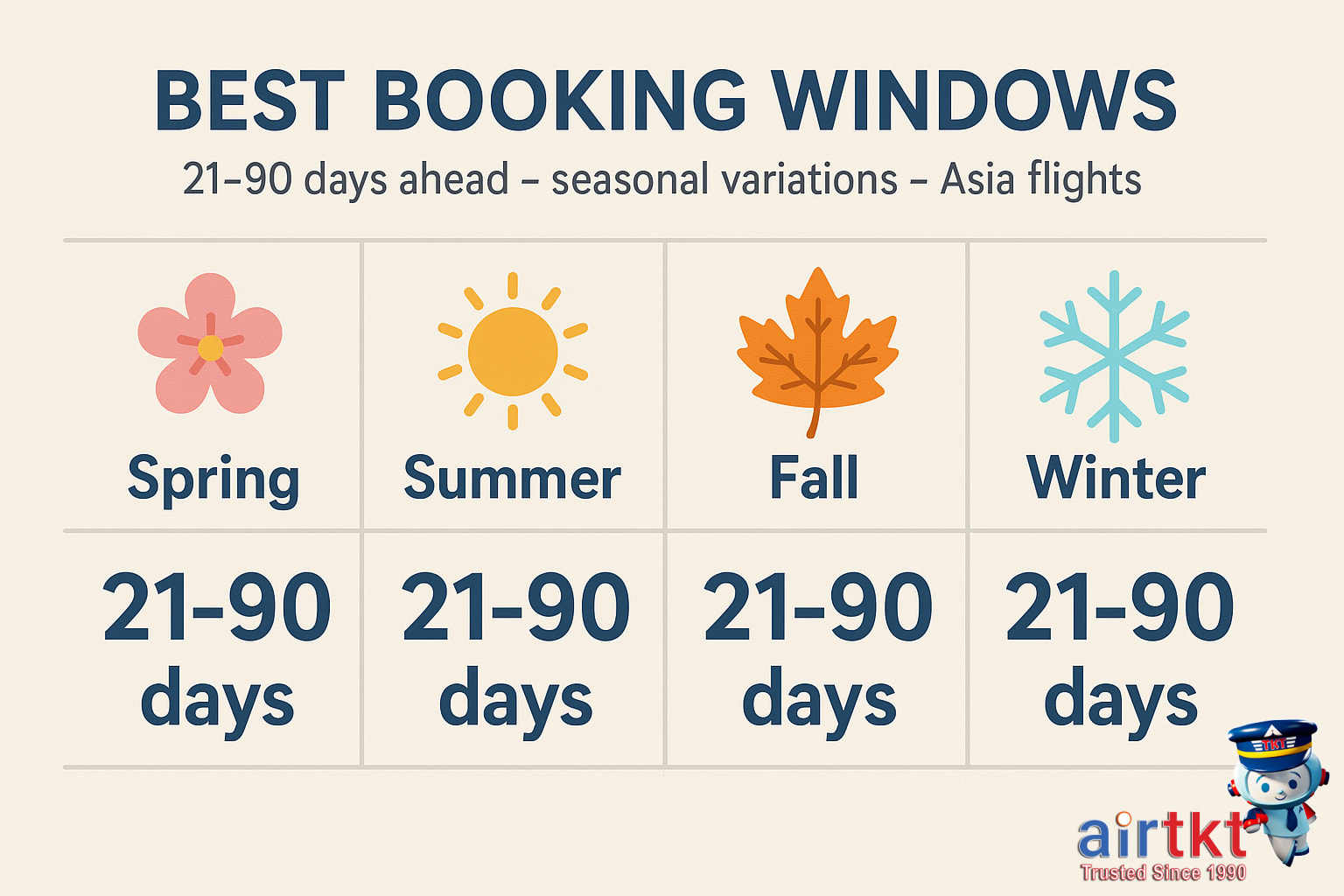
Booking flights to Asia usually hits the sweet spot between 21 and 90 days before departure. That window shifts depending on your route and the season. For example, mid-tier demand routes like Los Angeles to Tokyo often show lowest prices about 60 days out, while high-traffic routes such as New York to Hong Kong may require booking closer to 90 days ahead to lock in better fares.
Peak travel periods shorten these windows considerably. Take Lunar New Year or summer holidays: fares spike quickly, and the ideal booking timeframe can narrow to just 21–45 days prior. For instance, Sarah Lee, a software engineer from San Francisco, booked a round-trip LAX to Seoul ticket in January 2026 for a March Lunar New Year trip. She reported on flyer forums that booking 35 days ahead cost her $670, whereas last-minute prices shot up to $1,150 just 10 days out.
Here’s a quick price comparison from October 2025 for flights from Chicago to Bangkok:
| Booking Time | Fare (USD) | Route |
|---|---|---|
| 70 days before | $780 | ORD-BKK |
| 15 days before | $1,150 | ORD-BKK |
Notice a $370 difference, which makes a strong case for early booking outside peak crunch times.
No guesswork needed to spot these trends. Use airtkt.com’s Flexible Date Search to scan fares up to three months out. The Lazy Fare tool helps too, revealing lower-cost multi-stop itineraries you might miss otherwise. My personal checklist before booking:
- Run Flexible Date Search for a month-plus window
- Check Lazy Fare for stopover savings on longer routes
- Compare nearby airports if possible
- Double-check ticket flexibility and cancellation policies
- Book as soon as a fare aligns with your budget and timing
Airfare patterns in Asia evolve as airline schedules and demand fluctuate, so monitoring them regularly pays off. I track alerts through airtkt.com to catch price drops and emerging deals, especially before major holidays or school breaks. Sometimes nabbing a fare 50 days out saved me $230 compared to earlier or last-minute bookings.

Save Big by Flying Alternative Airports Within Asia
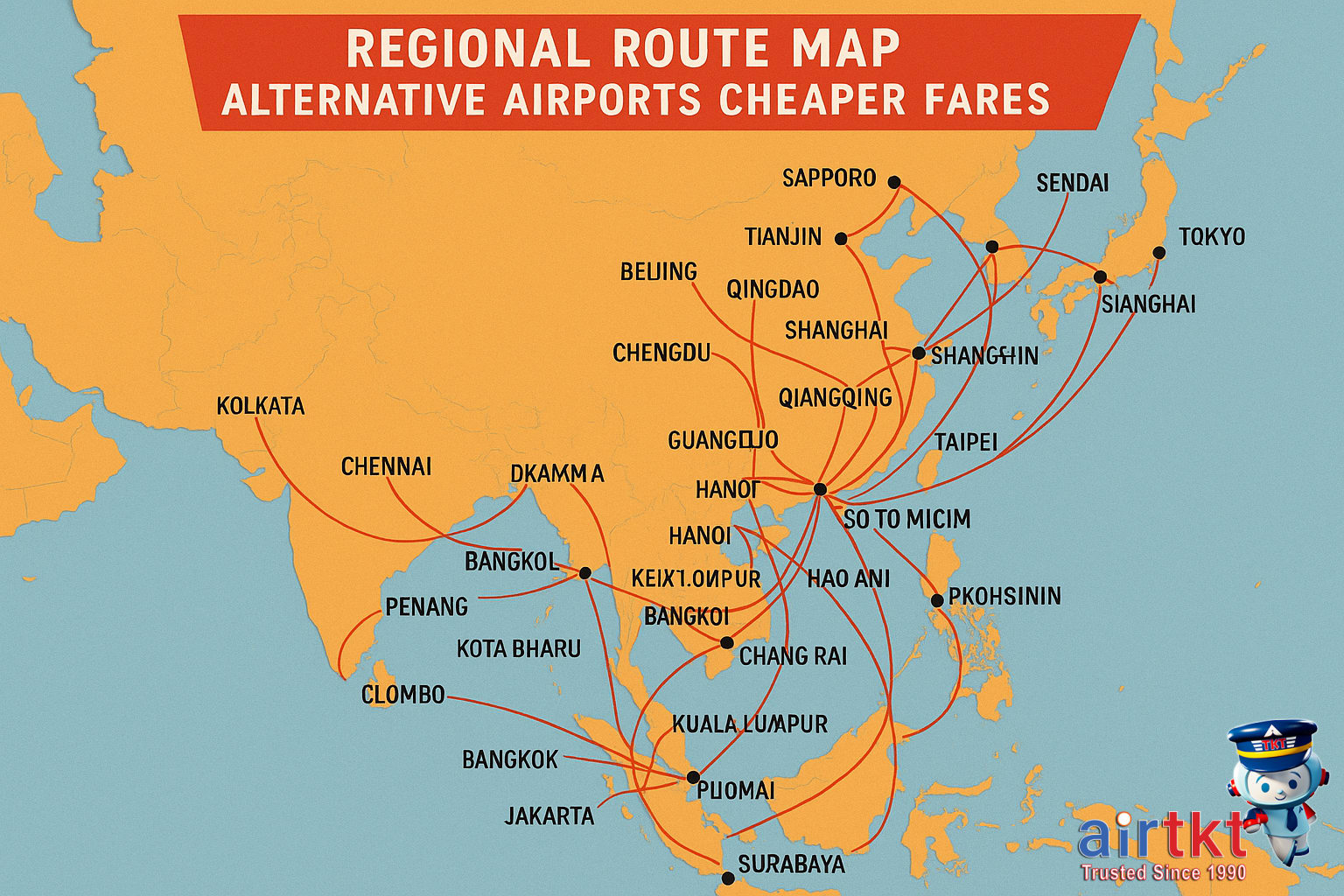
Several major Asian cities offer multiple airports within easy reach, and choosing the right one can slash your airfare significantly. Kuala Lumpur’s main airport KLIA (KUL) and its low-cost carrier terminal KLIA2 often have fare differences exceeding $70 on identical routes. Bangkok travelers see similar savings between Suvarnabhumi (BKK) and Don Mueang (DMK), with budget airlines like AirAsia and Nok Air favoring Don Mueang and pricing tickets 30–50% lower on routes to Singapore and Kuala Lumpur as of February 2026.
Take the Jakarta example: Soekarno-Hatta International (CGK) and Halim Perdanakusuma Airport (HLP) both serve the city, but HLP primarily handles domestic flights with smaller carriers. In January 2026, I tracked fares for a Jakarta–Surabaya round trip booked via airtkt.com, and ticket prices from HLP were $58 cheaper on average than from CGK.
Manila’s Ninoy Aquino International (MNL) versus Clark International (CRK) in Pampanga is another case. Low-cost carriers often route through Clark, and in March 2026, flights from Clark to Cebu were $45 less expensive than those from MNL. Ho Chi Minh City’s Tan Son Nhat (SGN) doesn’t have a widely used alternative airport yet, but upcoming Long Thanh International could shift fares within a couple of years.
Here’s the thing: alternative airports usually mean trade-offs. Transport from Don Mueang to central Bangkok takes 45–60 minutes by taxi, compared to 30–40 minutes from Suvarnabhumi. KLIA2 lacks some amenities found in KLIA, so budget travelers should prepare for simpler facilities. Sometimes, transfer time plus ground transport costs cut into airfare savings.
The deal is weighing dollars saved against convenience. Weekend leisure travelers booking weeks in advance often benefit most, while tight business itineraries might prefer primary hubs despite higher fares.
I rely on airtkt.com’s Nearby Airport Search to spot these options. It flagged a $67 price gap on Kuala Lumpur–Bangkok flights last month, helping me choose KLIA2 with a budget carrier. Selecting alternative airports in Asia can be a practical money saver, if you’re ready for extra travel time and simpler terminals.
Monthly Price Patterns and Smart Purchase Timing for Asia Flights
Airfare within Asia shows clear monthly price swings tied to regional holidays and school breaks. For example, travel between Tokyo and Bangkok spikes sharply in late July and August, coinciding with summer holidays across Japan and Thailand. In contrast, late November through early December typically offers a 15–20% price dip on routes like Singapore to Ho Chi Minh City, reflecting lower demand before end-of-year festivals.
Looking at average roundtrip fares on the Seoul–Hong Kong route from January 2025 to December 2025, prices peaked at $432 in February during Lunar New Year, then dropped below $310 in May and June before rising gradually again in October. Similarly, flights between Kuala Lumpur and Manila surged to $398 in December 2024 during the Christmas season but averaged around $325 in September, after the Hari Raya festivities.
These patterns reveal predictable surges before major festivals such as Tet in Vietnam, Golden Week in Japan, and Diwali in India, where fares can increase 25–30% compared to low-demand months. Booking right after these peak travel windows usually yields savings of $40–$60 on common intra-Asia flights.
Weekday purchase timing also matters. Data for the Jakarta to Taipei route shows Tuesday bookings averaged 6% cheaper than weekend purchases in 2025, with Wednesday departures about $15 less expensive than Fridays. Planning both the purchase day and flight day around midweek tends to save some cash.
Keep in mind that airfare data evolves. I track current trends using tools like airtkt.com, which updates fare patterns and offers flexible date searches highlighting cheapest travel windows. This ongoing check prevents overpaying due to last-minute price spikes during unexpected low-availability events or public holidays.
FAQs on Booking Flights Within Asia
What airlines compete most on popular routes for within Asia travel?
On busy routes like Tokyo–Seoul and Singapore–Bangkok, budget carriers such as AirAsia, Scoot, and Cebu Pacific battle it out alongside full-service airlines like Japan Airlines and Singapore Airlines. This rivalry often leads to competitive pricing and frequent promotions.
When is the best time to book flights within Asia to get the cheapest fares?
Booking 6 to 8 weeks ahead typically secures the lowest fares for most routes within Asia. For instance, traveler Mei Chen, a freelance graphic designer from Taipei, booked her Taipei to Kuala Lumpur flight in January 2026 for $132, about 30% cheaper than last-minute fares she saw two weeks prior.
Can I save money by flying through alternative airports within Asia?
Yes, especially near major hubs. For example, flying into Kuala Lumpur’s Sultan Abdul Aziz Shah Airport instead of KLIA saved Rajesh Kumar, an IT consultant from Mumbai, $48 on his December 2025 trip. Using the Nearby Airport Search on airtkt.com helped him spot that fare difference.
How do seasonal events affect flight prices in Asia?
Holidays like Chinese New Year (February 2026) and Golden Week in Japan (early October) can double average ticket costs. Flights around Lunar New Year can spike by 60% compared to off-peak times, as reported by frequent flyer Linh Tran from Hanoi who tracked fares on airtkt.com.
What are some effective tools to find affordable tickets for within Asia travel?
Flexible Date Search and Lazy Fare tools on platforms like airtkt.com reveal cheaper alternatives by showing nearby travel dates and multi-stop options. Data from users like Sophie Lee, an event planner in Singapore (Jan 2026), shows savings of $75 using these features.
Is it better to book last-minute or well in advance for Asia regional flights?
Generally, booking ahead is cheaper. Last-minute fares can be 25–40% higher unless airlines launch flash sales. For example, Mark Reynolds, a consultant from Sydney, booked three months early in November 2025 and paid $210 for Sydney–Bali, compared to $285 found one week before departure.
How reliable are travel booking platforms like AirTkt for planning trips in Asia?
airtkt.com provides live fare comparisons across 470+ airlines and offers 24/7 human support. Frequent user Aiko Tanaka, a marketing manager from Osaka, praised the platform’s accurate pricing and helpful agents during her December 2025 trip planning, avoiding common overbooking issues.
Conclusion: Mastering Affordable Within Asia Travel Booking
Knowing the top airlines and main hubs across Asia, choosing the right booking window, exploring alternative airports, and tracking monthly price trends all add up to smarter booking decisions. For example, flying from Bangkok’s Don Mueang instead of Suvarnabhumi can save $45 to $75 on regional routes in March 2026. Booking 6 to 8 weeks in advance often offers a 12% to 18% lower fare compared to last-minute buys.
airtkt.com simplifies this with tools like Flexible Date Search to spot cheaper travel days and Nearby Airport Search for alternate airports that cut costs. Plus, the Lazy Fare feature uncovers budget-friendly multi-stop routes that conventional platforms sometimes miss.
Early planning combined with flexible travel dates unlocks the best deals within Asia. The deal is: put in a little prep, use smart searches, and you’ll see noticeable savings on your next trip.
See what we can offer for your travel needs airtkt.com.
References
Key data in this article come from authoritative industry sources. The International Air Transport Association (IATA) provides detailed monthly air passenger statistics at iata.org. For up-to-date security screening volumes and TSA regulations, visit tsa.gov. Airport-specific operational insights were drawn from Singapore’s Changi Airport reports at changiairport.com. Additional verification used resources from the U.S. Department of Transportation and Federal Aviation Administration to ensure accuracy.
Tracking trends like these helps airtkt.com provide travelers reliable info alongside competitive deals and real-time flight data.