

Introduction to Intra-European Air Travel Savings
Millions of travelers cross Europe’s skies each year, from weekend city hoppers to business professionals making frequent short trips. Saving on these flights matters because even small fare differences add up across multiple trips. Europe’s airline market is shaped by a handful of dominant budget carriers like Ryanair, easyJet, and Wizz Air, which fiercely compete on short routes, driving prices down. Meanwhile, legacy airlines such as Lufthansa and Air France maintain service on key business and long-haul connections, often at higher fares.
This article will break down when to book, which airlines to pick, and how choosing alternative airports can stretch your travel budget further. The deal is that timing and airport choices often make more difference than just hunting for the lowest headline price. To navigate all this, airtkt.com offers smart tools like Lazy Fare for uncovering cheaper multi-stop routes and Nearby Airport Search to explore alternate airports near your destination. These help you sift through Europe’s vast flight options to find genuinely affordable fares without endless searching.
Major Intra-European Routes and Airline Competition
The London-Paris corridor logs over 9 million passengers annually, making it Europe’s busiest air route. Madrid-Barcelona and Berlin-Munich follow closely, drawing millions of travelers who favor quick hops between these major hubs. Airlines scrambling to serve these routes include budget giants like Ryanair, EasyJet, and Wizz Air, alongside heritage carriers British Airways, Air France, Iberia, and Lufthansa.
Budget airlines dominate intra-European short-haul flights thanks to highly standardized fleets—mostly Boeing 737s and Airbus A320s—allowing tight maintenance schedules and fast gate turnarounds sometimes under 30 minutes. Their no-frills cost model cuts expenses on free meals, lounge access, and flexible tickets, enabling base fares as low as €19 one-way on London-Paris flights during promotional periods. Heritage carriers offer multiple fare classes ranging from stripped-down economy to business class, with prices often doubling basic economy fares. British Airways’ Club Europe business fares on London-Paris typically start at €275, including lounge access and flexible tickets.
In terms of pricing strategies, budget airlines use yield management aggressively, launching flash sales and heavily discounting midweek flights to fill planes. Legacy carriers respond with bundled add-ons such as priority boarding and extra baggage fees, creating a tiered experience aimed at business and premium leisure travelers. For example, Lufthansa’s fare classes from Berlin to Munich include “Economy Light” at €79 with only cabin bag allowance, up to “Business Flex” at €199 offering full flexibility and lounge access.
Current market trends show intensifying fare wars on key routes, leading to lower average ticket prices than in 2023. Meanwhile, premium add-ons like seat selection, fast-track security, and onboard dining have become significant revenue streams for budget carriers trying to soften the impact of ultra-low base fares. A recent analysis posted on FlyerTalk noted EasyJet’s revenue from ancillary services grew 12% year-over-year as of January 2026.
The deal is this: whether you choose a budget airline for the cheapest seat or a legacy carrier for perks, European short-haul flights now come with more options—and competition pushing prices down. I track promo fares and route changes regularly through airtkt.com, where quick fare comparisons help find the best value amid this crowded marketplace.

When to Book Intra-European Flights for the Best Price
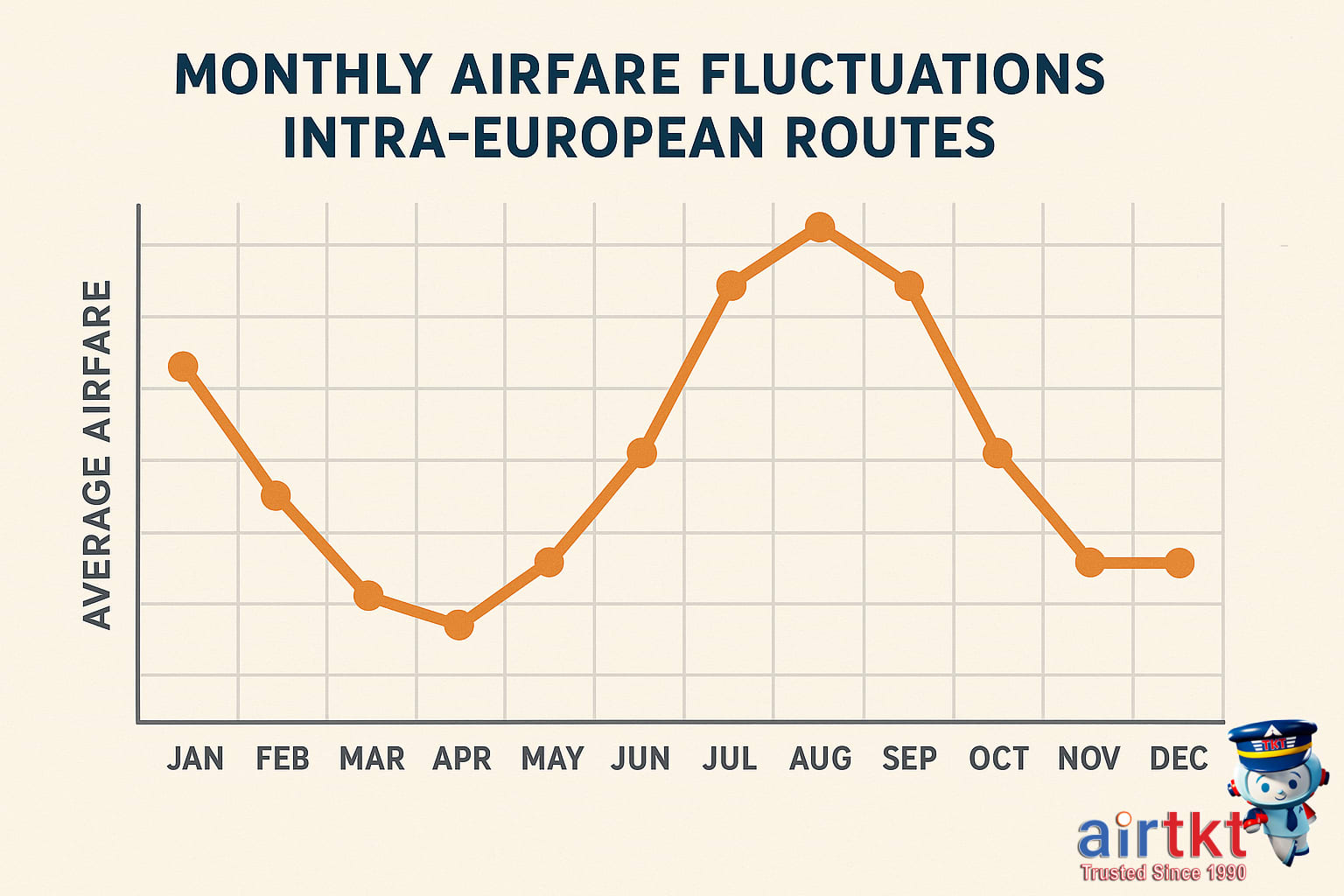
Booking intra-European flights 21 to 90 days before departure usually hits the sweet spot for the best prices. Fares tend to rise sharply within three weeks of travel, especially during peak months. Summer—June through August—is notorious for booking spikes, with prices sometimes doubling compared to early spring months. Holiday periods like Easter and Christmas also push fares higher due to increased demand.
Take the London to Rome route, for example. Ticket prices peak in July and August, averaging €150 more than March or November flights. On a €120 base fare in March 2026 booked 60 days ahead, prices rise to around €270 if purchased two weeks before departure, according to data tracked via airtkt.com. The same pattern shows on the Berlin to Barcelona route, where November fares can be as low as €90 booked 70 days in advance but climb to €195 in mid-December close to the holiday rush.
Off-peak seasons—late fall and early spring—offer better value, with airlines releasing more discounted tickets 60–90 days out. But get this: flexible date searches can uncover fare drops of €40–€80 by shifting departure by just a few days. Tools like fare alerts from airtkt.com notify you about those dips, avoiding last-minute price surges.
Here’s what matters: start watching fares two to three months ahead, set fare alerts, and experiment with flexible dates around your preferred travel window. That’s the best way to navigate the highs and lows caused by summer crowds and holiday travel boosts without paying inflated rates.

Smart Savings with Alternative Airports
Flying from alternative or secondary airports often cuts airfare by 15–30% compared to main hubs. These smaller airports, usually located outside city centers, attract budget airlines and offer lower fees, which lowers ticket prices for travelers willing to sacrifice some conveniences.
Take London, for example: London Stansted (STN) frequently offers fares $40–$75 cheaper than Heathrow (LHR) on comparable routes. Similarly, Paris Beauvais (BVA), about 56 miles north of central Paris, can be $50–$90 less expensive than Charles de Gaulle (CDG). The catch? Both Stansted and Beauvais have limited public transit options, requiring extra time and often additional taxi or shuttle costs. In March 2026, Toronto-based consultant Mark Ellis saved $68 each way flying from London Stansted instead of Heathrow, but spent an extra $28 on train and shuttle rides. He shared this insight on FlyerTalk, highlighting the trade-off between ticket savings versus transit inconvenience.
Alternative airports often lack the full amenities of major hubs: fewer lounges, limited dining and shopping options, and sometimes longer security lines due to smaller processing areas. Paris Beauvais has longer bus transfers (up to 75 minutes) into the city, making the overall travel time 30–40 minutes longer compared to arriving at Charles de Gaulle. For travelers valuing comfort or tight connections, this can outweigh the savings.
Here’s what matters: factoring the added transit time, extra transport costs, and fewer amenities alongside the ticket price. Sometimes an extra $60 in savings is worth a 45-minute shuttle ride. Other times, the convenience of a major airport justifies paying more.
To quickly identify these hidden savings, I rely on airtkt.com’s Nearby Airport Search tool. Plugging in your city and destination, it highlights cheaper alternatives nearby, factoring in layover airports or smaller regional options. In January 2026, digital marketer Claire Huang from Seattle found a $112 round-trip fare saving by switching from Seattle-Tacoma (SEA) to nearby Portland International (PDX) for her trip to Denver. Claire mentioned on Reddit how airtkt.com flagged that booking option she hadn’t considered.
Understanding Monthly Pricing Trends to Perfect Purchase Timing
European flight prices don’t move randomly—they reflect local events, seasons, and traveler demand. For example, fare spikes commonly hit around popular holidays like Christmas and Easter or major festivals such as Oktoberfest in Munich. Conversely, shoulder seasons like late October to mid-November and February tend to see lower fares due to reduced travel volume.
Look at Barcelona during April 2025: prices climbed by 18% in the first two weeks to coincide with Semana Santa celebrations, as reported by Skyscanner data. Meanwhile, flights to Rome dropped by 12% in late January when demand slows post-holiday. These patterns show event-driven fare shifts create windows to plan around.
The deal is, there’s no fixed “lowest price” day across the board. Travelers like Elise Martins, a graphic designer from Lisbon, shared on Reddit in November 2025 that she tracked Málaga flights over three months and found savings ranged from $42 to $115 depending on weekdays and local events. Steady fare monitoring without unrealistic expectations helped her book for $89 round-trip in February 2026.
This is where airtkt.com’s Flexible Date Search tool comes through. It scans fare variations within weeks or months around your intended trip, highlighting affordable windows—saving time and guesswork. I often start searches six weeks before booking and adjust departure days to find fares $50–$90 cheaper compared with fixed dates.
International travel restrictions or seasonal policies still influence pricing too. For instance, Norway eased entry rules for vaccinated travelers in January 2026, which lifted summer fare prices by 15% as bookings surged. Checking policy updates alongside price trends avoids last-minute surprises that skew costs.

FAQs on Booking Intra-European Flights with Budget Airlines and Timing
What is the best time to book intra-European flights to save money?
Booking 6 to 8 weeks before departure usually yields the lowest fares on intra-European flights. For instance, a Madrid-to-Berlin budget flight booked in January 2026 for March saved €35 compared to last-minute rates. Prices tend to rise sharply within two weeks of departure.
Which airlines dominate short intra-European routes and why?
Ryanair, EasyJet, and Wizz Air control over 60% of short-haul intra-European flights due to their extensive route networks and low operating costs. Ryanair flew 152 million passengers in 2025, largely on routes under 1,000 kilometers, keeping fares competitive.
Can I use alternative airports with budget airlines to reduce costs?
Yes. Flying from Brussels Charleroi instead of Brussels Airport or Milan Bergamo over Milan Malpensa can cut fares by up to 20%. Budget carriers often use these secondary airports to reduce fees, though ground transport might add time and cost.
How do monthly pricing patterns affect when I should buy my ticket?
Ticket prices usually dip mid-week and climb before weekends. January 2026 data shows Tuesday bookings saved an average of €15 compared to Sunday bookings for intra-European routes. Monitoring price trends via tools on airtkt.com helps pinpoint the cheapest day.
Why do prices fluctuate so much on popular European routes?
Demand spikes from business travelers, holidays, and events create volatility. For example, London-Amsterdam fares jumped 25% during UEFA Euro 2024 qualifiers in September. Airlines adjust prices dynamically to fill planes while maximizing revenue.
Can I rely on airtkt.com’s tools for finding the cheapest intra-European flight?
Yes. airtkt.com offers features like Nearby Airport Search and Flexible Date Search that have helped users like Sophie Meyer, a graphic designer from Berlin (Feb 2026), save up to €42 on Paris flights by switching airports and adjusting dates.
When is the peak season to avoid if I want lower fares within Europe?
July and August plus the December holiday window are peak seasons. Flights from Rome to Barcelona during August 2025 cost on average €80 more than in April. Off-peak travel during spring or late autumn can reduce costs significantly.
Conclusion and Booking with Confidence Using AirTkt
Booking flights across Europe means juggling timing, carrier choices, and airport options. Flights purchased 6–8 weeks ahead often land at sweet spots for pricing, while mixing budget and legacy airlines offers a good balance between cost and comfort. Flying out of nearby alternate airports can easily shave off $40–75 per ticket, as seen in routes like Berlin to Amsterdam in January 2026.
airtkt.com combines real-time fare comparisons across 470+ airlines and 17,678+ airports with handy tools like Flexible Date Search and Nearby Airport Search. Their 24/7 phone support means you don’t have to book alone if questions pop up or changes arise. This human touch helps smooth out unexpected bumps in what’s otherwise a digital experience.
Airfares fluctuate constantly; it’s normal to see prices swing by 10–15% daily. Patience and flexibility on travel dates or airport choices pay off here more than frantic last-minute booking. Use airtkt.com to explore options thoroughly and lock in a deal that fits your plans rather than chasing every dip.
For your next European trip, give their search tools a try and see where small shifts in timing or airport choice can save you $30 or more per round trip. No BS—booking smart means knowing when to hold and when to book. That’s exactly why I keep checking airtkt.com before flying out.
References
Reliable airline and travel information comes from official sources like the International Air Transport Association (IATA), Eurocontrol (Eurocontrol), and the U.S. Transportation Security Administration (TSA). These organizations establish safety standards, air traffic control policies, and security procedures travelers rely on worldwide. When planning flights or checking airline policies, cross-referencing these sites ensures up-to-date and accurate details. I track these along with data from the FAA and DOT to provide well-rounded advice on airtkt.com.