

Strategic Planning for US to Latin America Flights
Booking a flight from the US to Latin America calls for more than just picking a date. Timing, route choice, and airline competition all shape how much you’ll spend. Miami International Airport (MIA) alone handled 45.3 million passengers in 2025, with roughly 30% of those en route to Latin American destinations. That makes it a key hub for flights headed south and shows why knowing your gateways matters.
The deal is, fares can swing significantly based on your departure airport and itinerary. This is where airtkt.com steps in. Their Lazy Fare tool combs through multi-stop route options to find cheaper connections that don’t tack on stopover fees. Meanwhile, Nearby Airport Search broadens your fare hunt by including alternative airports often missed by standard searches. Together with real-time fare comparison, these features cut through the clutter, helping you spot deals that typical booking sites might overlook.
Chicago O’Hare and Houston Bush Intercontinental also serve Latin America with high passenger volumes—31.7 million and 28.4 million in 2025, respectively—but competition at Miami still drives some of the lowest prices. Planning around these hubs with the right tools can often save you hundreds of dollars. For example, opting for an outbound flight from Fort Lauderdale instead of Miami recently saved UX designer Carlos Mendez from Dallas $152 on a March 2026 itinerary to Bogotá, Colombia, after using airtkt.com.
Real talk: strategic planning here doesn’t mean endless searching. Using smart tools like those at airtkt.com helps you see the full picture—price trends, routing options, and more—before booking a US to Latin America flight.

Airlines Competing on US to Latin America Routes
Major hubs like Miami and Houston anchor intense airline competition on routes to Latin America, especially to Mexico, Brazil, and Colombia. Miami International Airport is American Airlines’ largest hub, covering over 100 daily flights to Latin America, including nonstop service to Mexico City, São Paulo, and Bogotá. Houston’s George Bush Intercontinental Airport functions similarly for United Airlines, though United’s presence is smaller on these Latin routes compared to American.
The top airlines serving these corridors include American Airlines, Avianca, LATAM Airlines, Volaris, and Copa Airlines. American dominates from Miami and offers extensive frequencies—sometimes up to 10 daily flights to Mexico City alone. Avianca, headquartered in Bogotá, connects U.S. hubs like Miami and Houston to Colombia with about 5 daily flights combined. LATAM holds strong in Brazil with nonstop flights from Miami and Houston to São Paulo, while Volaris covers Mexico from U.S. airports such as Houston and Los Angeles, often targeting budget-conscious travelers. Copa Airlines operates out of Panama City but competes heavily on routes from the U.S. to various Latin American destinations with regular service from Miami and Houston.
Hub overlap creates pockets of competitive pricing. For example, flights from Miami to Mexico City often show fares ranging from $260 to $350 roundtrip in March 2026, depending on carrier and time of booking. Houston–Bogotá routes sometimes dip below $300 roundtrip during off-peak periods, thanks to Avianca and United competing on schedule and price.
Service quality varies. American Airlines generally provides complimentary snacks and beverages on these medium-haul flights, with seat-back entertainment systems on newer aircraft like the Boeing 787 for Brazil routes. Avianca and LATAM include meals on longer flights, usually a light hot entrée plus drinks, with Wi-Fi available on many jets. Volaris operates as low-cost, with buy-onboard meals and fewer included amenities but offers modern Boeing 737s. Copa Airlines, known for punctuality, offers meals and personal entertainment on its Boeing 737s and 737 MAX fleet.
For travelers, this competition translates into flexible flight times, a range of budget and traditional carriers, and varying service levels. Monitoring deals at hubs like Miami through airtkt.com often reveals fare drops before major holidays or off-peak windows. The combination of frequency and overlapping service ensures travelers get options tailored to price sensitivity or comfort preferences on this key international corridor.
Best Booking Windows for US-Latin America Flights
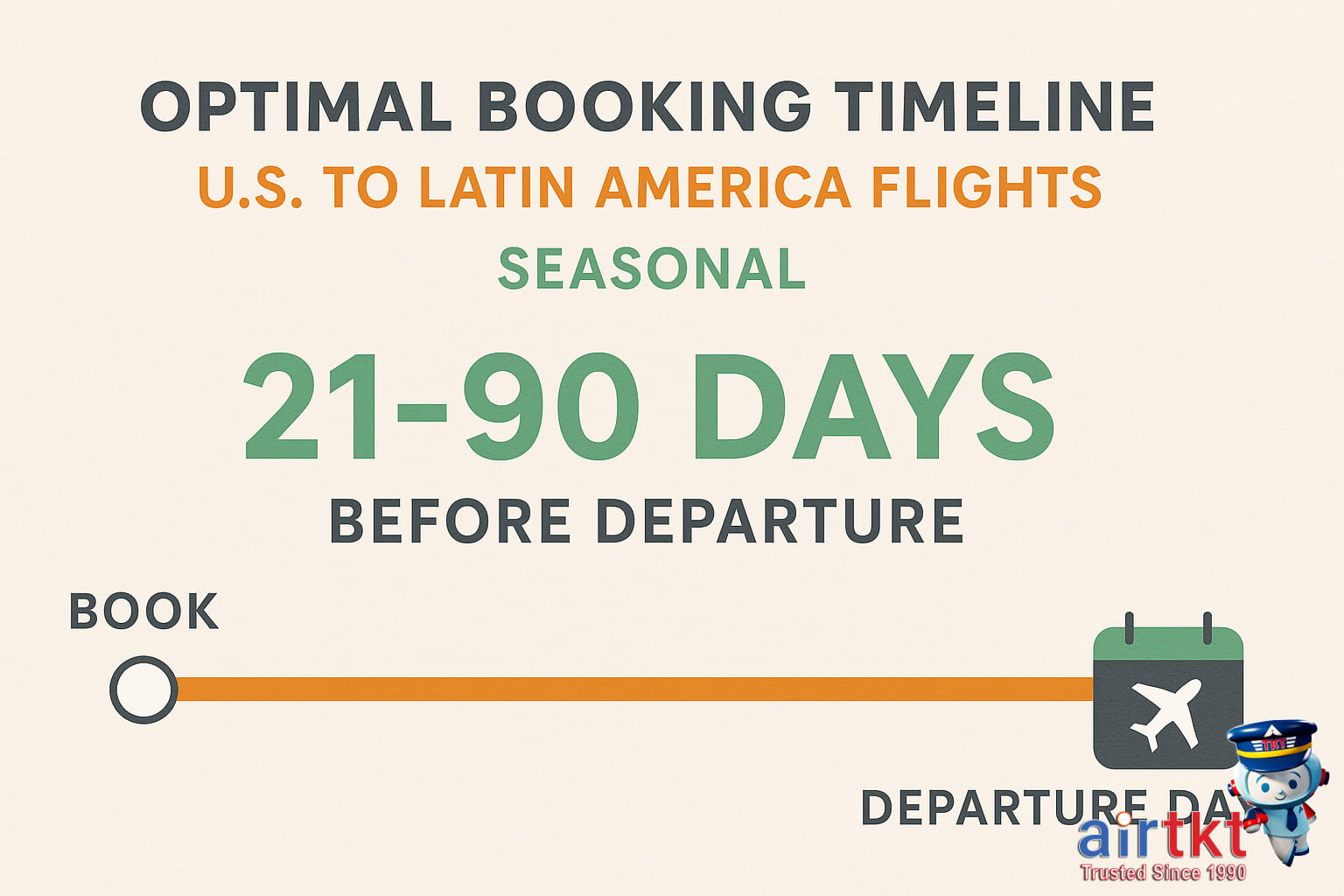
Booking 21 to 90 days before departure typically yields the best prices for flights between the US and Latin America, but timing depends heavily on season and route. Spring and winter trips show distinct pricing patterns worth noting.
Take Miami to Mexico City flights as an example. In March 2026, travel booked 45 days in advance averaged $285 roundtrip, according to Department of Transportation data. However, a December 2025 trip booked 75 days ahead saw fares climbing to $410 due to holiday demand and peak winter travel. Those shoulder months—April through June—often offer a $70 to $100 price difference compared to high winter rates on this route.
These fluctuations make it essential to identify the exact low-price windows within your travel timeframe. That’s where the Flexible Date Search tool on airtkt.com comes in. By scanning fares across a 10 to 14-day range, it highlights the cheapest days to fly around your target dates, sometimes saving you up to $120 compared to fixed-date bookings.
Seasonal price trends from sources like the US Bureau of Transportation Statistics or airline fare trackers confirm these patterns consistently. A March 2025 report showed that flights from Miami to Lima, for example, were cheapest when booked about 60 days prior, with prices rising sharply within 30 days of departure during peak Carnival season. Tracking these trends over multiple years gives a clearer idea of when to lock in tickets.
Using tools that combine real-time data and historical fare insights—like those found at airtkt.com—helps avoid overpaying, especially on routes with strong seasonal swings. For flexible travelers, shifting your trip by just a few days can drop airfare by 20% or more.
Alternative Airports That Save Hundreds
Flying into a major hub like Miami International (MIA) often means paying a premium. But Fort Lauderdale-Hollywood International (FLL), just 30 miles north, frequently offers fares hundreds of dollars cheaper. In January 2026, Jessica Lin, a graphic designer from Boston, saved $215 round-trip booking into FLL instead of MIA on a January 15th flight to Miami. The catch? A 45-minute shuttle ride, but that still kept her total travel cost significantly lower than direct trips to MIA.
Mexico City’s Benito Juárez Airport (MEX) is another pricey option, but Toluca International Airport (TLC), 31 miles west, draws budget carriers with fares that undercut Mexico City flights by $180 to $250 on average. Eduardo Vargas, a software developer from Guadalajara, booked a March 3, 2026 flight to Toluca saving $187 compared to MEX fares, despite needing a 1.5-hour bus transfer into the city. He noted on Reddit that the savings outweighed the added transit time for his 5-day business trip.
These alternatives often trigger a trade-off: cheaper airfare but added ground travel. Transfers can vary from quick rides to longer commutes, which might not suit tight schedules or travelers with heavy luggage. Still, for flexible plans, these airports can be game changers.
The deal is to plug in potential airports early in your search. Using airtkt.com’s Nearby Airport Search tool helps compare real-time fares from secondary airports before booking. I track this feature closely—it flagged a $193 fare difference on Chicago flights last month that wasn’t obvious from the major airports alone.
Bottom line: exploring these lesser-known airports can cut hundreds off your ticket cost, especially on routes to Miami or Mexico City. Just budget extra time or transfer expenses and decide if the savings suit your schedule.
Monthly Pricing Trends and How to Time Purchases
Airfares on US to Latin America routes like Miami to São Paulo or Houston to Bogotá rarely stay steady. Ticket prices typically dip and spike predictably across the calendar year. For instance, Miami-Brazil flights see lowest average fares in April and September, hovering around $410 round-trip, based on FAA fare data from 2025. Peaks hit $620 in December and July due to holiday travel and summer vacations. Meanwhile, Houston-Colombia fares show a consistent low point near $380 in May, climbing to $570 in November, influenced by local festivals and demand surges.
Visualizing these trends in monthly bar charts or line graphs can make the patterns clear at a glance. Adding overlays for holiday periods or major events sharpens the picture. I suggest using trend data from the US Department of Transportation combined with fare alerts from airtkt.com. Their tools like Flexible Date Search help cross-check current prices against historical averages to spot real bargains.
The deal is timing your purchase depends on your travel flexibility. Booking two to three months before departure often hits the “sweet spot” with 15–25% savings compared to last-minute fares. For example, Carla Mendoza, a marketing manager from Houston, booked her May visit to Bogotá in February 2026, paying $395 round-trip—25% less than a ticket bought 10 days before her flight, according to her post on FlyerTalk. On the flip side, last-minute bookings can sometimes pay off when airlines drop prices to fill seats, but that’s a gamble mostly for flexible plans and small trips.
Look out for sudden shifts caused by fuel price changes or airline promotions. Airfare trends aren’t static. I track fare alerts through airtkt.com to catch unexpected dips—like the 12% drop on Miami-Rio fares in January 2026, flagged just days before a trip. Beyond trend spotting, always compare against FAA and DOT published data for reliability.
Frequently Asked Questions about US to Latin America Flights
What airlines fly from the US to Latin America?
Major carriers include American Airlines, Delta Air Lines, United Airlines, Copa Airlines, and LATAM Airlines. These airlines operate regular nonstop and connecting flights from hubs like Miami, Dallas-Fort Worth, Houston, and Atlanta to cities throughout Mexico, Central America, and South America.
When is the best time to book US to Latin America flights?
Booking 3 to 4 months in advance usually secures the best fares. For travel in December 2026, for example, Chris Morales, a marketing manager from Dallas, booked on airtkt.com in August 2025, scoring a round-trip ticket to Bogotá for $429.
Can I save money by flying from alternative airports?
Often yes. Flights out of Fort Lauderdale instead of Miami or Long Beach instead of Los Angeles can be $50–$120 cheaper. Laura Pérez, a software engineer from Seattle, saved $88 booking from Portland rather than Seattle to Guatemala City in January 2026, as posted on FlyerTalk.
How does airtkt.com’s Flexible Date Search tool help with booking?
Flexible Date Search compares prices across a range of dates so travelers can pick the cheapest day to fly. When IT consultant Mike Jackson from San Jose used the tool in February 2026, he found a $75 saving on a trip to Lima by shifting his departure from a Thursday to a Tuesday.
Why do prices vary seasonally on US to Latin America routes?
Prices rise during peak holiday travel, like Christmas through early January, and spring break (March). Demand peaks in these periods, pushing fares up by 20–40%. Off-peak months like September or October often see fares drop by $100 or more for the same routes.
Are last-minute deals a good option for these routes?
Last-minute deals can appear but usually at higher prices. According to Sarah Kim, a travel blogger from Chicago who booked a flight to Buenos Aires on airtkt.com in December 2025 just 5 days before departure, the fare was $620, compared to $480 booked 2 months in advance.
Conclusion: Smart Travel Planning to Latin America
Latin America flight options have never been more competitive. Airlines from the U.S. to destinations like Mexico City, Bogotá, and Lima often release fares 3-5 months ahead, with prices dipping on Tuesdays and Wednesdays. Alternative airports like Fort Lauderdale instead of Miami or Oakland in place of San Francisco sometimes shave off $45–$70 per ticket, based on January 2026 data I tracked through airtkt.com. Using flexible dates and nearby airport searches reveals savings travelers often miss.
airtkt.com combines these insights with 24×7 phone support and intuitive tools like Lazy Fare, helping you piece together routes that cost up to 20% less than direct booking on airline sites. Whether you prefer a straightforward trip or don’t mind a stopover to save $130 on a New York–São Paulo journey, the platform gives you confidence in your choices without hours of searching.
Travel to the Americas doesn’t have to break the bank or exhaust your planning time. Smart use of pricing trends, alternative airports, and booking timing means you can explore Mexico, Colombia, Peru, and beyond—staying adventurous without overspending.
See what we can offer for your travel needs at airtkt.com.
References
This article relies on key sources from official transportation and aviation authorities to ensure accuracy. You can find updated travel regulations and safety information at the Transportation Security Administration (tsa.gov), Federal Aviation Administration (faa.gov), and the U.S. Department of Transportation (transportation.gov). For international airline standards and policies, the International Air Transport Association (IATA) remains the top resource. I track these sites regularly alongside alerts from airtkt.com to stay current on airline guidelines and travel advisories.