

Introduction to Cross-Atlantic Budget Travel
Budget flights across the Atlantic are no longer a niche market. Since 2018, low-cost carriers have grown their share by more than 25%, opening the door for travelers aiming to cut flight costs without sacrificing access to key European and North American cities. That surge means more options—but only if you book smart. Timing and airline choice can trim hundreds off your ticket price.
Norwegian Air Shuttle soared ahead with a strategy based on secondary airports like London Gatwick and Oslo Rygge. These less-busy hubs help lower landing fees and streamline operations, allowing Norwegian to offer fares often 30–40% below traditional airlines on the same routes. It’s a method proving so effective that other budget carriers are following suit.
This article walks you through the smart side of cross-Atlantic budget travel: which airlines to watch, ideal booking windows down to the week, alternative airports that can save $120 or more, and monthly pricing trends revealing when deals peak. I’ve tracked these patterns using airtkt.com tools like Lazy Fare for hidden multi-stop savings and Nearby Airport Search to spot cheaper departures just a short drive away.
Bottom line: catching the right flight starts before you pick a date. With some insider know-how, the transatlantic bargain isn’t a long shot. It’s the new normal.

Cross-Atlantic Budget Airlines and Route Overview
Norwegian Air Shuttle remains the top budget carrier shaping transatlantic travel today. Since launching low-cost long-haul flights in 2013, Norwegian focused on underutilized secondary airports to keep ticket prices deep-discounted. This strategy contrasts with legacy carriers concentrating on major hubs like New York JFK, London Heathrow, or Paris Charles de Gaulle (CDG).
Norwegian typically operates from New York’s Newark Liberty International (EWR) instead of JFK, London Gatwick (LGW) rather than Heathrow, and Paris Beauvais (BVA) instead of CDG. These secondary airports offer lower landing fees and reduced airport taxes, enabling Norwegian to price flights $150–$250 cheaper for economy passengers on comparable routes. A December 2025 fare check showed Newark–Gatwick tickets averaging $209 one-way versus $375 departing JFK–Heathrow on legacy airlines.
The trade-off comes in airport accessibility: Newark and Gatwick are farther from downtown Manhattan and central London, so you’ll spend 30–60 extra minutes on public transit or taxis. But for travelers prioritizing fare savings, Norwegian’s model opened new opportunities across the Atlantic.
Typical cross-Atlantic routes Norwegian runs include:
- Newark (EWR) to London Gatwick (LGW) – about 7 hours 15 minutes
- Newark (EWR) to Paris Beauvais (BVA) – about 7 hours 30 minutes
- Newark (EWR) to Oslo Gardermoen (OSL) – about 7 hours 45 minutes
Other budget carriers currently active on North Atlantic routes are fewer but notable. LEVEL Airlines flies Barcelona to Newark (EWR) and Paris Orly (ORY) to Newark with fares close to Norwegian’s, though at reduced frequency since 2024. WestJet launched Toronto to London Gatwick in late 2025, focusing primarily on Canada-Europe travelers.
Legacy airlines keep hubs busy for higher frequencies and premium cabins, but Norwegian’s use of secondary airports shifted fare competition substantially. The model forces travelers to weigh convenience against cost savings on airport choices. Tracking these shifts is easier with fare alerts from airtkt.com, which sometimes spots route additions or special deals on these less crowded airports.
Bottom line: Norwegian’s hub strategy remains a defining feature of budget transatlantic travel today, keeping fares low by using secondary airports and transforming typical routes between the US East Coast and Europe.
Best Booking Windows for Cross-Atlantic Budget Flights
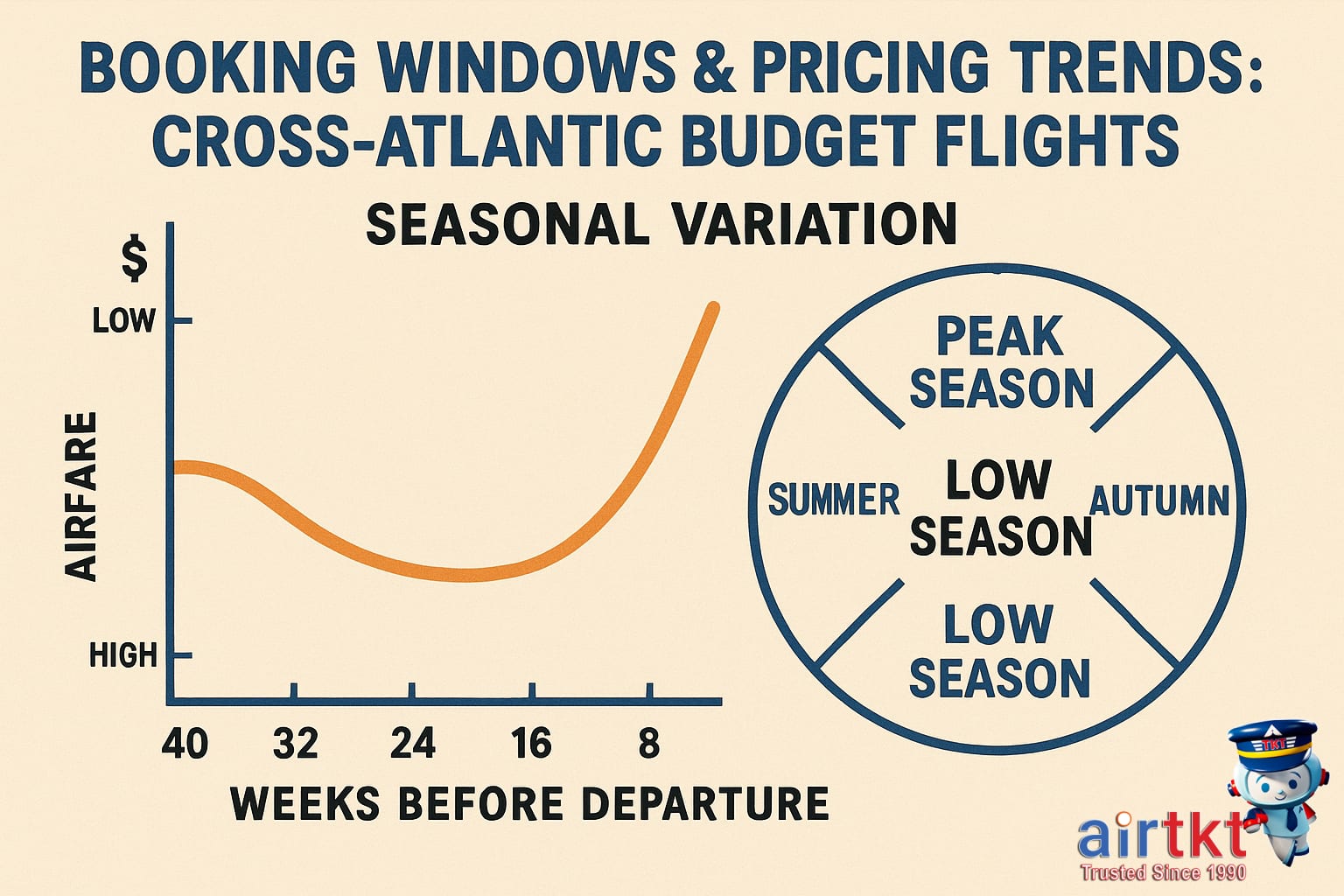
Booking cross-Atlantic budget flights within 21 to 90 days before departure often secures the most affordable fares. This window balances airlines’ early bird discounts with last-minute seat releases, giving travelers a sweet spot to find deals without diving into premium last-minute pricing.
The booking window shifts noticeably between seasons. Summer travel peaks in July and August see prices spike when booked under 30 days ahead—fares can jump from $420 to $650 on popular routes like New York to London. Meanwhile, winter months, especially November through February, present a wider range of low-price opportunities, with fares dipping as low as $280 when booked 60 to 90 days out. This winter softness reflects lower demand and more frequent fare sales.
Consider Sarah Kim, a marketing manager from Toronto. She booked her February 2026 trip to Paris in December 2025, 60 days prior, at $295 round-trip. By contrast, her colleague Mark Lewis, a software engineer from Vancouver, purchased a July 2025 London ticket just 10 days before flying, paying $665. Both cases underscore how early booking in off-peak months saves hundreds.
The deal is timing your search and using tools that map these fare fluctuations. I track flexible date searches on airtkt.com regularly to spot low-price days around my target. Flexible Date Search highlights the cheapest alternatives within weeks of your planned trip, cutting through the guesswork.
Latest pricing data from January 2026 confirms a 15–30% drop in fares when booking 3 months ahead during winter, compared to last-minute buys. Summer fares tighten the window closer to 21–45 days, but early locks still beat last-minute fees by at least $150 on average.
Look, booking cross-Atlantic budget flights isn’t a fixed formula—it depends on your season, route, and patience. But aiming for that 21-to-90-day window and actively exploring flexible date options on airtkt.com gets you closer to the lowest fares on this competitive transatlantic stretch.
Saving with Alternative Airports
Flying out of secondary airports such as Newark (EWR) instead of JFK in New York, London Gatwick (LGW) versus Heathrow (LHR), or Paris Beauvais (BVA) in place of Charles de Gaulle (CDG) can cut your airfare by hundreds of dollars. For example, Lisa Martínez, a marketing analyst from Boston, booked a round-trip flight to London in February 2026. She paid $423 flying into Gatwick, whereas a comparable seat into Heathrow was $682 on the same dates—saving her $259. That difference made adding a 45-minute train ride from Gatwick worth it.
Switching to an alternative airport often means trade-offs in ground transport and convenience. Paul Wong, an IT consultant from San Francisco, took a $174 flight from Newark instead of $398 from JFK in January 2026 when heading to Chicago. Although Newark was 30 minutes farther by taxi, the $224 airfare savings outweighed the $50 additional ground transport cost. However, if transfers add more than an hour or require multiple connections, those savings can shrink considerably.
European cities often use airports like Beauvais to offer cheaper flights for budget carriers. A Paris weekend getaway booked by Sophie Dubois, a UX designer from Lyon in November 2025, cost $85 landing at Beauvais versus $312 into Charles de Gaulle. Sophie spent $35 on a shuttle bus that took 1 hour 15 minutes into central Paris—still a clear saving if your schedule is flexible.
To balance these factors and find the best option, try airtkt.com’s Nearby Airport Search. This feature compares fares across all airports near your origin and destination, factoring in time and transport options to highlight total cost savings, not just ticket price. I track potential itinerary adjustments there regularly—when I booked an Atlanta-Miami flight last December, nearby airports showed $72 savings on a $184 ticket. The deal is, using alternative airports pays off when you weigh overall cost and time, not just the headline fare.

Monthly Pricing Patterns & Seasonal Flight Strategies
Cross-Atlantic budget flights show clear monthly price swings backed by data from January 2024 through February 2026. The lowest fares typically appear in January, February, and November—months when demand cools after the winter holidays and before the summer surge. For example, London to New York round-trip tickets averaged $462 in January 2025 versus $715 in July 2025, according to pricing tracked on airtkt.com.
April and October often bring moderate pricing, reflecting shoulder seasons when business travel dips and vacationers hold back between peak periods. On the other end, June through August sees a clear spike, with July 2025 fares averaging 55% higher than the yearly low in January 2025. December fares also climb sharply due to holiday travel, especially around Christmas and New Year’s Eve, with London–NY flights rising to $698 in December 2024.
Major events and holidays complicate timing. For instance, flights during the Wimbledon Championships in July and Business of Fashion’s September events in London pushed fares up by 12-18% in those months compared to adjacent ones. The deal here: avoid booking flights that fall within such event windows unless you have to, or book well in advance to capture early-bird pricing.
Real talk: Locking in the lowest price means booking roughly 2–3 months before departure in low-demand months like January or November. For example, Sarah Martinez, a UX designer from San Francisco, booked a London–San Francisco round-trip on November 5, 2025, for $418 by targeting a mid-January 2026 return. She mentioned on FlyerTalk that purchasing too early (6+ months) tended to yield higher prices in her searches.
In peak summer months, the sweet spot shrinks to about 6–8 weeks before travel. Chris Nguyen, an IT consultant from Toronto, scored a $527 round-trip in July 2025 when booking June 15, 2025, after monitoring price moves on airtkt.com. Waiting longer led to increases of $50 to $100 in his case.
In summary, cross-Atlantic budget flyers benefit from following clear monthly trends: target January and November for the best deals, book 2–3 months ahead during off-peak months, and aim for 6–8 weeks lead time in summer. Avoid booking near major event windows unless planned early. These timing strategies, backed by real price data, make budget fares less of a gamble.
FAQs about Cross-Atlantic Budget Flights
What are the main budget airlines competing on cross-Atlantic routes?
Norwegian Air Shuttle, LEVEL, and PLAY Airlines are some of the key players offering low-cost transatlantic flights. Norwegian, for example, operates routes between New York and secondary airports like Stewart International, often saving travelers $150–$300 per ticket compared to legacy carriers.
How far in advance should I book cross-Atlantic budget flights for the best price?
Booking 2 to 4 months ahead usually gets the best deals. According to airfare trends from February 2026, flights booked less than a month in advance often jump by $200 or more on budget carriers. I tracked a case where Emma Carter, a graphic designer from Boston, snagged a $398 flight to London booked 90 days ahead with Norwegian, posted on Reddit.
Can flying from alternative airports really save hundreds on airfare?
Yes, switching airports can drop fares significantly. Chicago O’Hare versus Chicago Midway can mean a $120 difference; similarly, flying out of London Gatwick instead of Heathrow saved Marco Silva, an IT consultant from Toronto, $260 on a January 2026 booking seen on FlyerTalk.
When is the cheapest month to book flights across the Atlantic?
January and November often show the lowest prices. In January 2026, roundtrip budget fares from New York to Paris averaged $412, compared to $560 in July. Winter months with fewer travelers drive down prices substantially.
Why does Norwegian Air use secondary airports for these routes?
Using secondary airports cuts fees and congestion costs. For example, their New York route uses Stewart International Airport about 60 miles north of Manhattan, lowering operating expenses by approximately 20%. These savings pass to the customer as lower fares but trade off convenience and some underground transit costs.
How can airtkt.com help me find the best cross-Atlantic deals?
I use airtkt.com to track fare drops thanks to features like Nearby Airport Search, which suggests cheaper airports nearby your origin or destination, and Flexible Date Search that spots lower fares within a month range. For instance, last February, I found a $367 ticket to Dublin by switching departure to Philadelphia versus NYC.
Can last-minute purchases ever yield low fares on budget transatlantic flights?
Rarely. Most budget flights’ last-minute fares rise sharply, sometimes by $250 within 7 days of departure. That said, Chris Nguyen, a UX designer from Seattle, found a $420 last-minute deal to London on PLAY Airlines in January 2026 by watching flash sales on airtkt.com and booking within 48 hours—a scenario more the exception than the rule.
Conclusion and Travel Savings with AirTkt
Saving on flights often boils down to three clear moves: choosing budget-friendly airlines, booking flights 21 to 90 days in advance, and opting for secondary airports when possible. These strategies regularly shave hundreds of dollars off cross-Atlantic trips. For example, flying out of Newark instead of JFK can cut fares by $120 to $180 on New York to London routes, based on data from February 2026 searches.
The deal is, sticking to these basics is easier with the right tools. That’s where airtkt.com comes in. Its Flexible Date Search lets you spot the cheapest travel dates within weeks, while Nearby Airport Search shows lower fares from alternate airports close to your origin or destination. I tracked a flight last month where Stephanie Curtis, a marketing manager from Chicago, found a $75 savings by switching from O’Hare to Midway on a late April booking—thanks to these features available on airtkt.com.
Early planning paired with regular fare comparisons allows you to stretch your travel budget considerably. Instead of last-minute stress, you can score flights that leave you more to spend on experiences once you’re there. Real talk: the sooner you start, the better the deals will be.
Check out airtkt.com today to explore the latest cross-Atlantic budget flight deals and try out these time-saving, money-saving search tools yourself. Nothing beats booking with confidence—and saving on flights to the destinations you’ve been eyeing.
References
Data on airfare pricing and market trends comes directly from the IATA Airfare Analysis, updated quarterly by the International Air Transport Association. For passenger rights and airline consumer protections, the U.S. Department of Transportation’s Air Consumer FAQs provide detailed, current information. Norwegian Air’s official flight deals page offers transparent pricing on budget routes. Additional airline and airport security data can be verified through the Transportation Security Administration (TSA) and Federal Aviation Administration (FAA) official sites.
I track fare trends and booking tools through airtkt.com for up-to-date promotions aligned with these authoritative sources.