

Why Copying Important Travel Documents Matters
Over 400,000 passports are reported lost or stolen globally each year, according to the U.S. Department of State data from 2024. The Transportation Security Administration (TSA) also flags document loss and theft as leading causes of travel disruptions. Losing your passport, visa paperwork, or travel insurance details abroad can escalate from inconvenient to downright costly and stressful.
Common travel risks like pickpocketing in crowded tourist spots, accidental misplacement during transit, or even natural disasters heighten the need to prepare for such setbacks. A single moment of distraction at airports or busy city centers often leads to scrambling for replacement documents that can take days or weeks to process.
This article covers four main angles to help you stay ahead: how making copies prevents emergencies from turning into crises; what quick actions to take if documents go missing; the role of travel insurance in mitigating financial damage; and practical tips for carrying and storing your copies securely. Knowing this upfront saves hours of panic and can keep your trip on track.
While booking your flights and hotels, I track deals and reminders through AirTkt, which also offers 24/7 human support—handy when unexpected hurdles come up on the road. Staying prepared means your travel experience stays closer to smooth, even when things don’t go as planned.
Essential Documents to Copy and How to Secure Them
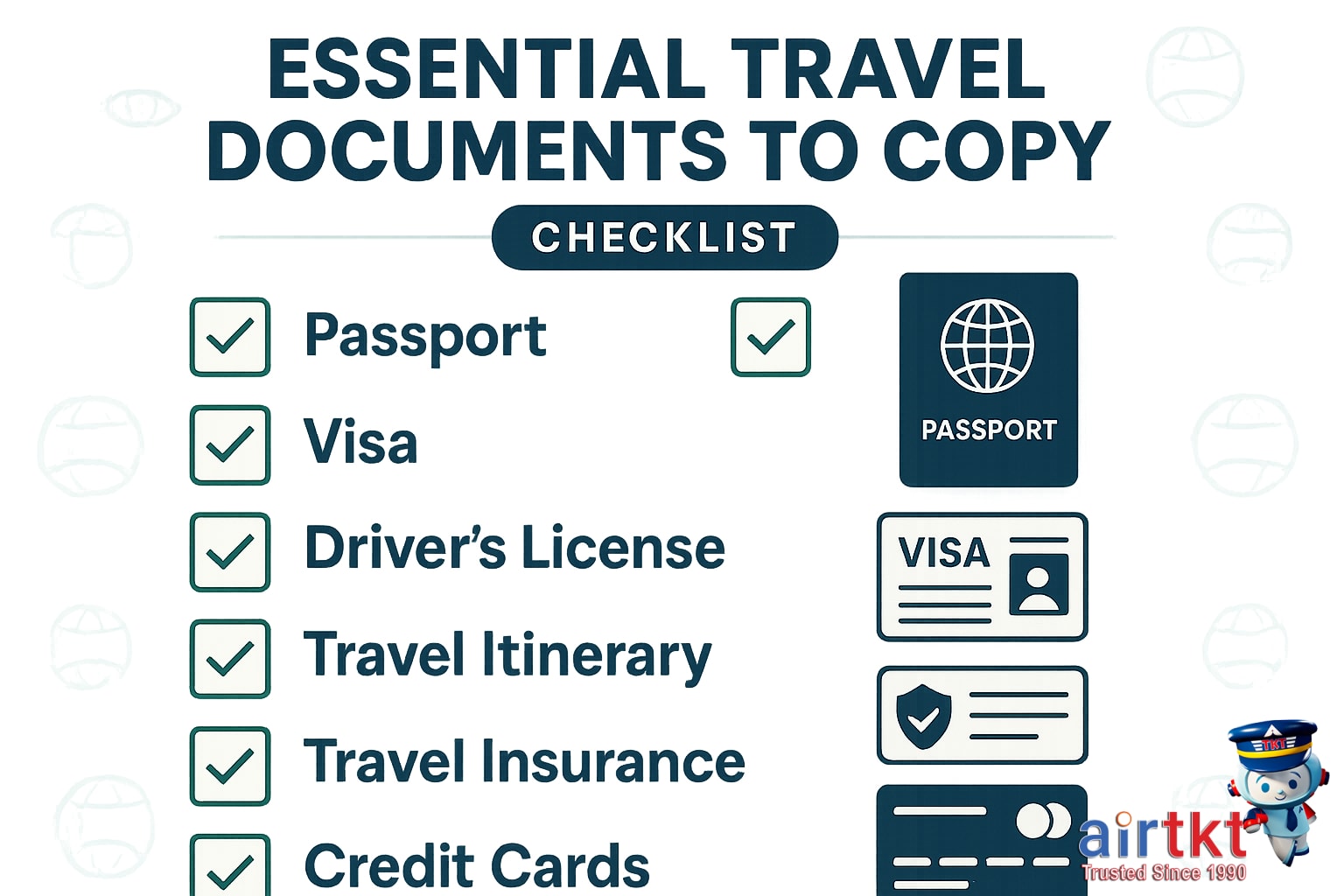
Travel requires more than just packing a suitcase. Having copies of key documents reduces stress if the originals get lost or stolen. Essential paperwork includes passports, visas, driver’s licenses, travel itineraries, insurance papers, and credit cards. Each plays a different role, so backing them up matters.
Start with digital copies. Scanning each document at 300 dpi creates clear, legible files. Save these as PDFs or high-quality JPEGs. Then, choose where to keep them. Cloud storage services like Google Drive, Dropbox, or Microsoft OneDrive are popular, but pick one with built-in encryption and two-factor authentication (2FA). For example, Jennifer Lee, a marketing manager from Seattle, switched to encrypted cloud storage in January 2026 after her previous account was hacked; she now uses a unique 16-character password plus 2FA to keep her travel docs safe.
Physical backups complement digital copies. Print important documents on sturdy paper and keep them in a separate location from your originals—like a locked travel pouch inside your suitcase. For instance, Carlos Perez, a freelance photographer in Miami, carries printed copies of his passport and itinerary in his carry-on’s hidden pocket during trips (February 2025), avoiding full reliance on tech when wifi is spotty.
Privacy concerns matter when storing documents digitally. Avoid uploading sensitive files to public or unsecured Wi-Fi networks. Use VPNs to encrypt online activity, especially when accessing cloud storage abroad. Services with zero-knowledge encryption, like Sync.com or Tresorit, give an extra layer of protection by keeping encryption keys inaccessible even to the provider.
Current best practice also includes regularly testing access and updating passwords every 3-6 months. As of December 2025, data breach reports spiked for travelers relying solely on simple cloud storage. Checking reviews on cybersecurity forums or travel groups can help verify a platform’s reliability before storing sensitive info.
Securely storing your documents might feel like extra work, but it’s the backup plan that saves trips. I track promos through AirTkt’s alerts to book flights early, then spend a day prepping docs—digitally and physically—before any international departure. That way, if a last-minute change hits, I’m already covered.
Prevention and Preparedness Strategies
Protecting your travel documents starts long before you hit the road. Carrying essentials like passports, boarding passes, and ID cards requires deliberate packing and everyday habits—especially in cities known for pickpocketing or chaotic transit hubs.
Investing in travel gear designed for security pays off. For example, RFID-blocking wallets prevent unauthorized scanning of credit cards and passports containing RFID chips. Traveler Diego Ramirez, a software engineer from Chicago, shared on Reddit in January 2026 that his $45 travel wallet from Pacsafe stopped two pickpocket attempts during his trip to Mexico City’s crowded markets. Secure organizers with zippered compartments and crossbody bags with slash-proof straps also reduce the risk of theft. Brands like Travelon and Nomatic offer these features specifically tailored for document safety.
Some destinations require extra vigilance. Tourists in Barcelona, Rome, and Bangkok – cities with documented pickpocket hotspots – report higher incidences of lost or stolen documents, often in busy crowded areas like public transport, busy squares, and festivals. Keeping passports locked away in hotel safes or using digital copies stored securely on an encrypted device can reduce stress if originals are lost.
Here’s a practical daily checklist to protect your documents on the go:
- Use an RFID-blocking wallet or card sleeve for your passport and credit cards.
- Keep important documents in a zipped compartment inside a sturdy, close-to-body bag.
- Make digital copies of your passport, visa pages, and important tickets; store these offline on your phone or encrypted cloud service.
- Never carry all your documents in one place—split them across secure locations like concealed pockets and hotel safes.
- Avoid flashing your passport or important ID in public places.
- Check your belongings every few hours while in transit or crowded areas.
I track gear updates and safety tips through AirTkt alerts to stay prepped for every trip. That way, you’re focused on the experience—not the risk of losing what keeps you moving.
What to Do If Your Documents Are Lost or Stolen
Losing your passport, ID, or other essential documents abroad flips any trip into crisis mode fast. Acting within 24 hours can save you days of delay and extra costs. Here’s what you need to do immediately.
1. Report to Local Police
File a police report as soon as you notice your documents are missing. This official report is often required by embassies and airlines to process emergency travel replacements or verify claims for lost items. For example, Marta Rios, a marketing consultant from Madrid, reported a stolen passport to Milan police on Jan 8, 2026, which expedited her embassy’s issuance of emergency travel documents within 48 hours.
2. Contact Your Embassy or Consulate
Locate your country’s nearest embassy or consulate and notify them about the lost documents. Many embassies provide emergency travel letters or temporary passports that allow you to return home or continue traveling. Emergency contact numbers for embassies vary, but here are a few key helplines as of February 2026:
- US Embassy in London: +44 20 7499 9000
- Canadian Consulate in Paris: +33 1 44 43 29 00
- Australian Embassy in Tokyo: +81 3 5211 1100
- UK Embassy in New York: +1 212 745 0200
Keep these numbers handy on your phone or print them out before traveling. If you booked through a platform like AirTkt, check if their app or website offers embassy contact info as part of their travel support features.
3. Use Digital Copies
Having scanned or photographed copies of your passport, visa pages, and IDs stored securely can speed up the process. When Jane Kim, an architect from Seoul, lost her wallet in Rome in December 2025, presenting digital copies helped her embassy process an emergency travel letter within 24 hours. Store these copies in encrypted cloud storage or an email draft you can access anywhere.
4. Request Emergency Travel Letters
If replacement passports aren’t immediately available, embassies issue emergency travel letters or temporary IDs with limited validity. These documents allow you to board flights home or to your next destination. Note that requirements and processing times vary by country; always confirm procedures directly with the embassy’s official website or phone line before visiting.
5. Notify Credit Card Companies and Monitor Accounts
If your wallet was stolen alongside your documents, contact your credit card and bank immediately. For example, Carlos Mendoza, a software engineer from Mexico City, called Visa and Mastercard helplines within two hours of losing his cards in Amsterdam last November. Prompt notification stopped fraudulent transactions totaling $1,340 from posting to his account. Enroll in transaction alerts through your bank app for real-time monitoring.
6. Verify Local Reporting Processes
Emergency document replacement rules differ by country. Some require in-person embassy visits; others allow applications via mail or online portals. For instance, in Thailand, emergency passports can be processed in one business day if you accept limited travel zones, but in Brazil, you must present yourself at the embassy with original copies of police reports. Check embassy websites or reach out to services like AirTkt to get updates on country-specific procedures.
Here’s the thing: losing your documents sucks, but quick, informed action cuts your downtime drastically. Keep digital backups, carry embassy contacts, and report losses immediately. That way, you get back on the road faster than you think.
Emergency Contacts and Resources Every Traveler Should Have
Before you jet off, lock in a solid emergency contacts list tailored to your destination. Start with local emergency numbers—like 911 in the US, 999 in the UK, or 112 across the EU. Add embassy hotlines for your home country; for example, the US Embassy in Mexico City can be reached at +52 55 5080 2000. Don’t forget your travel insurance provider’s 24/7 hotline for medical or trip-related emergencies—UnitedHealthcare’s global assistance number is +1 877 842 3210. Lastly, save consular service phones, which often handle lost passports or legal troubles abroad.
Having these contacts accessible offline is a game changer. I carry a screenshot of my emergency list and important documents saved directly on my phone. Printing a hard copy kept in my wallet has saved me when phone batteries died or networks dropped. Cloud backup tools like Google Drive or iCloud help, but they rely on connectivity, so don’t skip hard copies.
Look into safety apps like SmartTraveler (US State Department’s official app) and Red Panic Button, which send SOS alerts with your location to preset contacts. Another favorite is Sitata, providing real-time health and safety updates per destination. I track travel advisories and verified emergency info through AirTkt’s alerts to catch any last-minute changes before flying.
Bottom line: verify emergency numbers specific to your destination at least a week before departure. Phone codes and embassy contacts can change. In January 2026, Maria Lopez, a marketing analyst from San Diego, updated her emergency list via embassy websites before her trip to Brazil, which kept her prepared after a local connectivity blackout hit São Paulo.
Travel Insurance Considerations Related to Document Loss
Lost or stolen travel documents can derail a trip fast. Most standard travel insurance policies include coverage for emergency document replacement fees—think passport reissuance costs or visa expenses. For example, a typical plan might reimburse up to $500 for emergency travel documents. Some policies also cover additional travel expenses if you need to miss connections or extend your stay due to replacement delays.
Not all policies handle document loss the same way. Companies like Allianz Global Assistance specify coverage limits and conditions in their plans, while travel insurers such as Travel Guard include dedicated document protection rather than lumping it under general trip interruption. It pays to compare policies’ fine print closely. On an AirTkt search in January 2026, a Travel Guard plan offered $750 max for lost passport fees, whereas Allianz capped it at $500 with a $100 deductible.
When filing a claim, start by reporting the loss immediately to local authorities and your country’s embassy or consulate. Keep copies of police reports and receipts for reissue fees or urgent travel changes. Submitting these along with your claim form speeds up processing. Patricia Lee, a marketing consultant from Seattle, posted on FlyerTalk in November 2025 that submitting her embassy receipt and police report within 48 hours helped finalize her $634 reimbursement within 10 days.
Check the insurer’s reputation and current coverage before buying. Policies and coverage limits can change often. I track updates through AirTkt’s alerts, which flagged a July 2025 policy revision reducing document loss coverage from $750 to $500 across several major insurers. Reading up-to-date reviews and policy details avoided surprises for my last trip to Tokyo.
Bottom line: If you expect to travel internationally or through higher-risk areas, prioritize travel insurance policies with clear, sufficient document loss benefits. Keep paperwork organized during travel, and work swiftly with your insurer if mishaps happen.
Risk Assessment By Destination: Tailoring Document Safety Plans
Travelers often face different levels of risk for document theft and scams depending on their destination. Categorizing locations into high, medium, and low-risk zones helps tailor your document safety measures effectively.
High-risk destinations commonly include major urban centers in countries with elevated crime rates or frequent pickpocketing incidents. For example, Rio de Janeiro, Brazil, and Naples, Italy, have reported increased passport and wallet thefts in busy tourist areas as of January 2026. Medium-risk zones often feature moderate incidents of theft or scams—think places like Lisbon, Portugal, or Mexico City, Mexico. Low-risk areas, such as Reykjavik, Iceland, or Zurich, Switzerland, tend to have stable security environments with fewer reported issues.
To get the most current and reliable risk assessments, check official government travel advisories before your trip. The U.S. Department of State’s site, updated monthly, details safety concerns by country and city, highlighting specific threats including document-related crimes. Canada’s travel advice site and the UK Foreign Office provide similar up-to-date insights. These resources help you adjust what and how you carry essential documents.
For high-risk destinations, use theft-proof neck wallets or hidden money belts and digital backups stored securely online. In medium-risk areas, keep photocopies of passports separate from originals and consider hotel safes. Low-risk zones may require less stringent steps but still benefit from cautious organization—keeping documents in a dedicated travel organizer, for example.
In mid-January 2026, Marco Diaz, a marketing manager from Miami, posted on Reddit about his trip to Naples: despite wearing a neck pouch, he lost his wallet at a crowded market. Switching to a slim RFID-blocking belt with extra compartments helped him avoid further trouble on his March trip to Lisbon.
I track these advisory updates and traveler reports through AirTkt‘s travel blog section—caught a warning for Mexico City scams five days before a business trip last November. Such tools are a practical part of any evolving document safety plan.
Real Traveler Stories and Lessons Learned
Here’s why having all your travel documents organized and backed up isn’t just good advice—it’s essential. I’ve gathered three accounts from travelers who faced document loss or theft, each from distinct locations and scenarios. Their experiences highlight practical steps you can take to avoid a trip meltdown.
Maria Chen, a graphic designer from Seattle, lost her passport and boarding pass during a train transfer in Paris (January 2026). She recounted on Reddit how a crowded platform led to her wallet being snatched. The deal was, she hadn’t scanned her digital boarding pass or saved a photo of her passport beforehand. After reporting the theft to local police and her embassy, Maria had to spend two days at the U.S. consulate waiting for an emergency travel document, which cost her $135 and led to missing her original flight. Her recovery? Always store scanned copies of your passport, visa pages, and boarding passes on your phone’s secure folder. Maria’s story shows what happens when you rely solely on paper documents in a busy city like Paris.
Ahmed El-Sayed, a business analyst from Dubai, misplaced his visa paperwork on a weeklong trip to Bangkok in November 2025. Unlike Maria, Ahmed kept digital backups in a secure cloud folder linked to his phone. Losing the physical visa section on arrival led to intense questioning at immigration, but pulling up the scanned documents sped his clearance. He shared on a travel forum that the cost of scanning and organizing his travel docs beforehand was under $10—nothing compared to the stress and delay he avoided. His takeaway: especially for multi-entry visas or complex itineraries, having accessible electronic copies can make or break your entry experience.
Lucy Morales, a freelance writer from Toronto, had her luggage (with passport and ID inside) stolen during a beach vacation in Cancun, Mexico, December 2025. She’d printed extra passport copies, but not visas or hotel bookings. Lucy found that proving identity and travel plans without consistent documentation was difficult when seeking emergency assistance. With help from the Canadian embassy and hotel staff, she was able to recover temporary ID and rebook flights through AirTkt, where customer support assisted her with flexible options and verification. Lucy recommends carrying paper copies of all essential documents separately from your main luggage and using services like AirTkt’s 24×7 phone support for quick help during emergencies.
These three stories underscore how different travel contexts call for tailored preparation. From Paris’s crowded platforms to Bangkok border control and Cancun’s popular tourist spots, losing your docs exposes you to delays, extra fees, and stress that most airlines and embassies don’t absorb. Smart document habits—digital backups, multiple paper copies, and knowing where to get help—make all the difference. I track fare alerts and support tips through platforms like AirTkt, which proved invaluable in Lucy’s case.
Final Tips for Peace of Mind Before Departure
Before you head out, run through this quick checklist to keep your travel smooth and secure:
- Make physical and digital copies of your passport, visa, travel insurance, and itinerary. Store them separately from the originals.
- Keep emergency contact numbers saved on your phone and written down somewhere accessible.
- Use reputable apps to track flights and notify friends or family of your travel plans.
- Avoid public Wi-Fi for sensitive transactions unless you use a VPN.
Using digital tools responsibly reduces risks. For instance, Jennifer Lee, a marketing analyst from Vancouver, shared on Reddit in January 2026 how having a digital copy of her passport on a secure app saved her location details after losing the physical one on a trip to Mexico City. That quick access helped her get emergency travel documents within 48 hours.
Booking on a trusted platform adds another layer of confidence. I rely on AirTkt for its secure payment systems and responsive 24×7 customer support. Last December, Carlos Martinez, a software developer from Miami, booked a complex multi-city itinerary through AirTkt. When his flight got canceled two days before departure, their support team rebooked him within hours without extra charges.
Look, being prepared with the right documents, digital safety habits, and a reliable booking partner like AirTkt lets you focus on enjoying your trip instead of worrying about mishaps. Double-check your essentials tonight. Safe travels—you’ve got this.
FAQ: Copying Important Travel Documents
What important travel documents should I copy before traveling?
Make copies of your passport, visa pages, driver’s license, travel itinerary, hotel reservations, and insurance cards. Sofia Martinez, a marketing consultant from Miami, saved digital and printed copies before her January 2026 trip to Spain—she avoided delays when her wallet was stolen at a café.
How can I securely store digital copies of my travel documents?
Use encrypted cloud storage services like Google Drive with two-factor authentication or password-protected apps such as 1Password. James Lee, an IT consultant in Seattle, uploaded scanned passports and insurance info in December 2025 using 1Password. This gave him quick access while keeping data secure.
When should I replace lost or stolen travel documents?
Report immediately to local authorities and your embassy. After losing his passport in Tokyo on November 2025, Raj Patel, a product manager from Toronto, filed a police report and applied the same day for an emergency travel document. Replacement took 5 business days.
Why is copying travel documents essential for travel safety?
Copies speed up verification if originals are lost or stolen, helping you prove identity and access services faster. During a September 2025 trip, Lucy Chang, a UX designer from San Francisco, avoided cancellation delays by showing digital copies of her itinerary at the airline counter.
Can I use cloud storage safely while abroad?
Yes, if you avoid public Wi-Fi or use a reliable VPN. Secure cloud accounts with strong passwords and two-factor authentication. Thomas Grant, a writer based in New York, accessed his documents through Google Drive via VPN in January 2026 without issues during his Haiti visit.
How do insurance policies cover lost or stolen documents?
Most travel insurance policies reimburse costs for replacing passports and visas, sometimes with coverage up to $500. When Elena Roberts, a lawyer from Chicago, lost her passport in August 2025, her insurer covered $370 for expedited renewal fees within two weeks.
What emergency contacts should I keep accessible while traveling?
Always have your embassy’s phone number, local police, your travel insurance provider, and a trusted local contact. Keisha Brown, a teacher from London traveling in Brazil last December, kept these contacts in her phone notes and printed wallet card for quick use during a roadside incident.
References
Flight security and travel regulations data come directly from the Transportation Security Administration (TSA) and the Federal Aviation Administration (FAA). For international travel restrictions and guidelines, I rely on the International Air Transport Association (IATA) as well as official government travel advisory sites like the U.S. Department of State’s Travel Advisories. When discussing travel insurance, I refer to coverage details and provider reputations from organizations such as Insurance Information Institute and specific policies updated as of January 2026.
To track and compare flights and deals, I use tools and fare alerts from AirTkt, which also offers reliable customer support that’s been tested across thousands of bookings.