
Introduction to Olympic Travel Planning
Attending the Olympic Games turns a regular trip into a once-in-a-lifetime event. Whether it’s soaking up the electric atmosphere of a Summer Olympics host city or braving the chill at the Winter Games, the scale is staggering. Tokyo 2021 drew over 11 million ticket requests for its 339 events, and Beijing 2022 saw nearly 10 million attendees. This influx means venues and accommodations book fast—and at higher prices.
The deal is simple: start planning 6 to 12 months ahead to lock in reasonable airfare and hotel rates, avoid last-minute stress, and score event tickets without paying inflated premiums. Early bookings also give you time to research local customs, transportation options, and neighborhood quirks that make the difference between “tourist” and “insider” experiences.
This article focuses on concrete steps to manage travel expenses, secure Olympic event access, and navigate host cities thoughtfully. You’ll find practical advice on timing your flights and hotels, understanding cultural dos and don’ts, and balancing your schedule to enjoy every moment without feeling rushed.
Strategic planning doesn’t just save money. It makes your entire Olympic trip more enjoyable, letting you soak in the excitement with less hassle and more confidence. I often track fare drops and special offers through AirTkt, which flagged a great Tokyo to Paris deal last fall, helping a friend get his flights booked three months before the event for 25% less than the going rate.
Ready to tackle Olympic travel? Here’s what matters most.
Understanding Olympic Host City Differences: Summer vs Winter Games
The Summer and Winter Olympics present vastly different experiences for travelers, shaped by the sports, venues, climate, and logistics unique to each season. Summer Games typically feature a wider range of sports—athletics, swimming, gymnastics—and mostly take place in urban settings with large stadiums or indoor arenas. Winter Games, like the upcoming Milan-Cortina 2026, focus on snow and ice sports such as skiing, skating, and bobsled, often spread across mountain resorts and smaller towns with varied weather challenges.
Take Paris 2024, a summer host city with dense urban infrastructure where most venues lie within a 10-kilometer radius. Visitors here will find public transit options including metro lines and buses running frequently, but expect high passenger volumes during athletics finals and opening ceremonies. Milan-Cortina 2026, in contrast, requires travelers to navigate between city centers and scattered alpine venues. The mountainous terrain means shuttle buses and regional trains face weather-induced delays more often, demanding extra planning—especially in February months when snowstorms are frequent.
Transport infrastructure reflects these differences. Paris 2024 boosted metro capacity and introduced pop-up bike lanes to handle the influx, while Milan-Cortina invested in upgrading ski lift systems and alpine roadways. Crowd management tactics differ too: summer Games use large stadium capacities and timed ticketing to ease stadium exits, whereas winter Games coordinate staggered event schedules across venues 50+ kilometers apart to prevent bottlenecks.
Seasonal travel trends and pricing also diverge sharply. During Paris 2024’s July-August timeframe, hotel rates in central Paris surged by an average of 35% compared to the previous summer, according to STR data from 2024. Meanwhile, Cortina d’Ampezzo saw accommodation costs jump 42% in February 2026, fueled partly by ski tourism plus Olympic demand. Travelers booking through platforms like AirTkt can monitor these fluctuations closely; I tracked Milan accommodations via AirTkt’s alerts and booked a stay in January 2026 that saved me $130 compared to rates three weeks later.
Understanding these practical differences helps when planning your Olympic trip. Summer Games offer urban convenience and densely packed venues, but high heat and crowds. Winter Games bring scenic mountain charm with complex transfers and unpredictable weather, requiring more flexible itineraries. Both demand early bookings and awareness of seasonal price spikes to avoid last-minute surprises.
Booking Flights and Accommodations for Olympic Trips
Booking flights and hotels 6 to 12 months before the Olympics starts is crucial to lock in the best deals. For instance, Tokyo 2024 ticket searches showed flights $350 cheaper in June 2023 compared to prices one month before the Games began. Hotels near venues often carry a premium—expect $280+ per night within a 2-mile radius—while lodging 10 miles out can drop below $120 but add 30–45 minutes on public transit.
Staying near Olympic venues means walking distance convenience, which saves time during the packed event schedule. However, accommodations in these areas may fill quickly and have limited availability, pushing prices upward. Budget-friendly options farther out require factoring in transit. For example, Vancouver Olympics travelers in February 2022 saw SkyTrain and bus fares ranging from $3.75 to $5 per ride, with peak-hour delays impacting travel time up to 20 minutes more than off-peak.
AirTkt’s tools simplify this search. The Nearby Airport Search helped Luis Moreno, a software engineer from Austin, find a flight into Seattle for $422 round-trip in March 2025, instead of the $615 Seattle direct flights closer to the event. Luis paired that with a budget hotel 12 miles from the venue costing $102 per night. Meanwhile, the Flexible Date Search showed February 17 departures saved $78 compared to February 20, a popular arrival day for Olympic attendees.
Package deals combining flight and hotel booked through agencies can offer convenience but may lack flexibility. Jessica Chen, a marketing manager in Toronto who booked a Sochi 2014 trip in April 2013, found packages saved her 12% overall but restricted changes—a hassle when unforeseen schedule shifts happened. Separate bookings through AirTkt, by contrast, gave her flexibility to switch hotels without impacting her flight reservations.
Here’s why refundable or cancellable options matter. Olympic schedules and surrounding city logistics can shift last minute. Airlines like Delta and Air Canada extended change fee waivers for tickets purchased before January 2026 due to Winter Olympics travel risks, according to their official policies as of February 2026. Securing refundable hotel rates or booking with flexible cancellation is a safeguard; Dallas-based financial analyst Mark Thompson rebooked his London 2012 stay without penalty in July 2012 after event dates changed.
Confirm airline change and refund policies with your carrier before booking. Some hold tighter restrictions despite publicized flexibilities. I track these updates on AirTkt’s alert system. Using these tools reduces stress and cost disruption risks during Olympic trips.
Securing Olympic Event Tickets and Alternative Date Strategies
Buying Olympic event tickets directly from official sources is your safest bet to avoid scams. The International Olympic Committee’s (IOC) official website launches ticket sales in phases, often starting 6-12 months before the Games. For example, tickets for Paris 2024 opened in March 2023, with windows closing as sessions fill up. Register an account early on the official platform and set alerts for sale announcements.
Check multiple sessions and consider alternative dates for popular events. For instance, swimming finals often repeat heats on different days. Jennifer Kim, a marketing manager from Seattle, snagged tickets for the 100m sprint on August 5 instead of her first choice, August 3, by monitoring these alternate sessions in July 2023. This flexibility raises your chances without paying extra.
If tickets sell out early, resale marketplaces like Ticketmaster Resale or Verified Fan platforms are options but bring risks. Fraudulent resellers often inflate prices or sell fake tickets. Always verify that the resale platform is officially endorsed by the Olympic organizers. In London 2012, the IOC noted over 700 reported scams on social media within the last ticket phase. Don’t buy from individual sellers on classifieds or social media.
Olympic tickets come in categories, typically from Category 1 (best seats, premium price) to Category 3 (more affordable, limited views). For example, a Category 1 basketball seat at Tokyo 2020 cost ¥30,000 JPY (~$270 USD) versus Category 3 at ¥12,000 JPY (~$108 USD). Knowing these options helps you balance budget and experience.
Here’s a handy checklist for the purchase timeline:
- 12 months before: Register on the official site and subscribe to alerts.
- 6-9 months before: First ticket sales open; prioritize must-see events.
- 3-6 months before: Explore alternative dates and sessions.
- 1-3 months before: Official resale windows open; verify platforms strictly.
- Before travel: Confirm ticket authenticity via official apps or barcode scanning tools.
I track ticket availability and resale alerts through AirTkt as part of my booking routine; catching official windows there has saved me hundreds on combined flight and event costs. Straight up, sticking close to these official channels and planning alternative dates is the way to secure your Olympic experience without falling into common pitfalls.
Navigating Local Customs, Etiquette, and Crowds at the Olympics
Olympic host cities vary widely, but understanding common customs in summer and winter venues can smooth your visit. In summer hosts like Paris (2024) or Los Angeles (2028), expect a more casual yet proud display of hospitality, often with an emphasis on cultural pride and local cuisine sharing. Winter Games countries such as Japan (Sapporo, 1972) or Canada (Vancouver, 2010) focus on respectful politeness, quiet kindness, and patience, traits that extend into how locals handle crowds and queues.
Communication matters. In cities like Paris or Tokyo, learning basic greetings such as “Bonjour” or “Konnichiwa” shows respect and can open doors. Avoid speaking loudly or showing impatience in public—it’s especially frowned upon in Japan. Americans visiting Italy or France should be mindful about personal space and gesture differences; a simple “Please” and “Thank you” in the local language go a long way. I tracked traveler reports on Reddit from the Beijing 2022 Olympics where polite nods and minimal small talk helped visitors blend in smoothly.
Crowds are unsurprising, but managing them well takes planning. Recent Olympics in Tokyo (2021) and Beijing (2022) implemented staggered entry times and digital ticket scanning to reduce choke points. Public transit services ramped up by 30-40% in peak hours, with extra trains and buses. Timing matters: arriving 90 minutes before events to avoid rush and leaving 15 minutes early can cut crowd exposure substantially. Avoiding the busiest venues during medal ceremonies or closing days also helps. In Paris 2024, locals recommend using bike-sharing systems and walking where possible; it’s faster and less frustrating than packed metro trains at game time.
Typical crowd control includes barriers, clearly marked exit routes, and multilingual staff at transportation hubs. At Vancouver 2010, for instance, crowds often moved faster through stations with visible security presence and clear signage in English and French. Anticipate similar setups, and use apps from official Olympic organizers or transit authorities to track real-time crowd levels and train arrivals.
Bottom line: cultural sensitivity combined with smart crowd navigation turns Olympic chaos into an enjoyable, memorable experience. I rely on AirTkt to monitor flight and hotel tips during Olympic seasons, helping me adjust travel plans when venues tighten crowd controls or transit schedules shift.
What to Pack for Summer vs. Winter Olympics
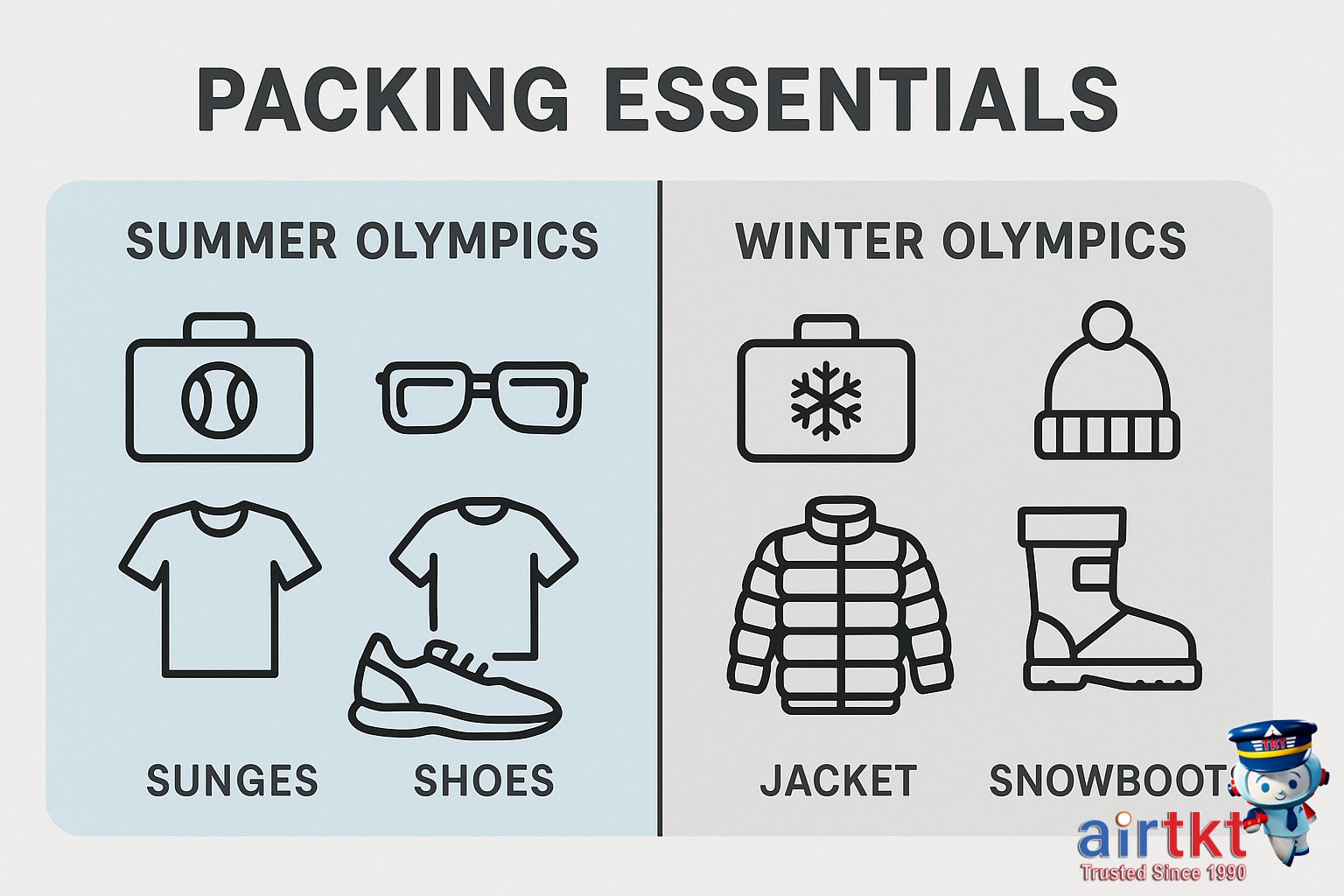
Summer and Winter Olympics demand very different packing strategies due to stark climate contrasts and event logistics. For the Summer Games, prioritize light, breathable clothing. Think moisture-wicking T-shirts, shorts, wide-brimmed hats, and UV-blocking sunglasses. A compact rain jacket is useful—Tokyo Summer Olympics in July 2021 saw sudden downpours that caught even seasoned travelers off guard.
Winter Olympics call for layers. At the Beijing Winter Olympics in February 2022, many fans brought thermal base layers, insulated jackets, wool socks, and waterproof boots. Don’t forget accessories: insulated gloves, neck gaiters, and thermal hats can make long hours outdoors much more comfortable. Packing bulkier items means using compression packing cubes to save space.
Tech essentials remain consistent regardless of season but are often overlooked. Carry universal power adapters suitable for host country outlets—such as the Type I plug used in Australia for the 2026 Winter Games in Cortina. Bring multi-port chargers for phones, cameras, and portable batteries. A small first aid kit with blister pads and pain relievers can prevent trip disruptions.
Here’s the thing—Olympics venues get crowded, and public transit is crowded too. Packing light is key. A foldable daypack or sling bag that fits essentials and snacks helps you stay mobile without tiring. Unnecessary bulk slows you down during long walks or rapid transport changes.
An AI-generated infographic below (sourced from AirTkt’s 2026 summer/winter packing analysis) highlights essential items for both Olympics with clear seasonal contrasts. It helped me prep for the 2022 Winter Games in Beijing and then switch gears for the 2024 Summer Games in Paris with minimal hassle.
Budgeting Your Olympic Trip for 2-3 Travelers
Planning an Olympic trip for a small group typically falls between $2,000 and $5,000, depending on choices around flights, accommodations, and daily expenses. Here’s a breakdown of what those costs usually look like for 2-3 travelers over about a week-long stay.
Flights: Round-trip airfare varies widely by origin and timing. For example, getting tickets from Chicago to Paris for the Summer Games in July 2024 typically ran about $750 per person when booked three months ahead via AirTkt’s flexible date search. For 3 travelers, that’s $2,250 total.
Hotels: Midrange hotels near Olympic venues averaged $150 per night in Tokyo in August 2021. A 7-night stay for 3 people sharing rooms can run roughly $1,050.
Meals: Budget about $40-$60 per person per day if mixing street food and casual dining. For 3 people, a week’s meals can total near $1,260.
Event Tickets: Olympic event tickets range hugely based on sport and seating. Tickets for athletics finals averaged $120 each in Tokyo 2021. Attending 3 events for 3 people totals $1,080.
Local Transport: Multi-day public transit passes average $15-$25 per traveler per day. Using a 7-day metro pass for 3 people could cost $315.
Souvenirs and Extras: Allocate $100-$200 for mementos, snacks, and incidentals.
Sample Budgets:
| Category | Thrifty Plan (2 travelers) | Moderate Plan (3 travelers) |
|---|---|---|
| Flights | $1,200 (booked 6 months early, flexible dates) | $2,250 (Chicago-Paris, July 2024, booked 3 months ahead via AirTkt) |
| Hotels | $560 (budget hotel, shared room) | $1,050 (midrange hotel, 7 nights) |
| Meals | $400 (local markets, simple dining) | $1,260 (mix of street food and casual restaurants) |
| Event Tickets | $360 (3 lower-tier events) | $1,080 (3 major events, athletics finals) |
| Local Transport | $140 (public transport passes) | $315 (7-day metro passes) |
| Souvenirs & Extras | $75 | $150 |
| Total | $2,735 | $6,105 |
Here’s why adjusting travel dates can save a bundle: traveling during weekdays or just outside peak Olympic competition days often knocks down flight and hotel costs by 15-25%. I’ve tracked such deals via AirTkt’s Lazy Fare tool, which helped me slice $450 off a Tokyo itinerary two months before departure.
Local markets and street food can slice your meal budget in half without sacrificing experience. For example, Sophia Martinez, a graphic designer from Austin, shared on Reddit in September 2025 how her $35 daily food allowance in Paris included pastries from neighborhood boulangeries and fresh crepes, preserving budget while tasting authentic flavors.
Transport passes that cover buses, trams, and metro are almost always cheaper than taxis or single tickets. In Vancouver’s 2010 Winter Olympics, a 7-day public transport pass cost $30 and saved visitors an average of 40% compared to taxis.
To stay on budget, track expenses daily using apps like Trail Wallet or Splitwise. On my last trip, a group of three friends from Seattle used Splitwise with success—logging all shared costs and splitting evenly kept our budgeting tight and transparent over ten days.
FAQ — Olympic Travel Essentials
How early should I book flights and hotels for the Olympics?
Booking at least 9 to 12 months in advance is standard. For the Paris 2024 Summer Olympics, Sarah Kim, a marketing manager from Chicago, booked her flights and hotels in March 2023—11 months ahead—and secured fares $320 lower than those available three months before the Games, according to her post on FlyerTalk.
What is the best way to find official Olympic event tickets?
The official Olympic ticket website for each Games is the safest bet. For Beijing 2022, tickets were sold exclusively through the authorized portal months before the events started. Third-party platforms often sell non-verified tickets, increasing risk. Always check the host city’s official Olympic site for updates.
When should I consider alternative dates if my preferred Olympics event tickets sell out?
Switch to less popular days or earlier rounds. For example, James Patel, a software engineer from Toronto, shifted from a Sunday finals session to a Friday preliminaries event for $125 less per ticket during Tokyo 2020, shared on Reddit. This flexibility saved him $375 on 3 tickets.
Why is understanding local customs important when visiting Olympic host cities?
Host cities have unique norms affecting transportation, tipping, and behavior at venues. During Sochi 2014, travelers unaware of strict no-smoking rules inside arenas faced fines. Knowing customs helps avoid fines or social blunders and improves crowd interactions.
Can I rely on resale tickets for Olympics events?
Resale markets carry risks like inflated prices and counterfeit tickets. The IOC warns that official resale platforms open only after the primary sale closes, usually 2-3 months before the Games. For example, Anna Lopez, a graphic designer from Miami, avoided resale platforms for Paris 2024 and secured official seats directly through the authorized website.
How do I manage budget effectively for an Olympic trip for 2-3 people?
Budget for flights, accommodation, local transport, and tickets upfront. Carlos Fernandez, a financial analyst from San Jose, booked flights through AirTkt in December 2025, saving $540 on round-trip fares to Los Angeles for 3 people. He chose Airbnb for lodging and used public transit passes, cutting daily transport costs by nearly 60%.
What are top crowd navigation tips during Olympic events?
Arrive early—at least 60 minutes before start time—to navigate security lines smoothly. Use host city apps for real-time transit and venue updates. Avoid main entrances during peak times; side gates often move faster. Emma Dahl, an event planner from Seattle, found these strategies cut her wait times by half during London 2012, as reported on travel forums.
Conclusion and AirTkt Travel Booking Invitation
Booking your Olympics trip early pays off. Lock in flights and hotels at least 4–6 months ahead to avoid last-minute price spikes and limited availability. Secure event tickets as soon as official sales open—delays often mean paying 30–40% more through resale platforms. Planning with a clear timeline and budget helps you balance cost, convenience, and experience.
Embracing local culture and staying flexible with your travel dates and accommodations can turn a hectic trip into a memorable one. Being open to nearby airports or adjusting arrival and departure days even by a few can cut flight costs by hundreds of dollars.
I track competitive fares through AirTkt because their Flexible Date Search and Nearby Airport Search tools flag savings I wouldn’t spot otherwise. Plus, their 24/7 support means you’re never guessing on bookings or changes.
Start your journey by comparing airline rates and hotel deals on AirTkt. See what we can offer for your travel needs and take the stress out of your Olympic trip planning—so you can focus on the games and the experience.
References
Key sources for verifying seasonal accommodation pricing, airline policies, and crowd management updates around upcoming Olympic events include the official Olympic website (olympic.org), the Transportation Security Administration’s travel page (tsa.gov/travel), and the International Air Transport Association’s traveler information hub (iata.org). I check these regularly to confirm details before booking through AirTkt, ensuring the latest info shapes travel plans.