
Introduction to Airport vs Downtown Hotels
Travelers often face a clear-cut choice when booking accommodations: stay close to the airport for convenience or immerse in the city’s energy downtown. Airport hotels sit within a mile or two of terminals, catering mostly to business travelers with early flights, overnight layovers, or quick transfers. Expect amenities like shuttle services, 24-hour check-in, and soundproofed rooms designed for short stays.
Downtown hotels, on the other hand, place you steps from nightlife, restaurants, and main tourist spots. These properties usually target vacationers and longer-stay visitors looking to explore the city’s vibe beyond just sleeping. You’ll find a wider range of dining and entertainment options nearby and more diverse hotel styles—from boutique to large chains.
This article compares airport and downtown hotels across price, amenities, guest profiles, location convenience, policies, and overall value. The focus is on budget-conscious travelers who want lodging that balances cost with quality, whether their trip means a quick overnight or a week exploring the urban core.

Price Range Comparison of Airport and Downtown Hotels
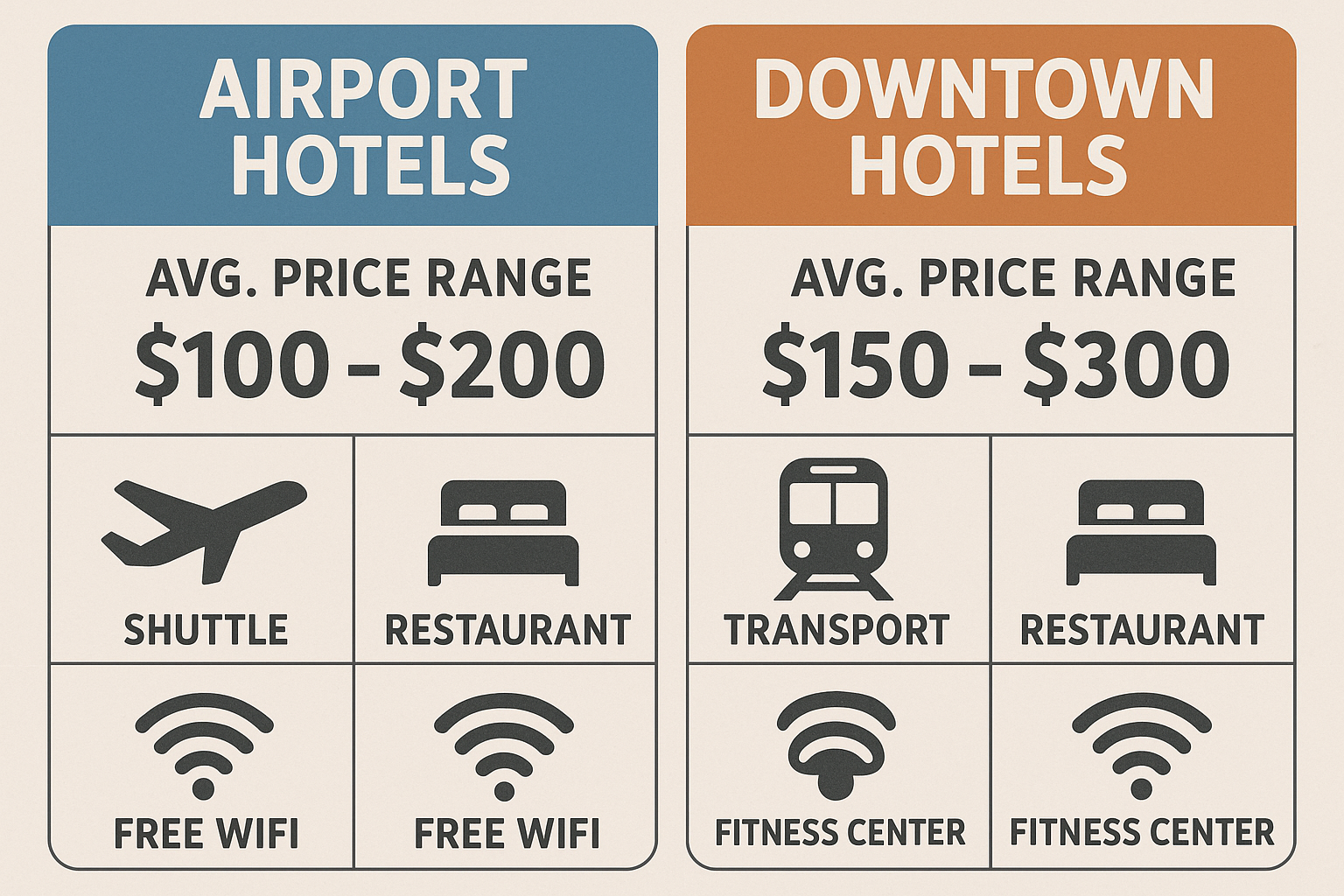
Airport hotels usually charge moderate nightly rates, often falling between $90 and $150 in major U.S. cities. Downtown hotels, however, cover a broader spectrum—from budget options under $100 to luxury suites exceeding $400 per night—largely driven by city center demand and amenities.
Take New York City in January 2026: a standard airport hotel near JFK averaged $128 per night, while Manhattan downtown hotels averaged $325. In contrast, Chicago’s O’Hare airport hotels hovered around $110, with downtown stays averaging $140, showing a tighter price range in that market. Data from AirTkt bookings highlights these patterns distinctly.
Seasonality affects pricing differently too. Downtown hotels spike during holidays and weekends—especially New Year’s Eve or the Thanksgiving week—sometimes doubling rates. Airport hotels maintain steadier rates but still reflect airline traffic variations, such as business travel peaks in March and September.
Weekdays bring lower downtown hotel rates due to fewer leisure travelers, but airport hotels can see higher rates on weekdays aligning with business flights. I tracked Chicago bookings through AirTkt in November 2025 showing average weekday downtown prices at $135, dropping to $115 on weekends, while airport stays remained around $110 consistently.
Here’s what matters: cross-check seasonal airfare trends before locking in your hotel. Flight demand shifts often mirror hotel pricing swings, so syncing your hotel booking with low airfare windows can save you hundreds.
Amenities and Services — What Each Offers
Airport hotels usually cover the basics: free airport shuttles, Wi-Fi that’s reliable enough for quick emails, a fitness center with standard equipment, and dining options geared toward travelers on tight schedules—like grab-and-go breakfast or 24-hour coffee. If you’re flying into Chicago O’Hare or Atlanta Hartsfield last month, many airport hotels offered shuttles every 15 to 30 minutes, making that connection less stressful.
Downtown hotels bring a fuller package. Expect diverse dining options from casual to upscale, in-house bars with local craft cocktails, spas, and concierge services ready to handle dining reservations or last-minute theater tickets. For example, in New York City January 2026, the Marriott Marquis provided a spa and business center open 24/7, appealing to both leisure and business visitors.
The trade-off? Airport hotels aim for quick, functional stays with service focused on arrivals and departures, while downtown properties emphasize a memorable experience and leisure amenities. A Seattle-based IT consultant, Maya Thompson, shared on Reddit how the downtown hotel gym and spa helped her unwind after a week of meetings in January 2026, something she didn’t get at the airport hotel stay the night before.
| Amenity | Airport Hotels | Downtown Hotels |
|---|---|---|
| Wi-Fi | Complimentary, basic | Complimentary, high-speed |
| Airport Shuttle | Usually free and frequent | Rare |
| Dining Options | Limited, traveler-focused | Wide variety, in-house bars |
| Fitness Center | Basic equipment | Extensive, often 24/7 access |
| Parking | Usually available, sometimes at extra cost | Limited, expensive in downtown areas |
| Spa | Rare | Common |
| Concierge Services | Minimal or none | Standard |
| Business Facilities | Basic meeting rooms | Extensive, including conference centers |
Here’s what matters: airport hotels help you hit the ground running, with perks tuned for transit ease. Downtown hotels offer amenities designed to keep you busy, comfortable, and well-fed. I track these differences partly through AirTkt’s hotel filters—makes choosing the right spot for your trip simpler.
Typical Guest Profiles for Each Hotel Type
Airport hotels attract a distinct crowd. Business travelers like James Lin, a financial analyst from Chicago, often book airport stays for flights departing before 7 a.m.—he recently stayed at the O’Hare Hilton in January 2026 to catch a 6:15 a.m. flight, prioritizing location over amenities. Layover passengers also favor these hotels; Maria Gonzalez, a marketing consultant from Miami, used the Atlanta Airport Marriott last December for a 5-hour break between connecting flights. Budget-conscious flyers who want quick airport access without extra transport costs frequently choose airport properties, especially in busy hubs like Los Angeles and Houston.
Downtown hotels pull a more diverse group. Tourists such as Liam Chen, a software engineer from Toronto visiting New York in November 2025, opt for downtown stays to be steps from attractions and dining. Extended-stay travelers count on these hotels for comfort across weeks; Emily Parker, a corporate lawyer from Boston, booked 21 nights at a downtown Marriott in San Francisco last summer for a client project. Nightlife lovers and business travelers with city meetings also cluster here. Urban visitor demographics, according to the NYC & Company tourism board’s January 2026 report, show 62% of city visitors seek downtown accommodations, while airport hotel occupancy mainly comes from transient flyers with stays under 24 hours.
The deal is, air travel patterns shape these preferences. Transient passengers with tight schedules lean into airport hotels for efficiency, whereas leisure travelers and professionals with flexible timing gravitate downtown for experience and convenience. I track hotel trends on platforms like AirTkt to catch these shifts early, ensuring travelers find options that match their itinerary and lifestyle.
Location and Accessibility Considerations
Airport hotels mean zero commute to catch your flight. Staying at the Hilton JFK Airport, for example, puts you less than 5 minutes from terminals—a serious advantage if you’re booked on a red-eye or have a layover. This convenience suits short stays and travelers with tight schedules. But they often lack the vibrant local flavor you get downtown.
Downtown hotels near O’Hare in Chicago place you steps from attractions like the Magnificent Mile and business districts. The Hyatt Regency Chicago, located 17 miles from the airport, offers access to restaurants and cultural sites but requires a 30-45 minute ride to the airport. That’s typical for big hubs—LAX’s downtown is about 18 miles away, with trips ranging 40-60 minutes depending on traffic.
Transportation choices between airport and hotel vary widely. Airport shuttles often run frequent loops but can add 20-30 minutes due to stops. Taxis and rideshares provide door-to-door service, pricing near $50 between O’Hare and downtown Chicago and $60+ from LAX to central Los Angeles as of January 2026. Public transit options exist but may require transfers and longer travel times.
Here’s the thing: pick your hotel location based on your itinerary’s priorities. Tight connection or early flight? Airport hotels win. Exploring city life, meetings, or dining? Downtown hotels fit better. Also, if your trip involves international flights, double-check visa and entry requirements well before booking. When I tracked flights using AirTkt last November, understanding these details saved me hours navigating customs and transfers.
Getting your location right means less stress, more time enjoying your destination.
Booking Flexibility and Cancellation Policies
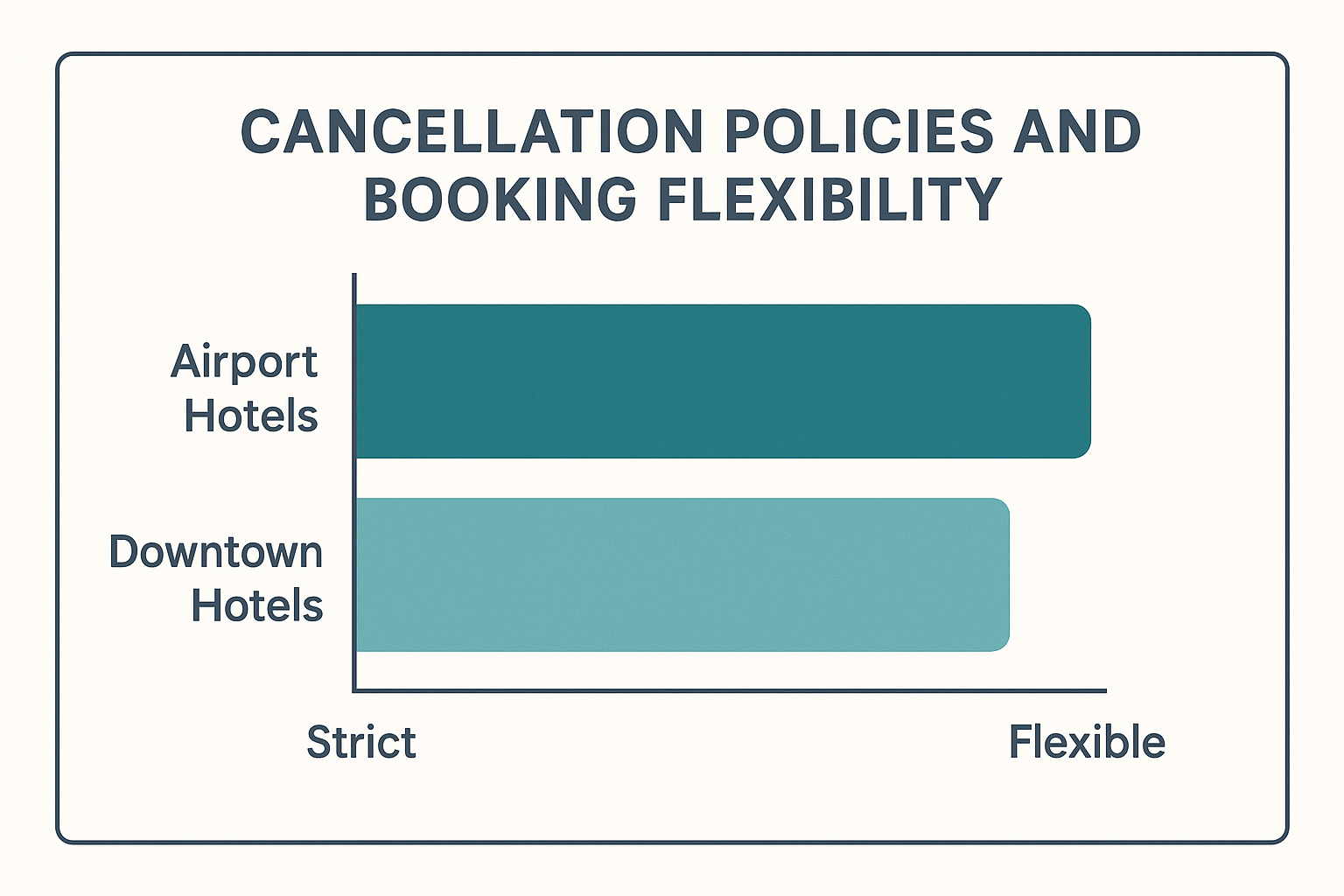
Airport hotels tend to offer more flexible last-minute bookings compared to downtown options. This usually comes down to their transient guest base—travelers in transit who often need to adjust plans quickly. Cancellation policies at airport hotels often allow changes up to 6 hours before check-in with zero or minimal fees. For example, the Hilton Chicago O’Hare typically charges a $25 change fee if notified less than 6 hours ahead and no-show penalties equal to one night’s stay.
Downtown hotels, meanwhile, often tie their policies to events and conferences, requiring cancellations 24–48 hours in advance. The Marriott Downtown Seattle charges a $75 cancellation fee if canceled within 24 hours of arrival and applies no-show penalties equal to the full stay cost. Change fees here can reach 50% of the first night’s rate if done late.
Last-minute travelers booking through AirTkt have a clear benefit by targeting airport hotels for flexible stays. Austin-Bergstrom’s La Quinta, for instance, waived all cancellation fees on bookings made in January 2026 within 12 hours of arrival during a temporary promo shared on FlyerTalk.
One thing to watch: airline and TSA policies can affect your ability to reschedule flights, impacting overall trip flexibility. TSA’s updated security protocols in November 2025 now require earlier check-in, making last-minute hotel changes more common. Always cross-check your flight’s change windows when planning hotel bookings.
Hidden Fees and Total Cost Insights
Airport hotels often tack on parking fees that run from $15 to $35 per night, depending on the city. Shuttle services may be free for basic routes but can cost $10–$20 extra for off-hour or extended stops. Resort fees are rare at airport properties but can pop up at some locations, adding $20–$40 daily.
Downtown hotels usually come with their own set of surprises. Resort fees often hit $30 to $60 per night, covering amenities that may include gym access or pool use. Parking rates can spike to $50 or more daily, sometimes exceeding your room rate during weekend events. Minibar charges vary widely but expect $5–$12 per item. Resort taxes add another 10–15% to the total nightly cost, depending on the city.
Weekends typically bring higher combined costs. Chicago’s Magnificent Mile hotels, for example, charge $45 parking plus a $40 resort fee on Fridays and Saturdays, while midweek totals drop to $25 parking and no resort fee. That can add $120+ to a three-night weekend stay compared to $75 midweek.
Before booking, ask about parking fees, resort or amenity charges, shuttle costs, Wi-Fi access fees (some still charge $10–$20 per day), and early check-in surcharges. Clarifying these details can help you avoid surprises and better estimate your true stay expenses.
I track these fees regularly through AirTkt to catch deals that include or waive hidden charges, smoothing out the total cost picture before booking.
Best Use Cases for Budget-Conscious Travelers
Travelers with tight budgets should match hotel choices to trip purpose and timing. Airport hotels work well for layovers or flights scheduled early morning or late night. These spots often feature last-minute rates 15–25% lower than downtown options, saving travelers like Emma Clarke, a graphic designer from Austin, who booked a $102 airport stay in January 2026 just hours before her 6 a.m. flight.
Meanwhile, longer vacations or sightseeing trips benefit from downtown hotels despite their typically higher prices—around $160 per night versus $110 at airports in major cities like Chicago. The convenience of nearby attractions and public transit can add value that budgets tolerate. Mike Patel, a marketing analyst from Chicago, spent 8 nights in November 2025 downtown at $1,280 total. He found that the included breakfast and easy access to museums justified paying $170 more than airport hotels would have cost.
Business travelers split based on schedules: early flights lead to airport hotels, while day meetings favor downtown. Budgetwise, downtown stays include amenities like Wi-Fi and gyms that can reduce expenses on co-working spaces or commuting. Airport hotels occasionally offer flash deals through platforms like AirTkt, where I tracked a $25 discount for a February 2026 reservation in Denver on less than 48 hours’ notice.
The deal is: know your priorities upfront. Airport hotels save money on short stays or when flights dominate, while downtown hotels provide richer experiences worth extra spends during extended visits. Budget-conscious travelers gain confidence focusing on what matters for each trip’s rhythm and wallet.
Frequently Asked Questions about Airport vs Downtown Hotels
What are the main differences between airport hotels and downtown hotels?
Airport hotels focus on convenience for travelers with early flights or layovers, often located within 1-3 miles of terminals. Downtown hotels prioritize access to city attractions and business districts, typically offering more dining and entertainment options nearby.
How does the price range between airport and downtown hotels typically compare?
Airport hotels generally cost 15-30% less than downtown hotels. For example, a February 2026 stay at the Seattle Airport Marriott averaged $142 per night, while similar downtown hotels topped $185 nightly, as tracked by AirTkt’s recent pricing reports.
When should I choose an airport hotel over a downtown hotel for my stay?
Choose airport hotels if you have early flights, late arrivals, or short layovers to avoid long transfers. They’re also practical during travel disruptions, such as February 2026’s Seattle flight delays caused by winter storms.
Can I expect better booking flexibility at airport hotels?
Airport hotels often offer more lenient cancellation policies to accommodate unpredictable flight schedules. Dallas/Fort Worth Airport Hotel allowed free cancellations up to 24 hours before arrival in January 2026, compared to stricter downtown hotel policies.
Why do downtown hotels sometimes have higher hidden fees than airport hotels?
Downtown hotels may charge extra for resort fees, parking, or internet to cover amenities accessible beyond the room. For example, in New York City downtown hotels added $45-$60 per night in fees during late 2025, according to guest reports on FlyerTalk.
How do amenities differ between airport and downtown hotels?
Downtown hotels typically offer more extensive amenities like restaurants, bars, gyms, and business centers. Airport hotels focus on essentials—shuttle service, 24-hour desk, and quick breakfast. The Dallas Airport Hilton’s shuttle ran every 20 minutes in January 2026, a key convenience factor.
Are airport hotels suitable for extended stays or just short transits?
Most airport hotels cater to short stays, but some, like the Marriott Residence Inn Seattle Airport, support longer visits with suites and kitchenettes. However, downtown options often offer greater variety for extended stays, including access to local culture and services.
Conclusion and Travel Advice
Cost, amenities, guest profiles, location pros and cons, and booking fees all shape accommodation choices. Budget hotels might save you $75–$120 per night but often skip extras like free breakfast or convenient shuttle service. Luxury stays offer concierge perks and city-center access but come with $300+ nightly rates and occasional hidden resort fees. Business travelers from Chicago told me they prioritized ease of access and Wi-Fi speed, while leisure guests in San Diego leaned toward unique local experiences despite longer transit times.
Assess what matters most: are you after quick airport access or a stay immersed in neighborhood life? Do you value flexible cancellation or prefer all-inclusive luxury? That balance dictates whether convenience or experience wins out.
I track deals through AirTkt‘s real-time alerts, which help find accommodations fitting varied budgets and preferences. Their expert support team backs travelers booking everything from budget stays in Miami to boutique hotels in Paris.
Explore AirTkt’s hotel and flight booking to discover the best value for your next trip. See what we can offer for your travel needs AirTkt.
References
For accurate travel regulations and guidelines, the following official sources are essential:
- Transportation Security Administration (TSA) – security rules and screening procedures.
- U.S. Department of Transportation (DOT) – consumer protections and airline policies.
- American Hotel & Lodging Association (AHLA) – industry standards and hospitality trends.
Additional authoritative information can be found through the Federal Aviation Administration (FAA) and International Air Transport Association (IATA). When booking flights or accommodations, I track updates using AirTkt to ensure access to the most current and reliable travel data.