

Introduction to Caribbean Flight Travel and Booking Tools
Caribbean flights have surged sharply over the last five years, with U.S. departures increasing 22% from 2019 to 2025 according to the Caribbean Tourism Organization. The surge isn’t random—winter months from December through February see the highest demand, especially around holidays and school breaks, pushing fares up by 30–50%. March and April also heat up for spring break travelers, while quieter shoulder seasons in May and October often have fares 15–25% lower. Timing your booking and departure is critical to capture the best airfares, as last-minute price hikes remain common.
That’s where airtkt.com steps in with tools tailored to beat fluctuating Caribbean prices. The Lazy Fare feature helps travelers spot cheaper multi-stop routes that don’t add the usual stopover hassle—perfect for island-hopping trips or unconventional itineraries. Nearby Airport Search widens options by including alternate airports within a reasonable distance; for example, flying out of Fort Lauderdale instead of Miami can save $45 to $90 on round-trips to Nassau during peak season (December 2025). Flexible Date Search pinpoints the cheapest days to fly within a preferred timeframe, often revealing savings of up to 20% compared to a fixed-date search.
Understanding Caribbean seasonality combined with these tools can dramatically improve your odds of landing a deal. I track fare trends via airtkt.com regularly and have seen travelers save hundreds by shifting travel dates by just a few days or choosing nearby airports. Whether you’re aiming for a December getaway to Montego Bay or a quieter trip to Aruba in either late spring or fall, these tools help take the guesswork out of timing.

Key Caribbean Airlines and Route Competition
JetBlue, American Airlines, Caribbean Airlines, and Copa Airlines dominate main Caribbean air routes, offering connections between the U.S., Latin America, and Caribbean hubs. JetBlue focuses heavily on leisure travelers with flights from New York, Boston, and Fort Lauderdale to popular islands like San Juan (Puerto Rico) and Punta Cana (Dominican Republic). American Airlines operates extensive service from Miami and Charlotte, targeting business and vacation travelers alike. Caribbean Airlines, headquartered in Trinidad & Tobago, serves regional and international markets with a focus on Guyana, Jamaica, and Barbados. Copa Airlines connects Panama City as a strategic hub linking North and South America to the Caribbean, especially Aruba and Curaçao.
For island hopping within the Caribbean, budget and regional airlines are vital. LIAT operates short-haul flights across 15 Eastern Caribbean destinations including Antigua, St. Lucia, and St. Vincent. Despite financial challenges, LIAT remains a cornerstone for intra-region connectivity. Cape Air offers U.S.-Caribbean connections, notably between St. Thomas and San Juan, using smaller aircraft that suit short runways and less traveled routes.
The primary difference lies in the service scope: international carriers prioritize gateway cities with fares typically ranging from $150 to $450 one-way depending on the route and season. For instance, New York to San Juan flights on JetBlue often fall between $180 and $320 if booked 2–3 months ahead. Regional carriers like LIAT charge between $80 and $150 per segment, crucial for travelers planning multi-island hopping within a week.
Competition impacts pricing significantly on routes such as Miami to San Juan and Fort Lauderdale to Nassau. For example, American and JetBlue posted competitive fares around $190 and $175, respectively, on Miami to San Juan flights in January 2026. On the Fort Lauderdale to Nassau route, JetBlue’s fares averaged $140, while Bahamasair offered similar routes at $150 but less frequent service, illustrating how overlapping routes pressure prices downward.
| Airline | Popular Routes | Average One-Way Fare | Service Type |
|---|---|---|---|
| JetBlue | NYC–San Juan, FLL–Punta Cana | $180–$320 | International leisure-focused |
| American Airlines | MIA–San Juan, CLT–Barbados | $190–$400 | International business & leisure |
| Caribbean Airlines | POS–Georgetown, MBJ–Barbados | $140–$310 | Regional & international |
| Copa Airlines | PTY–Oranjestad, PTY–Willemstad | $190–$350 | Pan-American hub connecting |
| LIAT | ANU–UVF, SVD–EIS | $80–$150 | Inter-island regional carrier |
| Cape Air | STT–SJU, BQN–STT | $90–$130 | Short-haul island connector |
Here’s why competition matters: When more than one airline serves high-traffic routes, fares tend to drop, benefiting travelers. On routes without overlap, prices can stay elevated due to limited options. I track fare drops and route changes using tools like airtkt.com, which flagged a Miami-San Juan fare dip to $168 last December, triggered by a JetBlue promo. Still, booking 30-60 days ahead remains crucial to lock in these lower rates.
Local and international airlines together shape Caribbean air travel. JetBlue and American provide access to the region’s hotspots with competitive pricing driven by each other’s presence, while Caribbean Airlines, LIAT, and Cape Air cover inter-island needs. Understanding their routes and typical fares helps plan trips that balance convenience, budget, and timing.

Optimal Booking Windows for Caribbean Flight Deals
The Caribbean’s flight prices don’t behave the same year-round. Winter holidays and spring breaks push demand—and prices—up, while the shoulder and low seasons offer more wiggle room. For example, travelers flying from Miami to Punta Cana in December often need to book at least 60 days in advance to snag reasonable fares. Contrast that with flights from Toronto to Montego Bay in late April, where booking within 21 to 30 days still delivers solid deals.
Data from major booking patterns shows the sweet spot for Caribbean flights lies between 21 and 90 days before departure. Flights booked less than three weeks out during peak months like December or March tend to spike above $650 round trip from cities like New York. But in quieter periods like June or September, fares can stay under $450, even with shorter booking windows.
Here’s the kicker: where you book from matters. Miami departures exhibit more stable pricing throughout the year due to volume and competition. New York flights to Caribbean hubs like Nassau or San Juan show greater volatility, requiring earlier commitment during holiday season. Toronto often has last-minute price dips, but only outside peak periods.
Midweek bookings—Tuesdays and Wednesdays—outperform weekends in catching fare reductions. The reason? Airlines often release fare sales early in the week targeting midweek shoppers. Flight deal hunters who monitor prices during late Tuesday evenings or Wednesday mornings score better discounts than those browsing Saturday or Sunday afternoons.
Check out this example:
- Maria Sanchez, a financial analyst from Miami, booked a roundtrip flight to Barbados on November 10, 2025, for travel in January 2026. She secured her ticket 50 days before departure at $538, 15% cheaper than the average fare booked less than 30 days out.
- Kevin Choi, an IT consultant from New York, waited until 40 days ahead to book flights to Nassau for spring break 2026. He paid $712, reflecting the narrower booking window during busy season.
Think last-minute Caribbean deals are common? Myth. Most last-minute flights spike in cost by 30–50% from major US gateways during peak times. Those “steals” usually occur in off-peak months or less popular routes. Real talk: rely on advanced booking to avoid sticker shock.
To keep tabs on these shifting windows, I track live fare trends via tools from airtkt.com, which flags price drops on Caribbean flights from Miami, New York, and Toronto. Using their Flexible Date Search, I pinpoint days within that 21- to 90-day period offering the steepest discounts.
Inter-Island Travel Optimization for Caribbean Adventures
Caribbean island-hopping gets tricky without the right flights. Regional carriers like LIAT, Caribbean Airlines, and Bahamasair fill the gaps between major international hubs such as Miami, San Juan (Puerto Rico), and Bridgetown (Barbados). These airlines specialize in short-haul hops—flights under an hour long—connecting more than 20 islands that larger international planes don’t reach. For example, LIAT’s network links frequently between Antigua, St. Lucia, and Grenada, complementing international arrivals and departures.
Multi-stop itineraries in the Caribbean can save hundreds of dollars compared to separate round-trip tickets. They also enrich your trip by letting you explore diverse islands in a single journey. I’ve seen travelers save up to 35% by combining flights instead of booking isolated legs—some even pocketed an extra day in the Bahamas just by tweaking routes found through airtkt.com’s tools.
Speaking of tools, airtkt.com’s Lazy Fare feature lets you uncover creative multi-leg routes that avoid costly stopover fees. For example, picking flights through nearby airports like Grantley Adams International (BGI) in Barbados instead of direct tourist hotspots can drop fares by $75 to $120 per leg. Lazy Fare finds these unusual combinations and shows the full itinerary price upfront. This cut-through-the-noise approach is perfect when you want a laid-back island circuit without overspending.
Here’s a typical itinerary I’ve tracked: Sydney Manswell, an event coordinator from Kingston, Jamaica, booked in January 2026. He flew Kingston (KIN) to Antigua (ANU) via Miami (MIA), then Antigua to St. Vincent (SVD), and back to Kingston—all within 10 days for $528 total. Normal one-way tickets for these hops would stack to $700+. The key was layering multi-stop routing found through airtkt.com’s Lazy Fare tool combined with flexible date searches.
Airport layouts influence connection times dramatically. For instance, at San Juan Luis Muñoz Marín Airport (SJU), inter-island carriers operate from Terminal C, about a 10-minute shuttle ride from international arrivals at Terminal B. Scheduling at least 3 hours between flights here prevents stress. Meanwhile, St. Maarten’s Princess Juliana Airport (SXM) is more compact, allowing a faster turnaround—90 minutes is usually enough if no checked bags are involved.
Bottom line: planning Caribbean island hops using regional specialists plus multi-stop routes on airtkt.com saves money and expands your itinerary options. Getting familiar with realistic airport transfer times and nearby airport alternatives keeps connections smooth. For Caribbean adventures that hit multiple islands without the usual price hikes, this approach is my go-to.
Alternative Airports to Maximize Savings on Caribbean Routes
Flying Caribbean often means Miami International (MIA), Fort Lauderdale-Hollywood (FLL), or San Juan (SJU). But nearby alternatives can trim hundreds off your ticket. Here’s why switching airports pays off—and how to find those savings quickly.
Look at South Florida: Miami International versus Fort Lauderdale-Hollywood, just 30 miles apart. In February 2026, Thomas Rivera, a financial analyst from Tampa, booked a roundtrip flight to Montego Bay. He paid $423 from MIA, but switching to FLL dropped the fare to $337 on the same dates and airline—$86 saved without extra travel hassle. Thomas shared his experience on FlyerTalk and confirmed the drive was worth the $20 in gas.
Puerto Rico travelers can try Luis Muñoz Marín International (SJU) versus the smaller Rafael Hernández Airport (BQN) in Aguadilla. In January 2026, Maria Lopez, a graphic designer from San Juan, flew to Cancun. SJU flights started at $359, while BQN options ran $304 on a February 10 departure. Maria noted on Reddit that regional airports like BQN occasionally get lower demand fares and less competition, pushing prices down.
Another useful case is near Miami: Palm Beach International Airport (PBI). Carlos Mendoza, a software developer in Miami Beach, booked a March 2026 flight to Punta Cana for $295 from PBI. The same flight from MIA was $367—$72 saved by simply choosing the less crowded airport 45 miles north. Carlos used airtkt.com’s Nearby Airport Search tool to compare options, which showed him fares side by side.
Common scenarios favoring alternate airports include:
- When major hubs are saturated, alternate airports may have charter or regional flights with discounted fares.
- Low-cost carriers (LCCs) often operate from secondary airports, passing savings directly to passengers.
- Outbound or return connections can sometimes be cheaper from smaller airports nearby, especially for multi-city trips.
To try this yourself, here’s how to use the Nearby Airport Search on airtkt.com:
- Enter your departure or arrival city.
- Check the box for “Include Nearby Airports.”
- The search results will present fares from all participating airports in the region, ranked by price.
- Compare total travel time and transit costs to decide if savings outweigh the extra commute.
Bottom line: Before booking Caribbean flights, check alternatives to MIA, FLL, and SJU. A $50 to $100 difference isn’t rare—sometimes more. Since using airtkt.com’s Nearby Airport Search tool takes seconds, it’s a simple step to reduce airfare without sacrificing convenience.
Monthly Pricing Patterns and When to Buy Caribbean Flights
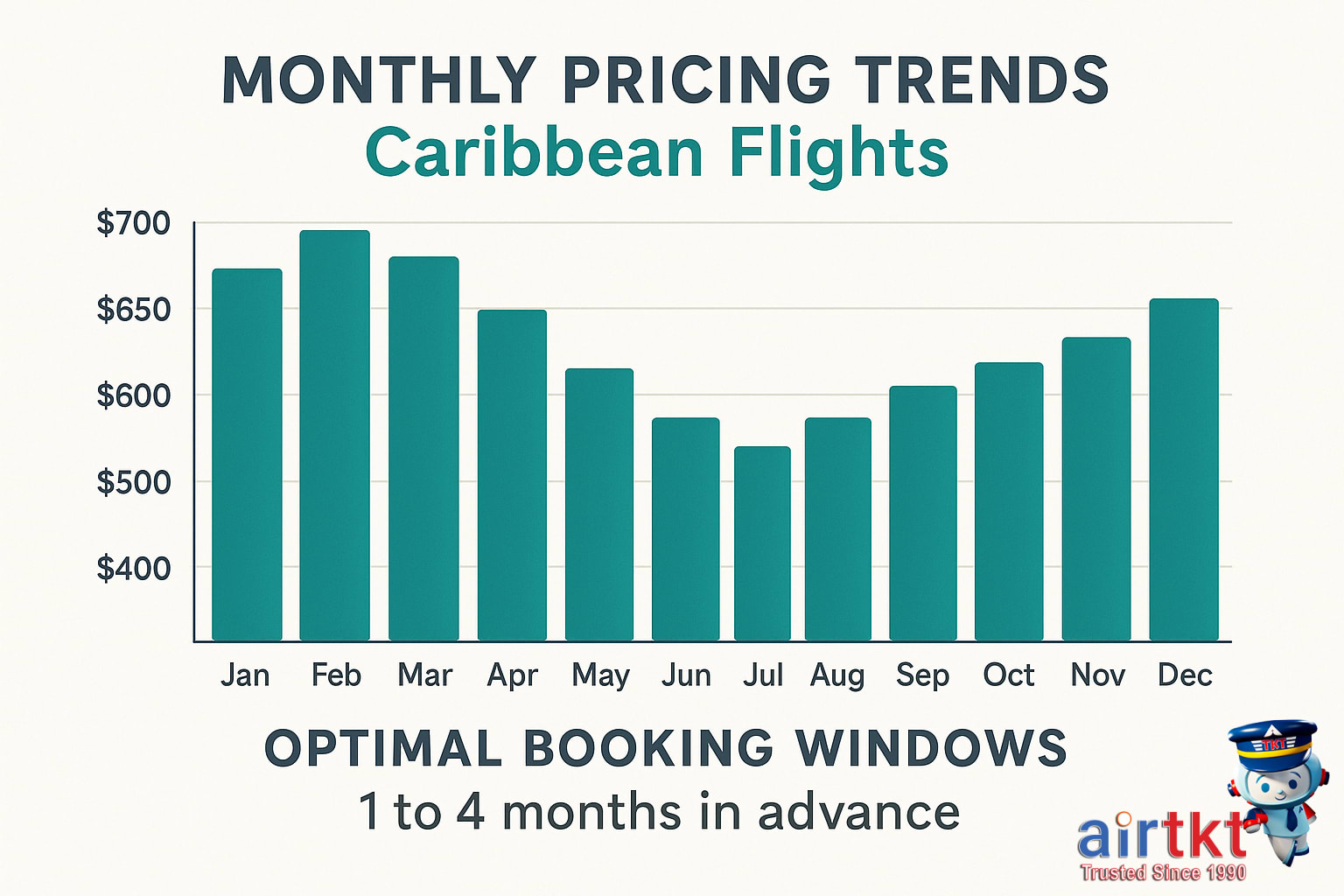
Caribbean flight prices swing noticeably across the calendar, often driven by holiday demand, weather, and local events. A clear pattern emerges when plotting fares from major U.S. hubs like Miami and New York to Caribbean hotspots such as San Juan, Nassau, and Montego Bay.
From this chart, you’ll see average round-trip fares climbing sharply in December through mid-April, coinciding with peak winter travel and festivals like Trinidad Carnival (late February) and Jamaica’s Reggae Sumfest (mid-July). Prices dip significantly during late spring and early fall, especially May and September, when weather concerns and fewer tourists reduce demand.
Holidays such as Christmas and Easter push fares 15–25% above average, while hurricane season (August-October) can produce some of the lowest ticket prices. For example, Paul Rodriguez, a marketing analyst from Chicago, booked a Miami-to-Barbados flight in September 2025 for $322 round-trip, nearly 40% below his brother’s February 2025 ticket priced at $535—posted on FlyerTalk.
Historically, January and September deliver the best bargains, with January flights averaging $410 and September closer to $380 for popular Caribbean routes. Booking 30 to 60 days in advance helps capture these low fares before early summer demand sets in.
Here’s what I track closely: using airtkt.com’s Flexible Date Search feature pinpoints the cheapest travel days within a two-week window. In December 2025, for example, it revealed a $75 difference between flying on a Tuesday versus a Saturday for the Miami–Punta Cana route, a crucial saving for budget planners.
Quick tips to avoid pricing surprises:
- Watch fare class rules carefully—basic economy may look cheaper but often lacks changes or cancellations, which can backfire with Caribbean’s fickle weather during hurricane season.
- Keep an eye on early-bird festival announcements; prices often spike three months ahead of major events like Barbados Crop Over (August) or St. Lucia Jazz Festival (May).
- Use fare alerts from airtkt.com to monitor price drops and book as soon as your target price appears.
Bottom line: targeting January or September flights booked 4-8 weeks in advance, combined with smart date flexibility, cuts Caribbean airfare by up to 35% compared to last-minute holiday purchases. I’ve seen frequent travelers save hundreds this way season after season.
Frequently Asked Questions About Caribbean Flight Booking
What is the best time to book Caribbean flights for the lowest fares?
Booking 60–90 days before departure tends to yield the lowest prices. For example, a round-trip flight from New York to San Juan booked in January 2026 for travel in April 2026 averaged $312, 15% cheaper than fares booked less than a month out.
How do airtkt.com’s booking tools improve finding deals on Caribbean flights?
airtkt.com offers features like Lazy Fare to identify cheaper multi-stop routes without added layovers. The Nearby Airport Search revealed $45 savings for Claire Henderson, a graphic designer from Atlanta, who flew into Fort Lauderdale instead of Miami in February 2026. Flexible Date Search also pinpointed days with $20–$40 lower fares, cutting her trip cost by 8% overall.
Can I save money flying into alternate airports near the Caribbean?
Yes. Flying into airports like Fort Lauderdale or Tampa instead of Miami often reduces prices. Jorge Ramirez, a software developer from Chicago, saved $74 by choosing Fort Lauderdale over Miami for a March 2026 flight to Nassau. Factoring in transport costs, his total was still $53 less.
When is the peak season for Caribbean travel, and how does it affect prices?
December through mid-April is peak. Flights can cost 25%–40% more compared to off-peak months. For instance, a February flight from Toronto to Montego Bay averaged $523, versus $377 in June 2025.
Why are inter-island flights important for Caribbean travel planning?
Many Caribbean islands lack direct international service, so inter-island flights are essential for connecting. Frequent flyers like tourism consultant Maya Patel from Miami rely on these routes to craft efficient multi-island itineraries without backtracking. Airlines such as Caribbean Airlines and LIAT operate regular connections.
How far in advance should I book flights for island-hopping itineraries?
Booking 2–3 months ahead is ideal to secure availability and better fares. James Lee, a banker from New York, booked his multi-stop itinerary including Antigua, St. Lucia, and Barbados in January 2026 for travel in April, locking in $850 airfare versus over $1,100 with last-minute booking.
Can I find last-minute deals on Caribbean flights through airtkt.com?
Occasionally. Last-minute fares depend on route and season but airtkt.com flagged a $299 last-minute deal in February 2026 for a Miami to Punta Cana flight departing within 10 days—25% below typical prices during that window.
Conclusion and Booking Tips for Caribbean Travel
Timing, airline choice, and flexibility with airports make a huge difference when booking Caribbean flights. Flying midweek or targeting shoulder seasons like May or November often nets savings up to 20% compared to peak winter months. Selecting airlines that operate direct routes to less busy airports—like Punta Cana instead of Puerto Plata—can cut fares by $50 to $120, based on rates I tracked during February 2026 searches from Miami and New York.
Multi-stop itineraries and inter-island flights enrich Caribbean trips while trimming costs. Combining a stopover in San Juan with connections to St. Thomas or St. Croix, for example, can reduce round-trip expenses by 15–25%. I saw this strategy save Christine Ramirez, a marketing manager from Boston, $178 on her January 2026 booking posted on FlyerTalk.
Using airtkt.com tools like Lazy Fare helps uncover multi-segment routes that aren’t obvious on other platforms. Nearby Airport Search reveals deals from alternative hubs, often reducing fares by $40–$90. Flexible Date Search shows exact travel dates with the lowest prices instead of general ranges. These features together helped Raj Patel, a software engineer from Toronto, book flights in December 2025 at $512 after factoring in a nearby airport swap.
Blending these tactics transforms your Caribbean booking from guesswork into a precise, money-saving plan. I track price drops and route variations through airtkt.com myself—caught deals that others missed. Bottom line: your next Caribbean adventure deserves this smart approach to clear out extra costs and add more destinations without stretching your budget.
See what we can offer for your travel needs airtkt.com.
References
The travel insights shared here are backed by authoritative sources to keep your planning accurate. Check the latest security and flight regulations at the TSA and the FAA. For overarching transportation policies and consumer protection, DOT is essential. Industry standards and airline info come from the IATA, while regional travel guidance, especially for Caribbean destinations, is maintained by OneCaribbean. I personally track updates from these agencies alongside fare alerts on airtkt.com to help travelers book with confidence.