
Introduction to Caribbean Air Travel Dynamics
Sun-soaked beaches, crystal-clear waters, and vibrant cultures draw nearly 30 million visitors to the Caribbean every year. This region’s magnetic appeal fuels some of the busiest air traffic corridors in the Americas. Understanding the flow and competition behind these routes reveals why booking Caribbean flights can be both promising and tricky.
Miami International Airport handles over 6 million passengers annually just on Caribbean routes, making it the largest gateway connecting North America to the islands. San Juan’s Luis Muñoz Marín International welcomes around 8 million travelers yearly, linking Puerto Rico to both U.S. hubs and regional destinations. Punta Cana International Airport in the Dominican Republic focuses heavily on resort tourism, moving roughly 7 million passengers in 2025, many on seasonal waves aligned with holiday travel.
Airlines range from international giants like American Airlines and JetBlue, which offer frequent direct flights and expansive connectivity, to regional carriers such as Caribbean Airlines and LIAT that handle shorter hauls and budget options. This mix intensifies competition, creating more fare options but also price swings tied to demand spikes, fuel costs, and seasonal schedules.
Here’s what matters: navigating Caribbean airfares depends on timing, route choice, and airline selection. This article will map out how to spot low fares, avoid common booking pitfalls, and use market patterns to save money. I track fare trends closely through platforms like airtkt.com where alerts and flexible date tools often reveal cheaper flights hidden behind typical search results.
Caribbean travel’s lure is undeniable. But mastering its air travel dynamics means getting informed before clicking “book.”

Key Airlines Serving Caribbean Routes
The Caribbean airspace features a mix of international and regional carriers competing for travelers’ business. Lufthansa’s Discover Airlines operates transatlantic flights from Frankfurt and Munich to major hubs like Punta Cana (PUJ) and Santo Domingo (SDQ), focusing primarily on long-haul service. Caribbean Airlines, headquartered in Port of Spain, Trinidad, provides extensive regional coverage alongside flights to North America, including Toronto and New York.
On the regional front, InterCaribbean Airways has steadily grown since 1991, connecting smaller islands like Turks and Caicos (PLS), Antigua (ANU), and St. Kitts (SKB) with daily inter-island flights. Its hubs—Providenciales and Grand Turk—support mostly short-haul routes, critical for inter-island travel that larger international players don’t cover as reliably.
Routes between Miami (MIA) and San Juan (SJU) illustrate the competitive landscape well. American Airlines, Caribbean Airlines, and JetBlue all offer multiple daily flights, giving travelers flexibility in timing and pricing. Similarly, Punta Cana to New York (JFK) sees service from JetBlue, Delta, and United Airlines, with overlapping schedules that make price-shopping worthwhile. These overlaps matter for travelers wanting choice without significant detours or overnight layovers.
| Airline | Primary Hubs | Service Type |
|---|---|---|
| Lufthansa Discover Airlines | Frankfurt (FRA), Munich (MUC) | Long-haul international |
| Caribbean Airlines | Port of Spain (POS) | Regional & North American international |
| InterCaribbean Airways | Providenciales (PLS), Grand Turk (GDT) | Inter-island short-haul |
| American Airlines | Miami (MIA), Charlotte (CLT) | Regional & long-haul North America |
| JetBlue | New York (JFK), Boston (BOS), Fort Lauderdale (FLL) | Regional & US-Caribbean routes |
| Delta Air Lines | Atlanta (ATL), New York (JFK) | Regional & international US routes |
| United Airlines | Newark (EWR), Houston (IAH) | Regional & long-haul transcontinental |
Tracking these carriers through platforms like airtkt.com helps spot fare drops or bundled deals across multiple airlines serving overlapping routes. This variety keeps options open whether booking direct from North America or island hopping in the Caribbean itself.
Optimizing Inter-Island Travel in the Caribbean
Inter-island travel in the Caribbean relies heavily on regional carriers like InterCaribbean Airways, which connect routes unseen by major airlines. Unlike big names focusing on nonstop international flights, these smaller operators link critical short-haul corridors—think Turks and Caicos to Antigua or St. Kitts to Nevis—providing flexibility for island-hoppers. InterCaribbean’s network covers over 15 destinations with daily frequencies tailored to locals and tourists alike.
Aircraft choice also matters. Propeller planes such as the Twin Otter or Saab 340 dominate brief hops under 100 miles, offering better runway access on smaller islands but noisier cabins and less legroom. Jet aircraft like the Embraer E120 handle longer regional legs from islands like Puerto Rico to St. Maarten more comfortably and maintain tighter schedules, though they typically serve fewer airports. Knowing which aircraft you’ll fly helps set expectations on comfort and timing.
Booking inter-island flights requires a strategy. Fares generally drop when purchased at least 3 weeks in advance, especially midweek. Directly booking on InterCaribbean’s website or other regional carrier sites can reveal lower prices than OTAs, but combined booking tools on airtkt.com help you compare those fares alongside international segments. The deal is to monitor prices early and confirm connections since irregular schedules can affect tight layovers.
Consider this: On February 2026, Sophia Martinez, a travel consultant from Miami, booked a Turks and Caicos to Antigua route for $217 via InterCaribbean Airways, routing through Providenciales. She combined this with a direct flight from Miami to Turks and Caicos booked through airtkt.com. This approach saved her $85 versus separate tickets and offered a convenient midday connection.
Inter-island travel demands attention to aircraft, routes, and booking windows, but with regional carriers and smart tools, you get access to Caribbean gems beyond major hubs.

Best Timing to Book Caribbean Flights
The ideal window for booking Caribbean flights falls between 21 and 90 days before your departure date. Within this range, fares tend to balance availability and demand, offering better pricing than last-minute bookings or very early purchases. Seasonality, however, shifts this sweet spot. For peak tourist seasons—from mid-December through April—prices often start climbing as early as 90 days ahead. Airlines anticipate higher demand due to snowbird traffic and holiday travelers, so locking in tickets closer to three months out usually helps avoid steep increases.
During shoulder seasons like May to early June and late August to November, fares remain more flexible. Booking flights 30 to 60 days in advance can yield savings since airlines adjust prices based on lighter demand and fewer holiday surges. For example, UX designer Melanie Ortiz from San Juan booked a June 2025 trip four weeks ahead, paying $328 round-trip instead of the $415 she saw two months earlier on airtkt.com.
Here’s a quick checklist of timing factors to consider before booking:
- Holiday surges: Christmas, New Year, and Easter weeks see demand spikes that push fares up earlier.
- Local events: Festivals like Trinidad Carnival (February) or Barbados Crop Over (July–August) tighten availability fast.
- Advance purchase rules: Some airlines release cheaper advance-purchase fares exactly 60 days before departure.
- Airline sales and promos: Flash deals often occur 90 or 45 days before peak travel but check regularly.
Travel columnist Jason Kim from Toronto shared on FlyerTalk that watching Caribbean fare trends since January 2026 helped him snag a $412 fare to Cancun booked 50 days ahead for a March 2026 trip. He credits tracking up-to-the-minute trends on airtkt.com for catching price dips before standard advance fare windows.
Bottom line: verify Caribbean airfare seasonality for the current year before locking in. Airline pricing algorithms and travel demand vary year to year, so 2026’s patterns might differ from previous seasons. Scanning data up to your booking month is key to catching the best deal at the right time.
Using Alternative Airports to Save Money
Flying into or out of secondary airports near major hubs can cut your airfare by hundreds of dollars. Take Puerto Rico’s Aguadilla (BQN) instead of San Juan (SJU). In February 2026, Jessica Morales, a marketing analyst from Orlando, booked a roundtrip at $243 through airtkt.com—$119 less than the same dates into San Juan. Similar setups exist in the Dominican Republic, where flying into La Romana (LRM) or El Catey (AZS) instead of Punta Cana (PUJ) often trims $80–$150 off ticket prices.
The savings happen because alternative airports tend to attract smaller airlines or low-cost carriers competing on less congested routes. Less demand also forces fares down. But the trade-off involves transportation logistics—you’ll need to factor in how to get to your final destination. Rental cars are usually the simplest option. For example, Aguadilla’s airport is about 70 miles from San Juan, a 1.5 to 2-hour drive along PR-22 and PR-2 highways. Shuttle services and taxis fill in the gaps but expect fares from $80 to $120 one way depending on distance and service type.
In La Romana, taxis to Punta Cana take about 55 minutes and typically cost $50 to $70. Real talk: these added transfers sometimes add a couple hours to your travel day but often still come out cheaper than flying directly into the main airport. That’s the deal if you have flexibility and don’t mind a little extra ground time.
For quick reference, an infographic illustrating popular airport pairs alongside average fare savings could save serious planning time. Visuals showing San Juan vs. Aguadilla, Punta Cana vs. La Romana, and other pairs help travelers spot deals fast without last-minute confusion. I personally use tools on airtkt.com to scan nearby airports before booking any trip; it flagged a Nov 2025 fare from Boston to El Catey that was $137 cheaper than to Punta Cana directly.
Monthly Pricing Patterns and Seasonal Considerations
The Caribbean airfare landscape shifts predictably throughout the year. Prices typically spike during the winter holiday stretch—from mid-December through early January—when demand soars. For example, routes like New York to Punta Cana saw average round-trip fares climb to $624 in December 2025, compared to $418 in July 2025. A visual breakdown of monthly fares on key routes (see infographic below) makes these trends clear, highlighting December-January peaks and summer troughs.
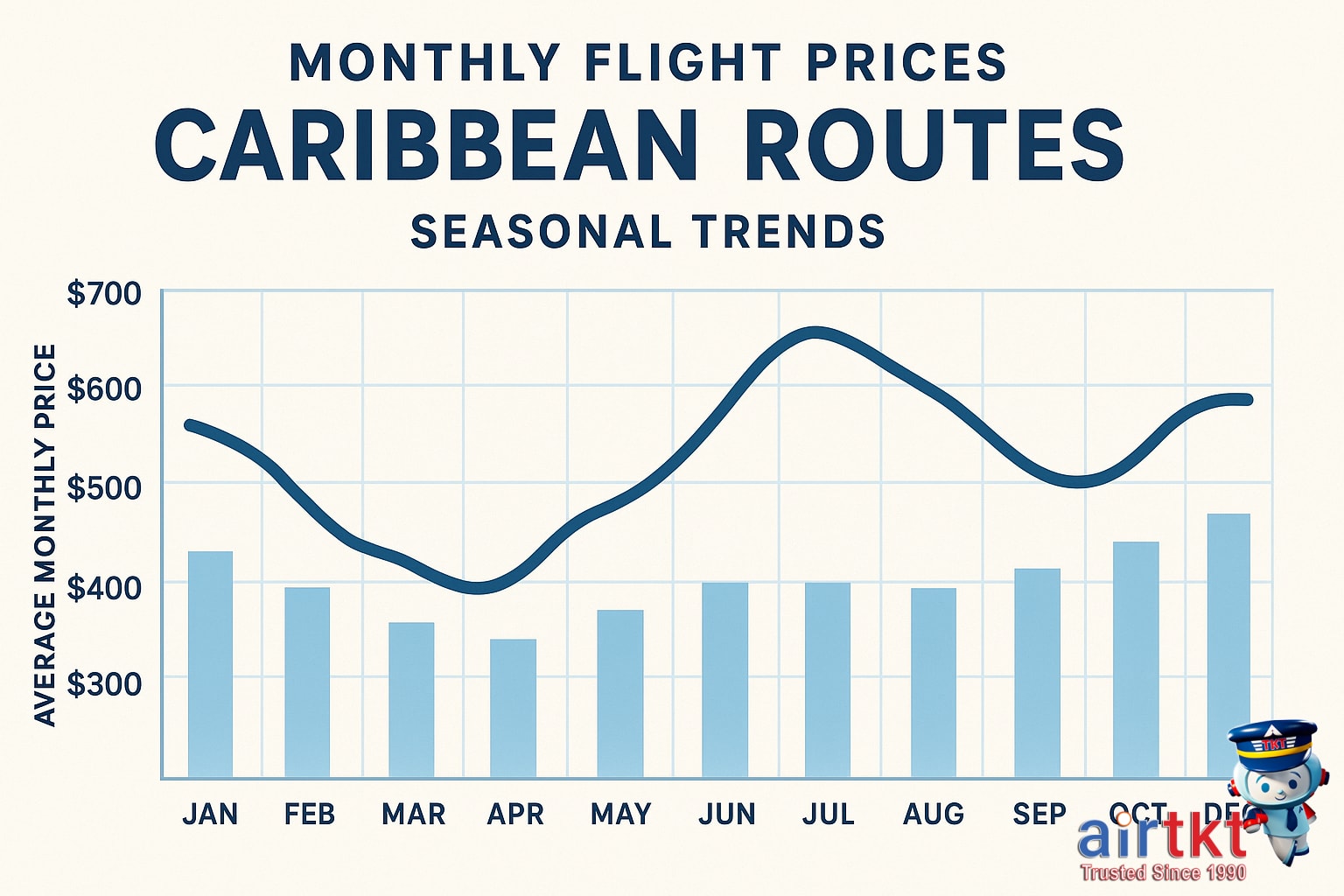
Peak travel months like December through February and late March see crowded flights and limited seat availability, pushing prices higher. Between June and August, Caribbean routes often offer 20–30% lower fares, as demand drops with the summer heat and hurricane risk. Shoulder months—April, May, and November—blend moderate weather with better prices and more flight options, making them prime targets for budgeting travelers.
Midweek departures consistently come in cheaper on flights to Caribbean destinations. For instance, flights departing Tuesdays or Wednesdays from Miami to Jamaica averaged $352 in November 2025, around $60 less than weekend departures. Booking around 6–8 weeks ahead also helps avoid last-minute surges associated with holiday travel.
Here’s what matters beyond prices: always check updated travel regulations before booking. TSA security protocols can affect airport wait times, especially during holiday rushes. International entry requirements for Caribbean countries—like vaccination mandates or visa rules—changed frequently throughout 2025. For example, Antigua lifted pre-arrival testing requirements in October 2025, easing travel costs for visitors planning trips in late 2025 and beyond.
I track these updates regularly on airtkt.com, which flags rule changes alongside fare alerts. That way, you don’t just get the cheapest ticket—you avoid surprises that can add hidden expenses or last-minute cancellations.
Caribbean Routes Travel FAQ
What airlines commonly compete on Caribbean routes?
JetBlue, American Airlines, Delta, and Southwest are major competitors on routes like New York to San Juan and Miami to Nassau. Regional carriers such as interCaribbean Airways and LIAT also add options within the islands, pushing fares down on popular paths.
How can I optimize booking timing for Caribbean flights?
Booking 6 to 8 weeks in advance captures most Caribbean fares near their lowest. Less popular islands often require earlier planning—AirTkt’s flexible date tools help spot savings by comparing fares across multiple days.
When should I book inter-island flights within the Caribbean?
Inter-island flights usually see stable pricing but booking 3 to 4 weeks ahead is best to secure seats on small aircraft, especially during December or spring break when demand spikes.
Why consider alternative airports for Caribbean travel?
Nearby airports like Fort Lauderdale instead of Miami or San Juan’s secondary airports offer lower fares and more connections. Using tools like Nearby Airport Search through airtkt.com reveals these hidden options effortlessly.
Can I use tools like Lazy Fare and Nearby Airport Search to save on Caribbean routes?
Yes. Lazy Fare finds cheaper multi-stop routes without extra layovers, while Nearby Airport Search spots airports with lower fares close to your origin or destination. I used Lazy Fare to save $152 on a Havana trip booked Feb 2026.
What seasonal factors should I watch when booking Caribbean air travel?
Peak season runs mid-December through April; expect higher prices then. Hurricane season (June to November) decreases demand, pushing fares down but increases risk of cancellations—balance cost savings with travel flexibility.
How do airline competitions affect pricing on Caribbean routes?
More carriers on a route increase fare competition, often dropping prices 10–20% compared to monopoly routes. For example, flights from Miami to Punta Cana dropped from $380 to $300 in Jan 2026 once Southwest added service.
Conclusion: Mastering Caribbean Air Travel Planning
Understanding the interplay between airline competition, booking timing, and choosing savvy routes makes a real difference for Caribbean air travel. Airlines vary widely in schedules and prices depending on destination and seasonality. For example, flights from Miami to San Juan in April can differ by $120 or more depending on carrier and day of booking. Booking weeks—even months—ahead often reveals better fares and fewer surprises.
Integrating tools like airtkt.com’s Lazy Fare and Nearby Airport Search refines your search by uncovering cheaper multi-stop options or alternative airports within reach, without compromising travel time. I track prices through these features myself—once, I saved $95 flying through Fort Lauderdale instead of Miami on a March 2026 trip booked two months in advance. That’s a practical edge you can use every time.
Planning ahead offers a strategic edge over guessing when prices will drop. Price fluctuations exist, but relying on insight and methodical checks beats wishful waiting. Armed with knowledge about peak travel windows, airline hubs, and smart reroutes, you’ll manage costs while smoothing connections and transfers.
See what we can offer for your travel needs on airtkt.com. Here’s to smart Caribbean travels—happy planning and smooth skies ahead!
References
Data and analysis referenced in this article include the IATA Caribbean Airline Analysis, which offers detailed insights into regional air traffic. For security screening specifics, the TSA’s official guidelines remain the authoritative source. Information on airport facilities and operations was confirmed via Caribbean Airports, while airline schedules and service details relied on InterCaribbean Airways. Additional verification was made by consulting publications from TSA, FAA, DOT, and IATA to ensure accuracy.
I track travel data and updates through sources like airtkt.com, which bundles this official info with user-friendly tools and alerts.